
Bitcoin's Leverage Flush Favors Accumulation, K33 Says

Crypto markets posted big declines on Tuesday, but signs of relief from the Federal Reserve helped prices bounce off their worst levels. A late day Truth Social post from President Trump reminded bulls that he has the power to reverse rising asset prices at any time.
Bitcoin BTC$112,920.16 traded as low as $109,800 during the early U.S. session Tuesday after tumbling from nearly the $116,000 level overnight. It's since bounced to $112,600, down 2.8% over the past 24 hours.. Ether ETH$4,121.87 declined 4%, while BNB, XRP and Dogecoin dropped between 4% and 6% during the same period. The broad-market CoinDesk 20 Index fell 3.2%.
Prices found some footing after Fed Chair Jerome Powell said the central bank is nearing the end of its quantitative tightening (QT) cycle — the process of shrinking its bond holdings. He also noted that the labor market is cooling and rising risks to employment, coupled with some signs of tightening in money markets. The comments add up to another likely rate cut later this month.
U.S. equity indexes responded sharply, with the Nasdaq and S&P 500 reversing early losses to briefly turn green before closing with 0.75% loss and 0.15% loss, respectively.
At least a portion of the day's bounce in both crypto and stocks was erased in a few minutes late in the session after President Trump took to Truth Social to suggest blocking cooking oil imports from China unless that country steps up its buying of soybeans.
Miners continue to be bid
Crypto mining stocks once again led digital asset equities as investors continue to bet that booming computing power demand from artificial intelligence (AI) will benefit these firms. Bitfarms (BITF), Cleanspark (CLSK), Iren (IREN), Marathon Digital (MARA) and TeraWulf (WULF) each surged over 10% on the day.
Massive leverage flush favors bitcoin accumulation
While the rebound from last week's flash crash lost momentum on Tuesday, Vetle Lunde, head of research at K33, sees the current dip as a constructive setup with bitcoin stabilizing after a major leverage reset.
"After the recent leverage purge, we turn constructively bullish on BTC, though patience remains key," Lunde wrote in a Tuesday note. He noted that liquidity is likely to stay thin in the short term as traders recover from forced selling but argued that prior unwinds of this kind often marked market bottoms.
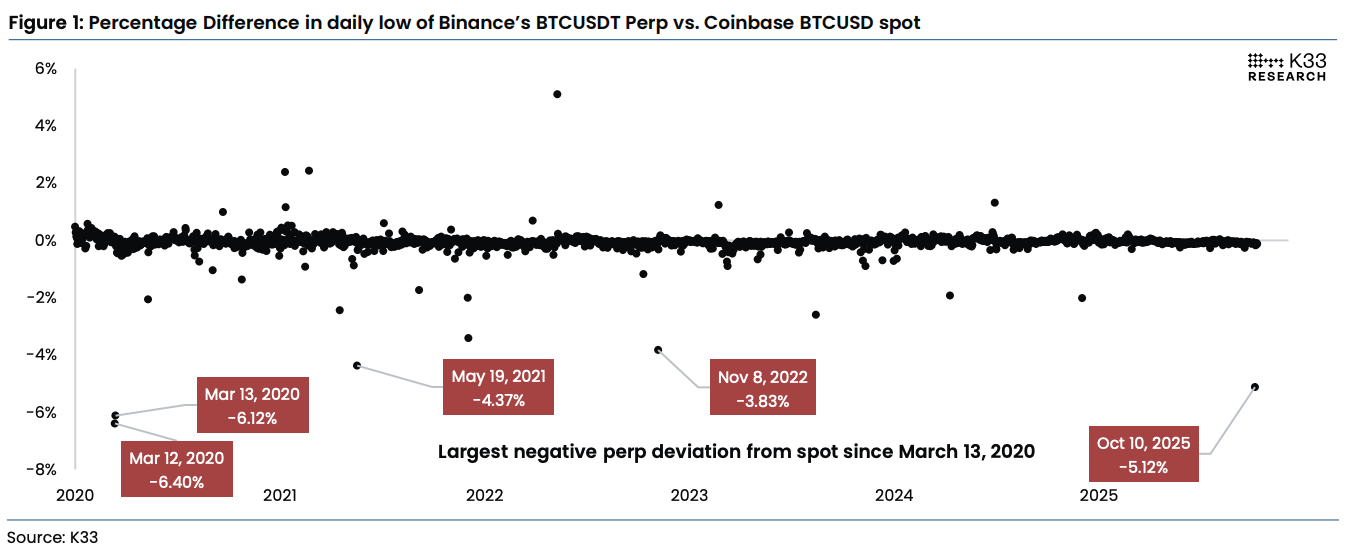
"We finally see current levels as attractive for increasing spot BTC exposure, as leverage has violently been cleared," he said. "Combined with a supportive backdrop, including expansionary policy expectations, high institutional demand, and pending ETF catalysts, the setup favors gradual accumulation.
Disclaimer: The content of this article solely reflects the author's opinion and does not represent the platform in any capacity. This article is not intended to serve as a reference for making investment decisions.
You may also like

Wall Street giants collectively raise rate hike forecasts, US Treasury futures continue to fall, gold drops over 1% to break 4000
After the US October CPI exceeded expectations, Goldman Sachs and Nomura added a forecast for an interest rate hike in March next year, while Deutsche Bank included a forecast for a rate hike in January next year. Currently, the market has fully priced in a 25 basis point rate hike in December, with a 13% probability for a 50 basis point hike. On Wednesday, the US Treasury spot market was closed, but Treasury futures continued to fall, with corresponding yields rising by about 2 to 4 basis points, and spot gold came under pressure, dropping by 1.1%.

No Need to Worry About the Cooling Down of AI Data Center Construction? The US Import Boom Is Unlikely to Subside in the Short Term, Real Impact May Come in 2029
It takes an average of 4.8 years from finalizing investment to starting construction of a data center project, and an additional 2.6 years from construction start to becoming operational. Servers usually cannot be installed until after the building structure and racks are completed. For trade partners such as Taiwan (China), South Korea, and Mexico who rely on US data center supply chain demand, the inertia in construction timelines provides at least a one- to two-year buffer for future exports.

Federal Reserve Major Debate: When Should the Tenure of “Number Three” Williams End?
The main point of contention is whether Williams should step down in June 2028, upon completing a full 10-year term, or in June 2027, when he reaches the mandatory retirement age of 65. Analysts point out that the Federal Reserve Board holds ultimate discretion; if he leaves early, Fed Chair Waller would be able to assert greater control over the appointment to this critical position. However, forcing Williams to shorten his term could easily be interpreted as political manipulation. Williams himself is expected to serve until June 2028.

Crypto prices
More


