
US Government Paralysis: 16 Crypto ETFs Stuck Awaiting a Green Light

Since October 1st, Washington has been paralyzed. Congress remains mired in its budget divisions, and the crypto industry is paying the price: sixteen crypto ETF applications await approval, including funds following Solana, XRP, Litecoin, and Dogecoin. Could this administrative paralysis paradoxically trigger a wave of approvals as soon as reopening?
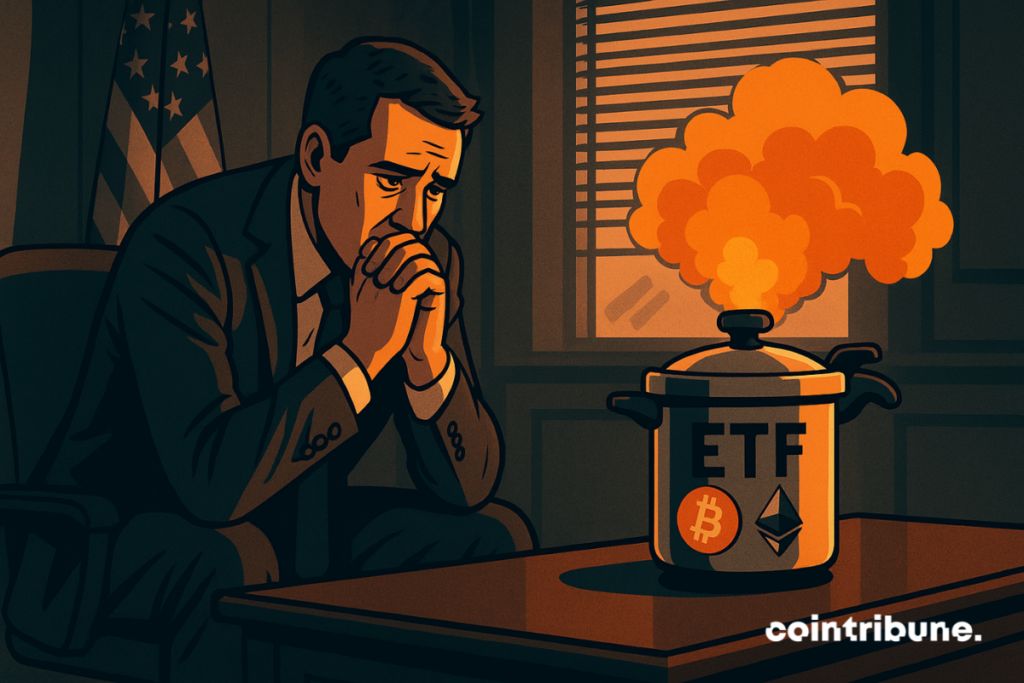
In brief
- The US government shutdown, now in its third week, is blocking approval of 16 crypto exchange-traded funds.
- The SEC is operating with minimum essential staff since October 1, leaving ETF applications pending.
- Republicans and Democrats remain in a budget deadlock, with no clear timeline to resolve the crisis.
- Analysts predict a massive wave of approvals once the shutdown ends, potentially triggering a new altcoin season.
A political deadlock that paralyzes the crypto industry
October 1st marked the beginning of a new government paralysis in the United States. Due to the lack of a budget agreement between Republicans and Democrats, crucial federal agencies such as the Securities and Exchange Commission are running at a slow pace. Only essential staff remain on duty, while major regulatory decisions are frozen.
The impact on the crypto market is significant. October was supposed to be a decisive month with at least 16 crypto ETFs awaiting their final verdict. The involved products include funds tracking Solana, XRP , Litecoin, and Dogecoin. Twenty-one other applications were filed during the first eight days of the month. All these files remain stuck today in administrative limbo.
Vugar Usi Zade, Chief Operating Officer at Bitget, puts this situation into perspective:
If the deadlock is quickly resolved, approvals should be postponed to late October or November. While this delay can weigh on short-term sentiment by putting billions of institutional capital on hold, it ultimately highlights how much the ecosystem has matured.
The sources of the disagreement are multiple. Republicans demand drastic budget cuts to curb a national debt now exceeding 37.8 trillion dollars, or about 111,000 dollars per American citizen.
They also call for increased funding for border security. On the other side, Democrats refuse any cuts to healthcare spending and want to extend tax credits that make health insurance more accessible.
The parliamentary schedule offers no immediate way out. The Senate does not plan a vote before next Tuesday, and the House of Representatives remains in recess.
To end this crisis, Congress must pass either separate funding bills or a continuing resolution maintaining budgets at current levels. The problem? Although Republicans control both chambers, they lack the votes in the Senate to pass these bills without Democratic support.
A perfect storm for institutional adoption
This situation paradoxically illustrates what cryptos seek to solve. Nate Geraci, ETF analyst and president of NovaDius Wealth Management, highlights the irony: “The growing budget debt and usual political theater hamper these efforts. That is precisely what cryptocurrencies aim at“. His analysis predicts that once the shutdown ends, “the floodgates for spot crypto ETFs will open” with massive approvals.
This outlook excites the market. Bitfinex analysts had anticipated as early as August that a wave of ETF approvals could trigger a new altcoin season. The logic is simple: these products offer exposure to cryptos with fewer direct risks, thus attracting more cautious institutional and retail investors.
The recent regulatory context strengthens this optimism. In September, the SEC adopted new general standards allowing exchanges to list certain crypto products without systematic individual approval.
This framework was supposed to accelerate review processes. But the government shutdown completely neutralizes these advances.
This is the eleventh government shutdown in American history and the first since the one from December 2018 to January 2019, which lasted 35 days. The record is yet to be beaten, but each passing day further delays the evolution of the American crypto landscape. Approval deadlines are expiring one after another without any decision being taken.
The American crypto market is in an unusual position: technically ready to leap, but politically hampered. When Washington finally emerges from this deadlock, the industry could experience its most transformative month since the approval of spot Bitcoin ETFs. The question is no longer if this wave will arrive, but when it will surge.
Disclaimer: The content of this article solely reflects the author's opinion and does not represent the platform in any capacity. This article is not intended to serve as a reference for making investment decisions.
You may also like

Wall Street giants collectively raise rate hike forecasts, US Treasury futures continue to fall, gold drops over 1% to break 4000
After the US October CPI exceeded expectations, Goldman Sachs and Nomura added a forecast for an interest rate hike in March next year, while Deutsche Bank included a forecast for a rate hike in January next year. Currently, the market has fully priced in a 25 basis point rate hike in December, with a 13% probability for a 50 basis point hike. On Wednesday, the US Treasury spot market was closed, but Treasury futures continued to fall, with corresponding yields rising by about 2 to 4 basis points, and spot gold came under pressure, dropping by 1.1%.

No Need to Worry About the Cooling Down of AI Data Center Construction? The US Import Boom Is Unlikely to Subside in the Short Term, Real Impact May Come in 2029
It takes an average of 4.8 years from finalizing investment to starting construction of a data center project, and an additional 2.6 years from construction start to becoming operational. Servers usually cannot be installed until after the building structure and racks are completed. For trade partners such as Taiwan (China), South Korea, and Mexico who rely on US data center supply chain demand, the inertia in construction timelines provides at least a one- to two-year buffer for future exports.

Federal Reserve Major Debate: When Should the Tenure of “Number Three” Williams End?
The main point of contention is whether Williams should step down in June 2028, upon completing a full 10-year term, or in June 2027, when he reaches the mandatory retirement age of 65. Analysts point out that the Federal Reserve Board holds ultimate discretion; if he leaves early, Fed Chair Waller would be able to assert greater control over the appointment to this critical position. However, forcing Williams to shorten his term could easily be interpreted as political manipulation. Williams himself is expected to serve until June 2028.

Crypto prices
More


