
Memecoins Power Crypto Market Rebound as Sector Surges After Flash Crash

After one of the steepest sell-offs in crypto history, digital assets have begun to recover. A renewed wave of buying has lifted both memecoins and major tokens, driven by easing tensions between the U.S. and China and a rebound in overall market sentiment.
In brief
- Memecoin market cap jumps to $68.8B, with Dogecoin, WIF, and PENGU leading double-digit gains.
- Bitcoin recovers to $115,227 after flash crash; major altcoins like ETH and SOL also rally.
- Arjun Vijay calls the crash a “temporary glitch,” driven by cascading liquidations and leverage.
- Analysts say the correction cleared excess leverage, setting the stage for a stronger market rebound.
Top Memecoins Surge as Crypto Market Recovers from Massive Selloff
Memecoins staged a sharp recovery on Monday as crypto markets bounced back from one of the worst liquidation events in recent history . The sector’s total market capitalization climbed to $68.8 billion, up 12.6% on the day, according to market data.
Here’s how the top memecoins performed during the session:
- Dogecoin (DOGE) jumped 11.9% to trade at $0.21, leading the memecoin rebound.
- Dogwifhat (WIF) posted the strongest gain, soaring 18.4% in 24 hours.
- Pudgy Penguins (PENGU) followed closely with a 17.5% surge as traders returned to riskier assets.
- Pepe (PEPE) also advanced, climbing 13.2% amid renewed market momentum.
- Bonk (BONK) rose 15.3%, extending its strong performance from last week.
- Shiba Inu (SHIB) added 9.4%, rounding out the memecoin sector’s broad recovery.
The strong performance across memecoins reflected a renewed appetite for risk following last week’s market turmoil.
Friday’s selloff wiped out nearly $20 billion in digital asset positions, with Bitcoin (BTC) plunging from $121,000 to as low as $109,000 in a single day. By Monday morning, BTC had recovered to $115,227, up 2.9%, while major altcoins also rallied—Ethereum (ETH) rose 8.4%, BNB (BNB) gained 12.2%, and Solana (SOL) added 8.7%.
Arjun Vijay Calls Flash Crash a ‘Temporary Glitch’ as Memecoins Lead the Comeback
Arjun Vijay, the founder of the crypto exchange Giottus, said the rebound was expected following the recent “flash crash.” He explained that cascading liquidations drove the previous drop and that high-risk assets, such as memecoins, typically recover the fastest during market rebounds.
The flash crash was a temporary glitch and was caused by the cascading liquidations, and everyone was expecting a rebound. During the rebound, the riskiest assets and those that crashed the most are expected to rebound the maximum. So it is no surprise that people are betting on memecoins, and this is leading to a virtuous cycle.
Arjun Vijay
The crash was triggered by President Donald Trump’s announcement of a “massive increase” in tariffs on Chinese imports, as well as the cancellation of a planned meeting with President Xi Jinping.
Predictably, the move sparked fears of renewed trade tensions, sending global markets lower and fueling liquidations across crypto exchanges. However, sentiment improved over the weekend.
Crypto Correction Clears Excessive Leverage, Paving Way for Stronger Market
A spokesperson for China’s Ministry of Commerce accused the United States of unfair trade actions and excessive export controls. Later, Trump struck a more conciliatory tone on Truth Social, saying the U.S. aims to support rather than harm China.
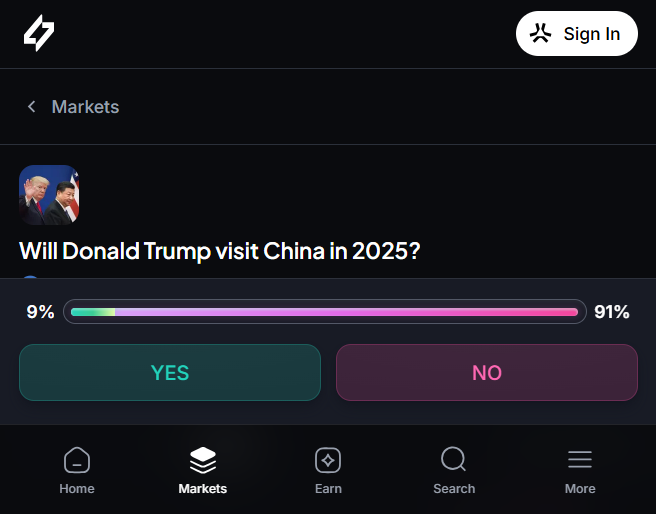
Prediction markets on Myriad still assign only a 9% chance of Trump visiting China before the end of the year, reflecting lingering uncertainty.
Despite the volatility, market participants say the correction could ultimately strengthen the crypto ecosystem. Charmaine Tam, head of OTC sales and trading at Hex Trust, called the event “a healthy reset.”
Tam noted that the recent market drop helped clear excessive leverage from the system, describing it as a constructive correction that could strengthen the market over time. She added that institutional infrastructure remained stable throughout the volatility. With Bitcoin’s dominance staying below 60.5%, altcoins may now be positioned to lead as liquidity returns.
As risk appetite improves and geopolitical concerns ease, memecoins appear to be at the forefront of the recovery—once again proving their ability to capture momentum when markets turn.
Disclaimer: The content of this article solely reflects the author's opinion and does not represent the platform in any capacity. This article is not intended to serve as a reference for making investment decisions.
You may also like

Wall Street giants collectively raise rate hike forecasts, US Treasury futures continue to fall, gold drops over 1% to break 4000
After the US October CPI exceeded expectations, Goldman Sachs and Nomura added a forecast for an interest rate hike in March next year, while Deutsche Bank included a forecast for a rate hike in January next year. Currently, the market has fully priced in a 25 basis point rate hike in December, with a 13% probability for a 50 basis point hike. On Wednesday, the US Treasury spot market was closed, but Treasury futures continued to fall, with corresponding yields rising by about 2 to 4 basis points, and spot gold came under pressure, dropping by 1.1%.

No Need to Worry About the Cooling Down of AI Data Center Construction? The US Import Boom Is Unlikely to Subside in the Short Term, Real Impact May Come in 2029
It takes an average of 4.8 years from finalizing investment to starting construction of a data center project, and an additional 2.6 years from construction start to becoming operational. Servers usually cannot be installed until after the building structure and racks are completed. For trade partners such as Taiwan (China), South Korea, and Mexico who rely on US data center supply chain demand, the inertia in construction timelines provides at least a one- to two-year buffer for future exports.

Federal Reserve Major Debate: When Should the Tenure of “Number Three” Williams End?
The main point of contention is whether Williams should step down in June 2028, upon completing a full 10-year term, or in June 2027, when he reaches the mandatory retirement age of 65. Analysts point out that the Federal Reserve Board holds ultimate discretion; if he leaves early, Fed Chair Waller would be able to assert greater control over the appointment to this critical position. However, forcing Williams to shorten his term could easily be interpreted as political manipulation. Williams himself is expected to serve until June 2028.

Crypto prices
More


