
Spot Buyers Step In, Futures Sit Out — Can HBAR Recover?

HBAR’s spot buyers are driving a mild recovery, but weak Futures market participation threatens momentum as traders remain hesitant post-crash.
HBAR is showing signs of a modest recovery following last week’s sharp market crash, largely driven by spot investors buying the dip.
However, the Futures market tells a different story. Confidence among derivatives traders remains low, raising concerns about whether HBAR’s rebound can sustain its current momentum.
Hedera Traders Remain Skeptical
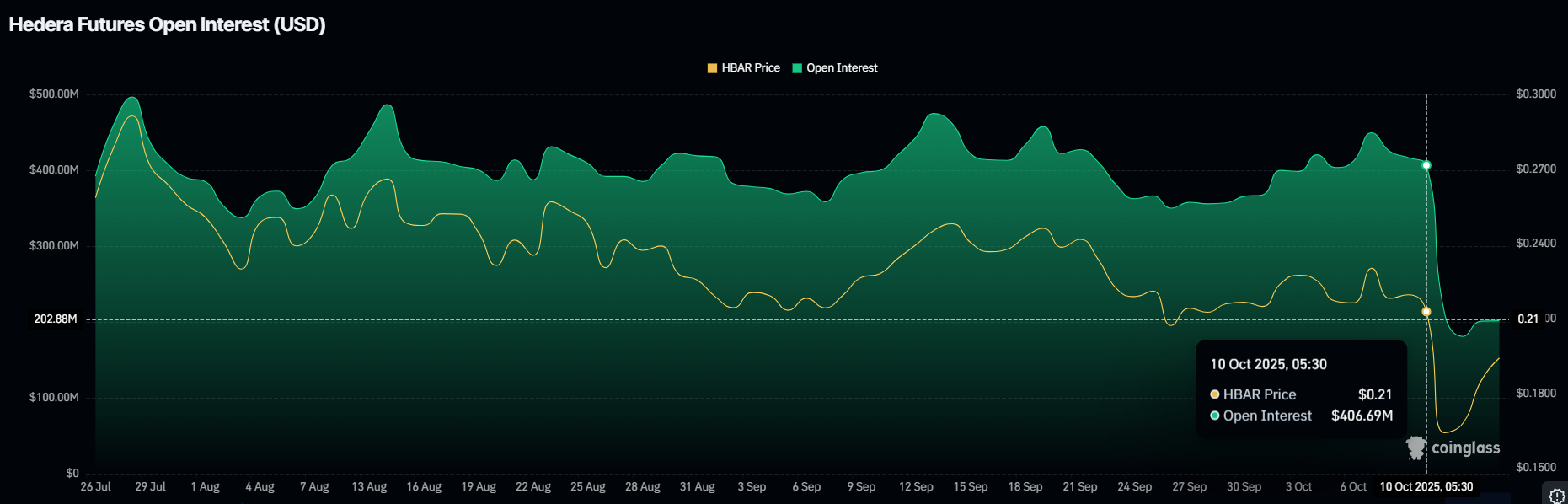
Despite the recovery in spot trading, HBAR’s Open Interest (OI) has yet to bounce back from the heavy losses seen during the crash. The Futures market experienced liquidations exceeding $200 million in a single day, pulling OI down to $202 million, where it continues to stagnate.
This stagnation reflects persistent skepticism among Futures traders about HBAR’s near-term prospects. Their hesitation to re-enter the market could hinder broader price recovery, as Futures activity often reinforces bullish momentum in volatile markets.
Want more token insights like this? Sign up for Editor Harsh Notariya’s Daily Crypto Newsletter here.
 HBAR Open Interest. Source:
Coinglass
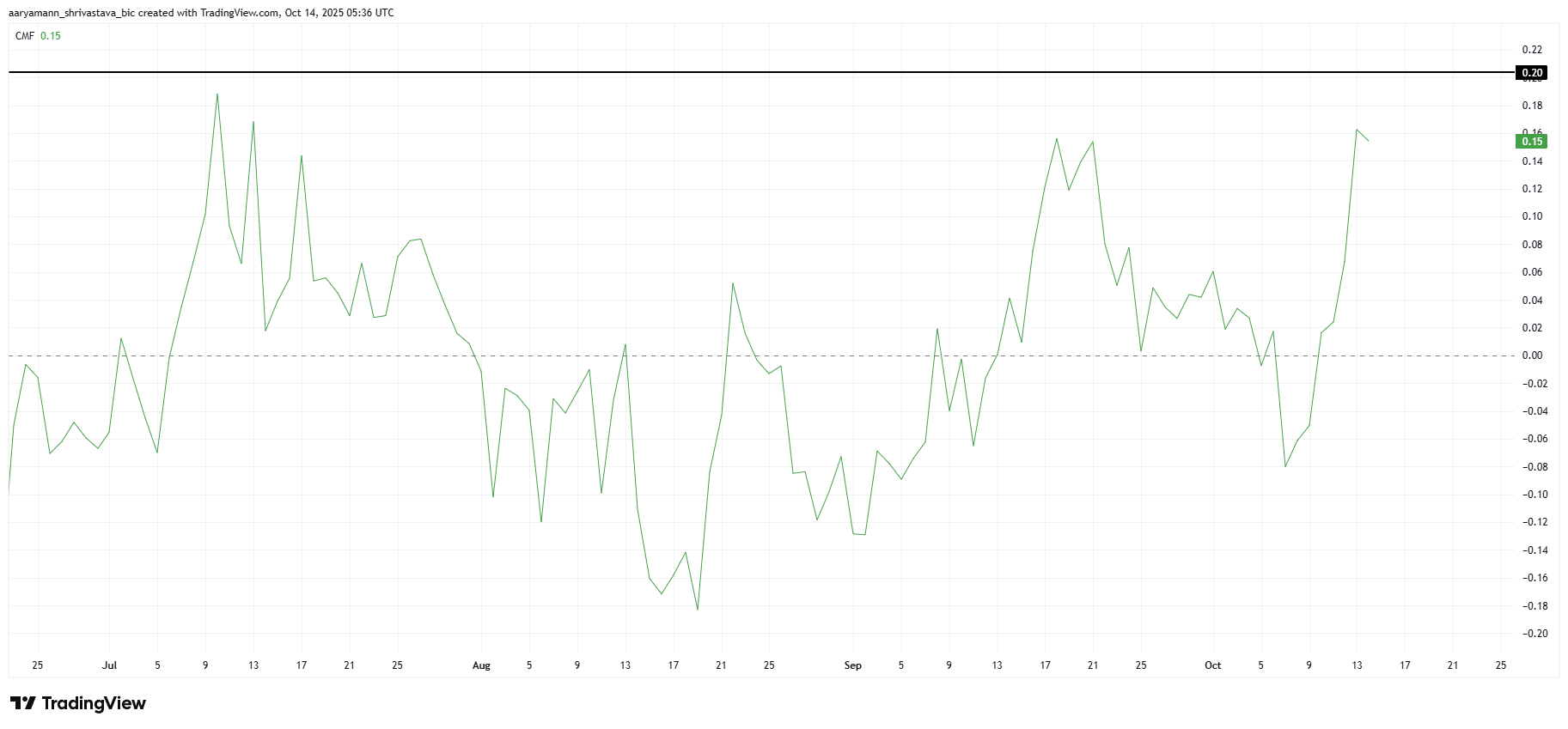
On the other hand, technical indicators show some encouraging signals. The Chaikin Money Flow (CMF) has spiked significantly since the crash, indicating strong inflows from spot investors.
This suggests that long-term holders and opportunistic buyers are taking advantage of lower prices to accumulate positions, aiding HBAR’s partial recovery.
However, CMF is approaching the 0.20 saturation mark, historically a level where inflows begin to slow and reversals can occur. If this pattern repeats, HBAR could face short-term headwinds, especially if broader market sentiment fails to improve.
 HBAR CMF. Source:
TradingView
HBAR Price Finds Support
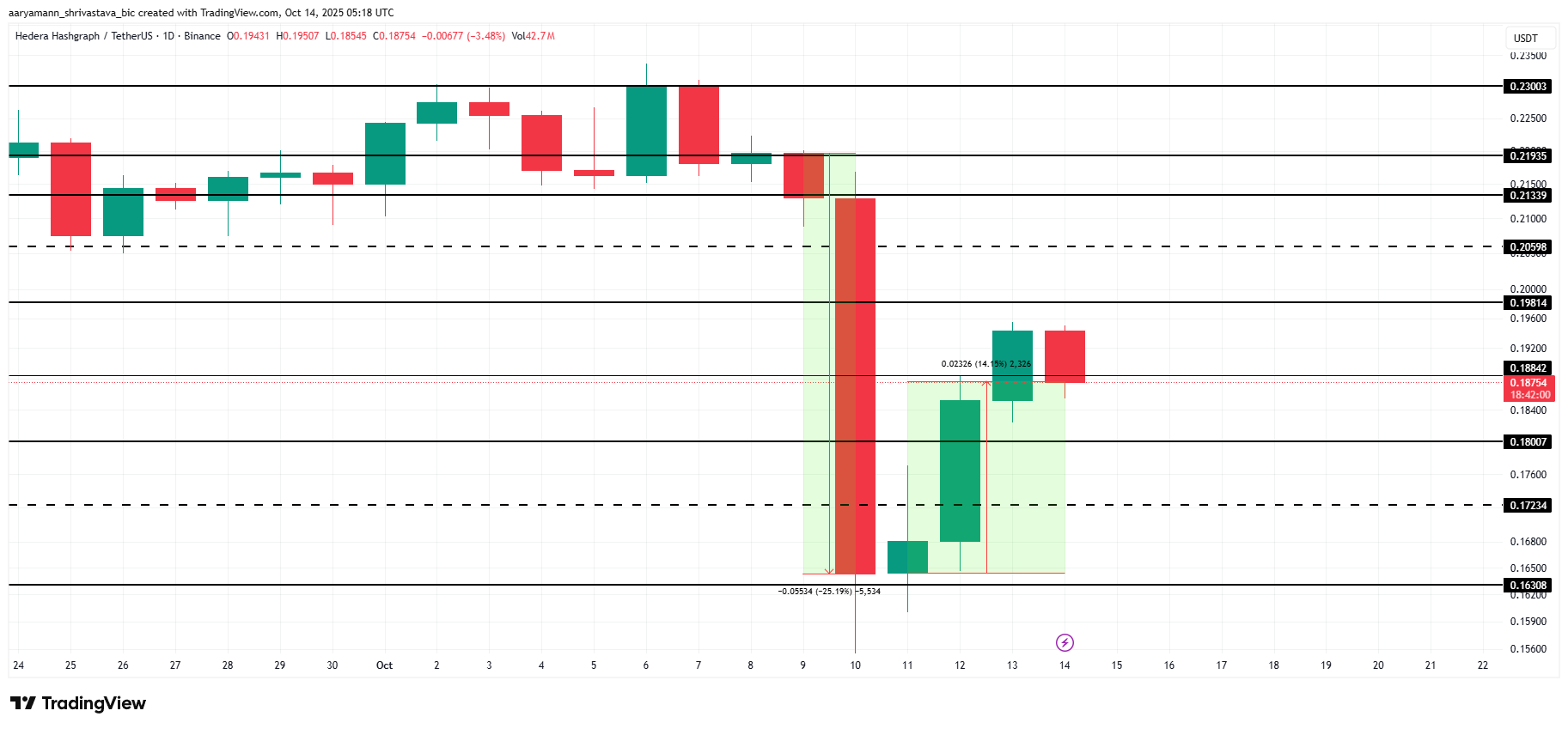
HBAR has gained 14% since the crash, currently trading at $0.187 while attempting to secure $0.188 as a support floor. Holding this level is essential for maintaining recovery momentum and preventing another pullback.
The altcoin dropped by 25% during the crash, and a full rebound would require reclaiming $0.219. This move depends on collaboration between spot buyers and Futures traders. Without Futures market support, HBAR risks slipping back to $0.180 or lower.
 HBAR Price Analysis. Source:
TradingView
However, if HBAR price receives renewed backing from investors, the altcoin could breach the $0.198 resistance. This would push the crypto token toward $0.205, signaling a return of bullish strength.
Disclaimer: The content of this article solely reflects the author's opinion and does not represent the platform in any capacity. This article is not intended to serve as a reference for making investment decisions.
You may also like

Wall Street giants collectively raise rate hike forecasts, US Treasury futures continue to fall, gold drops over 1% to break 4000
After the US October CPI exceeded expectations, Goldman Sachs and Nomura added a forecast for an interest rate hike in March next year, while Deutsche Bank included a forecast for a rate hike in January next year. Currently, the market has fully priced in a 25 basis point rate hike in December, with a 13% probability for a 50 basis point hike. On Wednesday, the US Treasury spot market was closed, but Treasury futures continued to fall, with corresponding yields rising by about 2 to 4 basis points, and spot gold came under pressure, dropping by 1.1%.

No Need to Worry About the Cooling Down of AI Data Center Construction? The US Import Boom Is Unlikely to Subside in the Short Term, Real Impact May Come in 2029
It takes an average of 4.8 years from finalizing investment to starting construction of a data center project, and an additional 2.6 years from construction start to becoming operational. Servers usually cannot be installed until after the building structure and racks are completed. For trade partners such as Taiwan (China), South Korea, and Mexico who rely on US data center supply chain demand, the inertia in construction timelines provides at least a one- to two-year buffer for future exports.

Federal Reserve Major Debate: When Should the Tenure of “Number Three” Williams End?
The main point of contention is whether Williams should step down in June 2028, upon completing a full 10-year term, or in June 2027, when he reaches the mandatory retirement age of 65. Analysts point out that the Federal Reserve Board holds ultimate discretion; if he leaves early, Fed Chair Waller would be able to assert greater control over the appointment to this critical position. However, forcing Williams to shorten his term could easily be interpreted as political manipulation. Williams himself is expected to serve until June 2028.

Crypto prices
More


