
Crypto Investment Products Defy Market Crash With $3.17B Inflows as Trading Volumes Hit Record Highs

Quick Breakdown
- Crypto ETPs recorded $3.17 billion inflows despite a massive flash crash.
- Trading volumes hit a record $53 billion, with Bitcoin funds leading inflows.
- Ether and altcoin funds saw slower inflows amid market uncertainty.
Crypto investment funds hold strong despite flash crash
Cryptocurrency investment products remained resilient amid last Friday’s flash crash, attracting significant capital inflows even as global markets reeled from renewed trade tensions. According to CoinShares’ weekly report published on Monday, crypto exchange-traded products (ETPs) recorded $3.17 billion in inflows over the past week signaling strong investor confidence despite a $20 billion market liquidation.
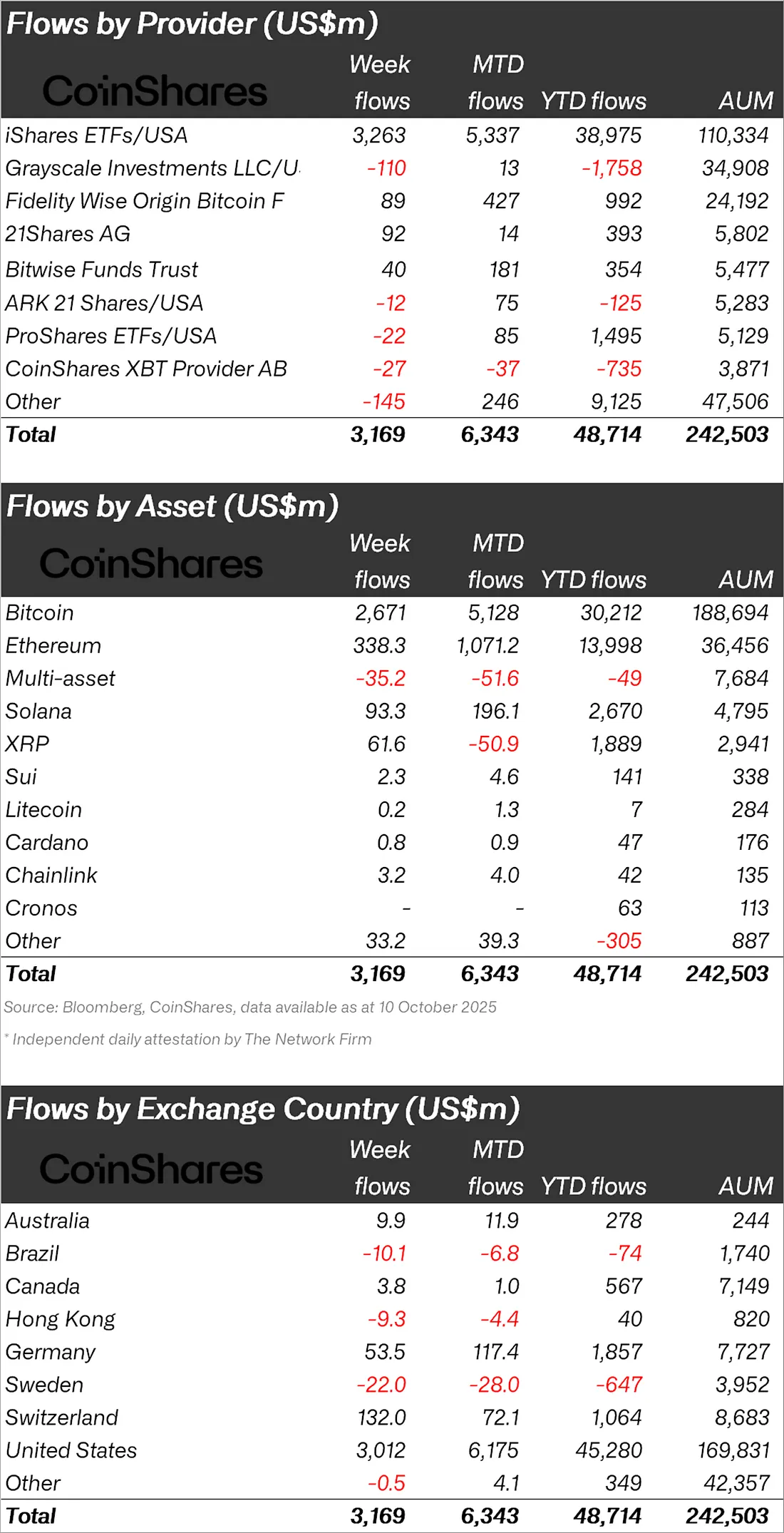 Crypto ETP flows by asset as of Friday (in millions of US dollars). Source: CoinShares
James Butterfill, CoinShares’ head of research, noted that Friday’s sell-off had only a limited effect on investor sentiment. “Friday saw little reaction with a paltry $159 million outflows,” he said, highlighting the sector’s resilience to the panic triggered by new China tariff treats from U.S. President Donald Trump.
Year-to-date, total inflows have climbed to $48.7 billion, surpassing the entire inflow figure for 2024.
Trading volumes soar to all-time highs
CoinShares also reported that trading activity surged to unprecedented levels, with weekly volumes reaching $53 billion, including $15.3 billion traded on Friday alone. Despite the inflows, total assets under management (AUM) slipped from $254 billion to $242 billion week-over-week as market valuations fell.
Bitcoin funds dominated the scene, securing $2.7 billion in inflows, pushing year-to-date totals to $30.2 billion — though still roughly 30% lower than last year’s record $41.7 billion. Butterfill added that Friday marked the highest daily trading volume ever for Bitcoin funds at $10.4 billion.
Ether leads outflows while Altcoin momentum slows
While Ether investment products brought in $338 million in inflows over the week, they suffered the largest single-day outflow on Friday at $172 million. Altcoin-focused funds also saw reduced interest compared to previous weeks. Solana products drew $93.3 million, and XRP funds added $61.6 million, both significantly lower than the prior week’s $706.5 million and $219 million, respectively.
U.S. shutdown delays ETF flood
With the U.S. government shutdown entering its third week, at least 16 pending crypto ETF applications remain in limbo. ETF analyst and NovaDius Wealth Management president Nate Geraci predicted a “flood” of new spot crypto ETFs once the shutdown ends, potentially unlocking a fresh wave of institutional demand.
Disclaimer: The content of this article solely reflects the author's opinion and does not represent the platform in any capacity. This article is not intended to serve as a reference for making investment decisions.
You may also like

Wall Street giants collectively raise rate hike forecasts, US Treasury futures continue to fall, gold drops over 1% to break 4000
After the US October CPI exceeded expectations, Goldman Sachs and Nomura added a forecast for an interest rate hike in March next year, while Deutsche Bank included a forecast for a rate hike in January next year. Currently, the market has fully priced in a 25 basis point rate hike in December, with a 13% probability for a 50 basis point hike. On Wednesday, the US Treasury spot market was closed, but Treasury futures continued to fall, with corresponding yields rising by about 2 to 4 basis points, and spot gold came under pressure, dropping by 1.1%.

No Need to Worry About the Cooling Down of AI Data Center Construction? The US Import Boom Is Unlikely to Subside in the Short Term, Real Impact May Come in 2029
It takes an average of 4.8 years from finalizing investment to starting construction of a data center project, and an additional 2.6 years from construction start to becoming operational. Servers usually cannot be installed until after the building structure and racks are completed. For trade partners such as Taiwan (China), South Korea, and Mexico who rely on US data center supply chain demand, the inertia in construction timelines provides at least a one- to two-year buffer for future exports.

Federal Reserve Major Debate: When Should the Tenure of “Number Three” Williams End?
The main point of contention is whether Williams should step down in June 2028, upon completing a full 10-year term, or in June 2027, when he reaches the mandatory retirement age of 65. Analysts point out that the Federal Reserve Board holds ultimate discretion; if he leaves early, Fed Chair Waller would be able to assert greater control over the appointment to this critical position. However, forcing Williams to shorten his term could easily be interpreted as political manipulation. Williams himself is expected to serve until June 2028.

Crypto prices
More


