
Dragonfly partner Haseeb: Has USDe really depegged?

During the market crash, the price of USDe on its main trading platform Curve dropped by only 0.3%.
During the market crash, the price of USDe on its main trading venue, Curve, only dropped by 0.3%.
Written by: Haseeb Qureshi, Partner at Dragonfly
Translated by: Luffy, Foresight News
I’ve seen a lot of discussion about Ethena depegging during this weekend’s market turmoil. The situation is that USDe (the stablecoin issued by Ethena) briefly depegged to around $0.68 before recovering. This is the Binance chart everyone is referencing:
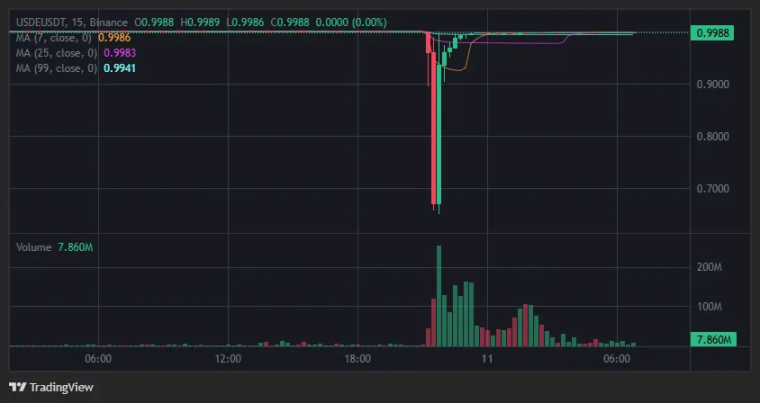
But after digging into the data and talking to many people over the past couple of days, I can now clearly say that this claim is incorrect—USDe did not depeg.
The first thing to understand is: the venue with the deepest USDe liquidity is actually not an exchange, but Curve. Curve has hundreds of millions of dollars in constant liquidity, while any exchange, including Binance, only has tens of millions of dollars in liquidity.
So if you only look at the USDe chart on Binance, it appears to have depegged. But if you overlay USDe’s liquidity across other venues, you get a different picture:
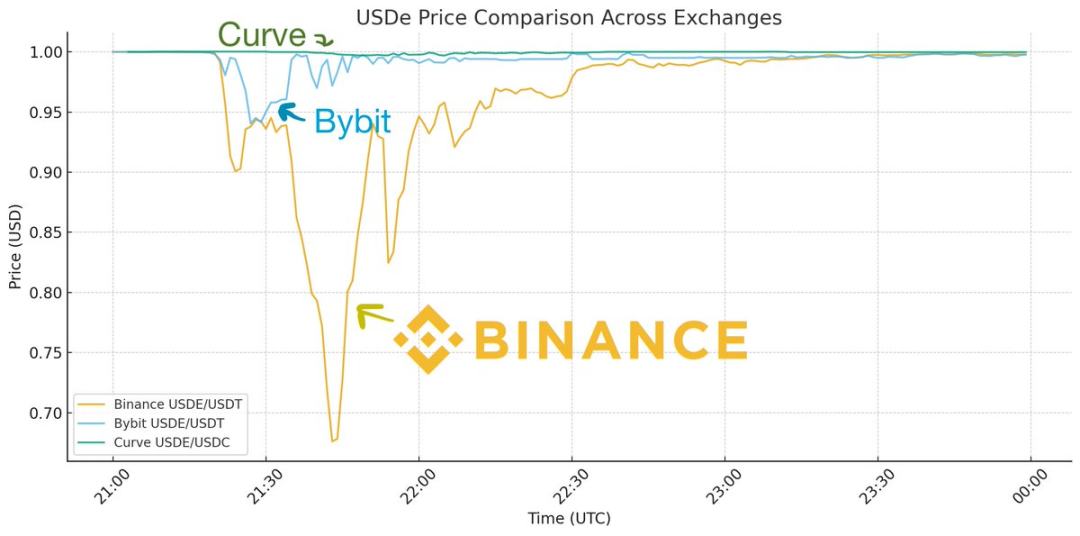
We can see that although USDe’s price dropped on every centralized exchange, the drop was not uniform. Bybit briefly fell to $0.95 before quickly recovering, while Binance’s depeg was much deeper and took a long time to recover. Meanwhile, the price on Curve only dropped by 0.3%. How do we explain this difference?
Remember, every exchange was under enormous strain that day—this was the largest liquidation event in crypto history. Binance was extremely unstable during this period; due to API failures, deposits and withdrawals were blocked, market makers couldn’t move positions, and no one could step in to arbitrage.
This is like a fire breaking out at Binance, but all the roads are blocked and firefighters can’t get in. This led to the situation on Binance spiraling out of control, but on almost every other venue, the fire was quickly put out by liquidity bridges. As Guy showed in his post, due to the same widespread instability, USDC also briefly depegged by a few cents on Binance—liquidity simply couldn’t get in—but this wasn’t a USDC depeg event either.
So, with unstable APIs, it’s not surprising that there were large price discrepancies across exchanges, because no one could take positions. But why did Binance’s price drop much deeper than Bybit’s?
The answer has two parts. First, Binance has no primary dealer relationship with Ethena and cannot mint or redeem directly on the platform (Bybit and other exchanges have integrated this feature), which allows market makers to stay on the platform and arbitrage. This is very important; otherwise, market makers would have to withdraw funds from Binance, go to Ethena for peg arbitrage, and then bring the position back. In a crisis when APIs are down, no one can do this.
Second, Binance’s oracle performed poorly and started liquidating positions that shouldn’t have been liquidated—a good liquidation mechanism should not trigger during a flash crash. If you’re not the main trading venue for an asset (Binance is not the main venue for USDe), you should reference the price from the main venue. If you only look at your own order book, you over-liquidate. This led Binance to start liquidating USDe at around $0.80, triggering a chain reaction. This is also a key reason why Binance is refunding users who were liquidated on USDe (as far as I know, other exchanges are not doing this). They only looked at their own price instead of the real external price, which was a mistake.
So this was a Binance-specific flash crash event, and better market structure could have prevented it. USDe on its main trading venue, Curve, actually maintained a relatively stable peg throughout the day. This is really different from the depeg scenario you described.
If you remember USDC during the 2023 Silicon Valley Bank crisis, that was a real depeg scenario:
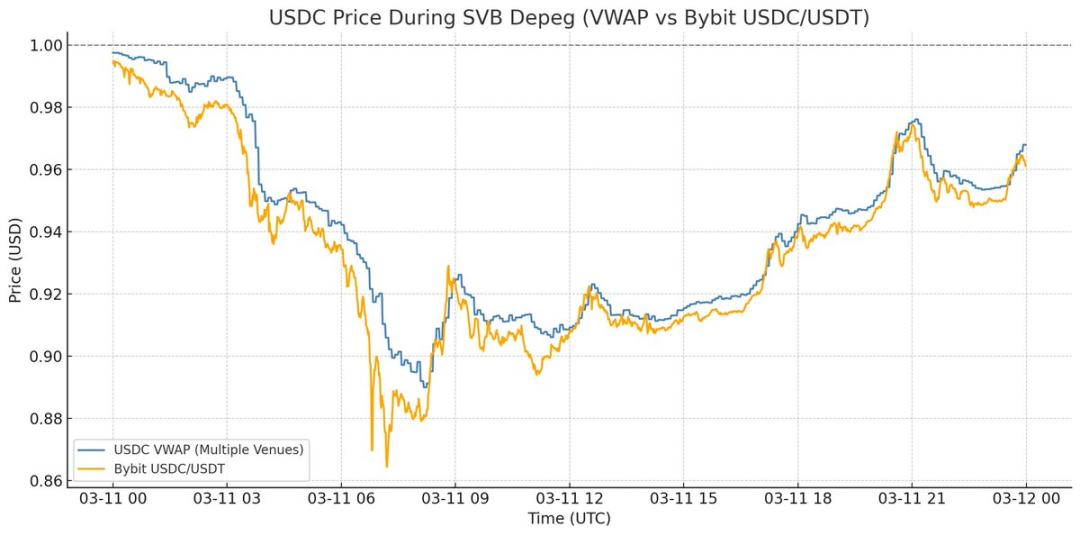
During the Silicon Valley Bank crisis, USDC’s price dropped on every venue—there was nowhere you could sell USDC for $1. Redemptions were actually paused, so $0.87 was its real price. That’s what depegging means.
This time, it was just a Binance-specific price dislocation. It’s an important lesson for market infrastructure, but if you’re trying to infer something about USDe’s mechanism from this weekend’s events, understanding the nuance is crucial.
Throughout the entire event, USDe was fully collateralized on its main trading venue, valued at $1, and due to price volatility, its collateral actually increased over the weekend. In other words, this market instability ultimately had a positive effect by providing a lesson for the entire industry. Guy’s post explains how any exchange, including Binance, can avoid this kind of issue in the future.
In short: USDe did not depeg; it was a pricing issue on Binance.
Disclaimer: The content of this article solely reflects the author's opinion and does not represent the platform in any capacity. This article is not intended to serve as a reference for making investment decisions.
You may also like

Wall Street giants collectively raise rate hike forecasts, US Treasury futures continue to fall, gold drops over 1% to break 4000
After the US October CPI exceeded expectations, Goldman Sachs and Nomura added a forecast for an interest rate hike in March next year, while Deutsche Bank included a forecast for a rate hike in January next year. Currently, the market has fully priced in a 25 basis point rate hike in December, with a 13% probability for a 50 basis point hike. On Wednesday, the US Treasury spot market was closed, but Treasury futures continued to fall, with corresponding yields rising by about 2 to 4 basis points, and spot gold came under pressure, dropping by 1.1%.

No Need to Worry About the Cooling Down of AI Data Center Construction? The US Import Boom Is Unlikely to Subside in the Short Term, Real Impact May Come in 2029
It takes an average of 4.8 years from finalizing investment to starting construction of a data center project, and an additional 2.6 years from construction start to becoming operational. Servers usually cannot be installed until after the building structure and racks are completed. For trade partners such as Taiwan (China), South Korea, and Mexico who rely on US data center supply chain demand, the inertia in construction timelines provides at least a one- to two-year buffer for future exports.

Federal Reserve Major Debate: When Should the Tenure of “Number Three” Williams End?
The main point of contention is whether Williams should step down in June 2028, upon completing a full 10-year term, or in June 2027, when he reaches the mandatory retirement age of 65. Analysts point out that the Federal Reserve Board holds ultimate discretion; if he leaves early, Fed Chair Waller would be able to assert greater control over the appointment to this critical position. However, forcing Williams to shorten his term could easily be interpreted as political manipulation. Williams himself is expected to serve until June 2028.

Crypto prices
More


