
Hyperliquid launches HIP-3 as HYPE rebounds after $10B liquidation wave

Hyperliquid is activating its HIP-3 upgrade on Monday, introducing permissionless perpetual market creation on its decentralized derivatives platform.
- HIP-3 allows builders to deploy perpetual futures markets on HyperCore by staking 500,000 HYPE tokens.
- The upgrade follows a $19.3 billion market-wide liquidation event, with $10 billion cleared on Hyperliquid alone.
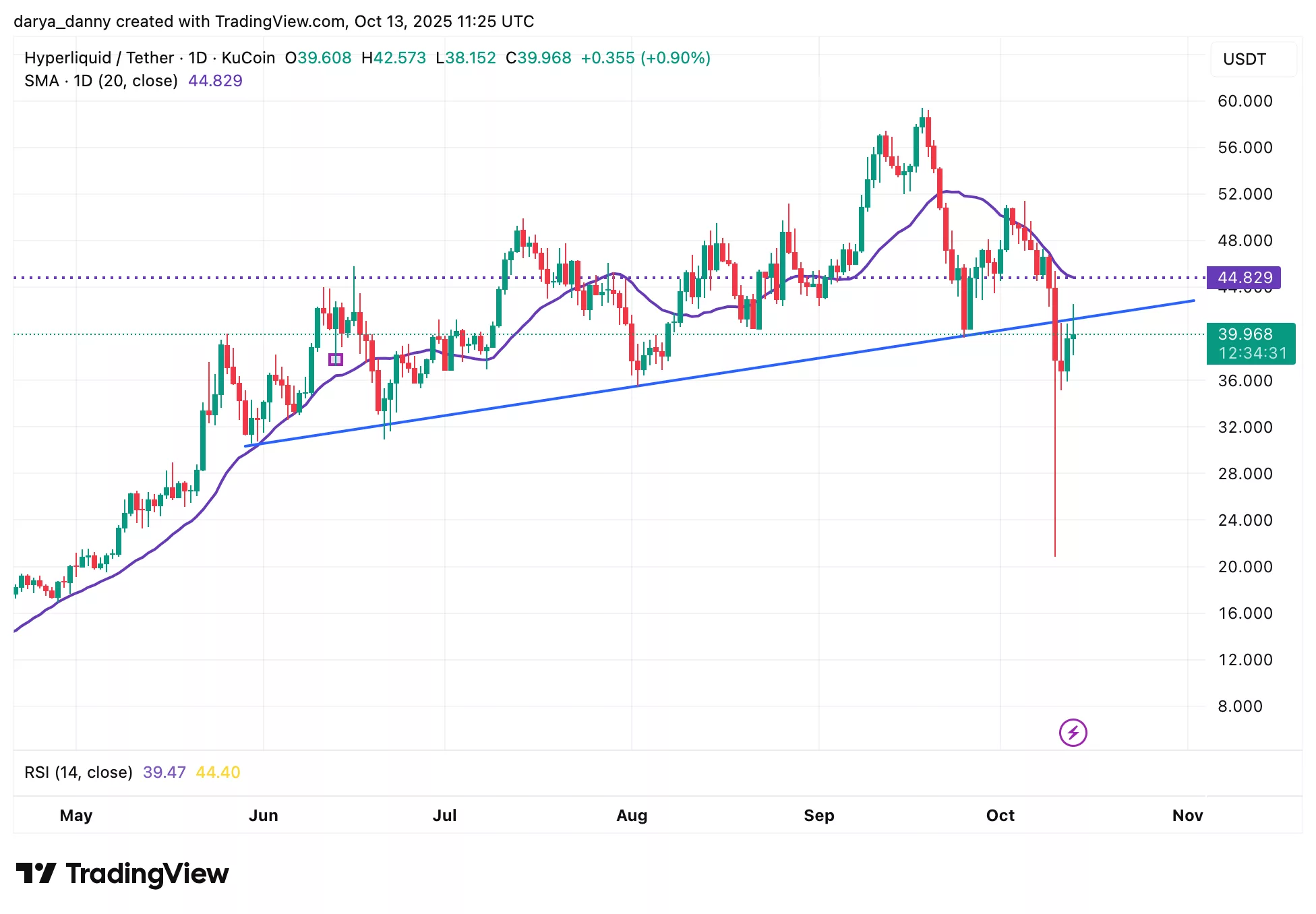
- HYPE price has rebounded from $20 to $42, aiming to break above the $45 resistance aligned with its 20-day SMA.
Hyperliquid ( HYPE ) is set to take a major leap toward decentralization with the activation of HIP-3 (Hyperliquid Improvement Proposal 3) upgrade.
According to an announcement shared in Hyperliquid’s official Discord, the network upgrade will go live on Oct. 13, and will include HIP-3. While there will be no immediate impact for existing users, builders who meet the on-chain criteria can begin deploying their own perpetual markets once preparations are complete.
Under HIP-3, deployers can launch decentralized perpetual exchanges on the HyperCore infrastructure by staking 500,000 HYPE tokens. The system integrates with HyperEVM, providing smart contract support and governance capabilities. To ensure market integrity, the proposal introduces safeguards such as validator slashing mechanisms and open interest caps.
A minimum viable product of this feature was previously live on testnet , and today marks its official mainnet rollout.
HYPE recovers as Hyperliquid weathers $10B liquidation
The HIP-3 rollout comes just days after one of the most turbulent weekends in crypto markets this year, sparked by renewed global trade tensions . A massive leverage flush across major exchanges wiped out roughly $19.3 billion in positions, with over $10 billion in liquidations occurring on Hyperliquid alone, according to Coinglass data.
Meanwhile, Hyperliquid’s native token HYPE is staging a strong rebound after last week’s drop to the $20 level. Now trading near $40, the token is attempting to reclaim the ascending trendline support, now acting as resistance, that has guided price action since late May. The $45 zone, aligning with the 20-day SMA, remains the short-term resistance. A successful breakout above it could set the stage for a move toward $52, corresponding to the most recent swing high.
 Source: TradingView
Disclaimer: The content of this article solely reflects the author's opinion and does not represent the platform in any capacity. This article is not intended to serve as a reference for making investment decisions.
You may also like

Wall Street giants collectively raise rate hike forecasts, US Treasury futures continue to fall, gold drops over 1% to break 4000
After the US October CPI exceeded expectations, Goldman Sachs and Nomura added a forecast for an interest rate hike in March next year, while Deutsche Bank included a forecast for a rate hike in January next year. Currently, the market has fully priced in a 25 basis point rate hike in December, with a 13% probability for a 50 basis point hike. On Wednesday, the US Treasury spot market was closed, but Treasury futures continued to fall, with corresponding yields rising by about 2 to 4 basis points, and spot gold came under pressure, dropping by 1.1%.

No Need to Worry About the Cooling Down of AI Data Center Construction? The US Import Boom Is Unlikely to Subside in the Short Term, Real Impact May Come in 2029
It takes an average of 4.8 years from finalizing investment to starting construction of a data center project, and an additional 2.6 years from construction start to becoming operational. Servers usually cannot be installed until after the building structure and racks are completed. For trade partners such as Taiwan (China), South Korea, and Mexico who rely on US data center supply chain demand, the inertia in construction timelines provides at least a one- to two-year buffer for future exports.

Federal Reserve Major Debate: When Should the Tenure of “Number Three” Williams End?
The main point of contention is whether Williams should step down in June 2028, upon completing a full 10-year term, or in June 2027, when he reaches the mandatory retirement age of 65. Analysts point out that the Federal Reserve Board holds ultimate discretion; if he leaves early, Fed Chair Waller would be able to assert greater control over the appointment to this critical position. However, forcing Williams to shorten his term could easily be interpreted as political manipulation. Williams himself is expected to serve until June 2028.

Crypto prices
More


