
Experts explain: Why Ethereum, Solana, XRP lead recovery

Crypto experts explain why blue-chip altcoins led the market recovery from the biggest liquidation event to date.
- Ethereum, Solana, and XRP were among the best performers post-crash
- The crash wiped out overleveraged positions, but institutional capital came back
- Still, auto-deleveraging exposes underlying liquidity risks
The weekend crash, which led to the biggest crypto liquidation event to date, blindsided even experienced traders. However, what followed was unexpected. By Monday, Oct. 13, Ethereum bounced back above $4,000, Solana attracted fresh capital, and XRP reclaimed key levels.
The rapid rebound caught the attention of crypto experts and industry insiders. In remarks for crypto.news, they explained why blue-chip altcoins were leading the recovery after the $1 trillion crypto market crash.
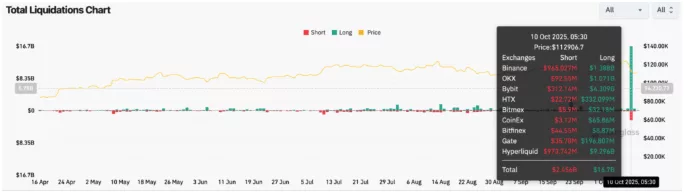 Chart depicting Bitcoin daily liquidations at $19 billion, which crashed the price of Ethereum, Solana, and XRP | Source: Bitfinex Alpha
Ethereum leads rally on fundamentals and staking
Nic Puckrin, founder of Coin Bureau, pointed to Ethereum (ETH) quickly recovering the $4,000 level after the “bloodbath” during the weekend. The good news, according to Puckrin, is that the crash cleaned out excessive leverage. Still, he pointed to some lessons that exchanges should learn.
“The biggest shock over the weekend was that traders were forced out of even profitable positions due to auto-deleveraging (ADL) on exchanges – a risk management mechanism that most will have not even heard about,” Nic Puckrin, Coin Bureau. “It’s a blunt instrument that certainly deserves some scrutiny” he added.
According to Arthur Azizov, founder and investor at B2 Ventures, Ethereum remained strong thanks to its fundamentals and large share of staked tokens. This effectively limited selling pressure in this crucial period of volatility.
“Ethereum looks more resilient (than Bitcoin), as if it can hold above $4,200; it could target $4,500 or higher,” Arthur Azizov, B2 Ventures
Solana’s rebound shows bullish fundamentals
Viktor Fischer, CEO of RockawayX explains that Solana’s (SOL) recovery is contributing to a bullish case for the token. He explains that its scale, speed, and efficiency attract economic activity and, in turn, institutional capital.
“Solana supports meaningful economic activity, including $15.5B in stablecoins, 97% of tokenized equities’ daily trading volume since the June 2025 launch of xStocks, and $4.6B in tokenized real estate deals on Parcl,” Viktor Fischer, RockawayX.
XRP saw major ETF inflows
Analysts at B2BinPay point to XRP’s sharp rebound to $2.60, which recovered 35% from Friday’s lows. This was partially due to strong ETF inflows. This indicates that investors are more confident about XRP after it settled its legal issues.
“Exchange-traded crypto products saw nearly $6 billion in inflows earlier this month, including over $200 million into XRP-linked funds,” said analysts at B2BinPay. “It’s a strong sign that professional investors are adding exposure following Ripple’s legal settlement with the SEC in August.”
Despite a murky macro outlook, the quick rebound indicates strong fundamental demand from investors. They added that the technical outlook shows resistance at $2.80–$3.00. A weekly close for XRP above that level could mean a rally to $3.40–$3.70.
Disclaimer: The content of this article solely reflects the author's opinion and does not represent the platform in any capacity. This article is not intended to serve as a reference for making investment decisions.
You may also like

Wall Street giants collectively raise rate hike forecasts, US Treasury futures continue to fall, gold drops over 1% to break 4000
After the US October CPI exceeded expectations, Goldman Sachs and Nomura added a forecast for an interest rate hike in March next year, while Deutsche Bank included a forecast for a rate hike in January next year. Currently, the market has fully priced in a 25 basis point rate hike in December, with a 13% probability for a 50 basis point hike. On Wednesday, the US Treasury spot market was closed, but Treasury futures continued to fall, with corresponding yields rising by about 2 to 4 basis points, and spot gold came under pressure, dropping by 1.1%.

No Need to Worry About the Cooling Down of AI Data Center Construction? The US Import Boom Is Unlikely to Subside in the Short Term, Real Impact May Come in 2029
It takes an average of 4.8 years from finalizing investment to starting construction of a data center project, and an additional 2.6 years from construction start to becoming operational. Servers usually cannot be installed until after the building structure and racks are completed. For trade partners such as Taiwan (China), South Korea, and Mexico who rely on US data center supply chain demand, the inertia in construction timelines provides at least a one- to two-year buffer for future exports.

Federal Reserve Major Debate: When Should the Tenure of “Number Three” Williams End?
The main point of contention is whether Williams should step down in June 2028, upon completing a full 10-year term, or in June 2027, when he reaches the mandatory retirement age of 65. Analysts point out that the Federal Reserve Board holds ultimate discretion; if he leaves early, Fed Chair Waller would be able to assert greater control over the appointment to this critical position. However, forcing Williams to shorten his term could easily be interpreted as political manipulation. Williams himself is expected to serve until June 2028.

Crypto prices
More


