
Could the crypto crash set Bitcoin up for its next major rally?

Bitcoin is recovering after one of its sharpest corrections this year, with on-chain data suggesting the recent crypto crash may have set the stage for a healthier rebound.
- Bitcoin’s open interest plunged by $12 billion during Friday’s crypto crash, marking one of the steepest leverage resets in recent history.
- Key on-chain metrics, including funding rates and the Stablecoin Supply Ratio, point to stabilizing sentiment and rising liquidity.
- Digital asset investment products saw US$3.17 billion in inflows last week, with BTC leading at US$2.67 billion, demonstrating continued investor confidence.
Bitcoin saw one of the biggest corrections in its history on Friday during the market-wide downturn. According to a recent CryptoQuant analysis , open interest suffered a $12 billion drop, plunging from $47 billion to $35 billion.
The correction pushed the asset’s price as low as $102,000, well below its recent peak above $126,000, before buyers stepped in over the weekend to fuel its recovery. At the time of writing, BTC ( BTC ) has rebounded to around $115,117, up more than 3% on the day.
While the sell-off was painful for many traders, it may have marked a much-needed reset that could pave the way for longer-term gains. The analysis noted that funding rates, which turned negative during Friday’s capitulation, have stabilized back to modestly positive levels, hinting that sentiment is normalizing as extreme bearish bets unwind.
Additionally, the BTC Estimated Leverage Ratio (ELR), which tracks how much leverage traders are using relative to Bitcoin held on exchanges, also fell sharply to its lowest point since August. This drop suggests that excessive leverage has been flushed out, reducing the risk of further liquidations and signaling a broad deleveraging across the derivatives markets.
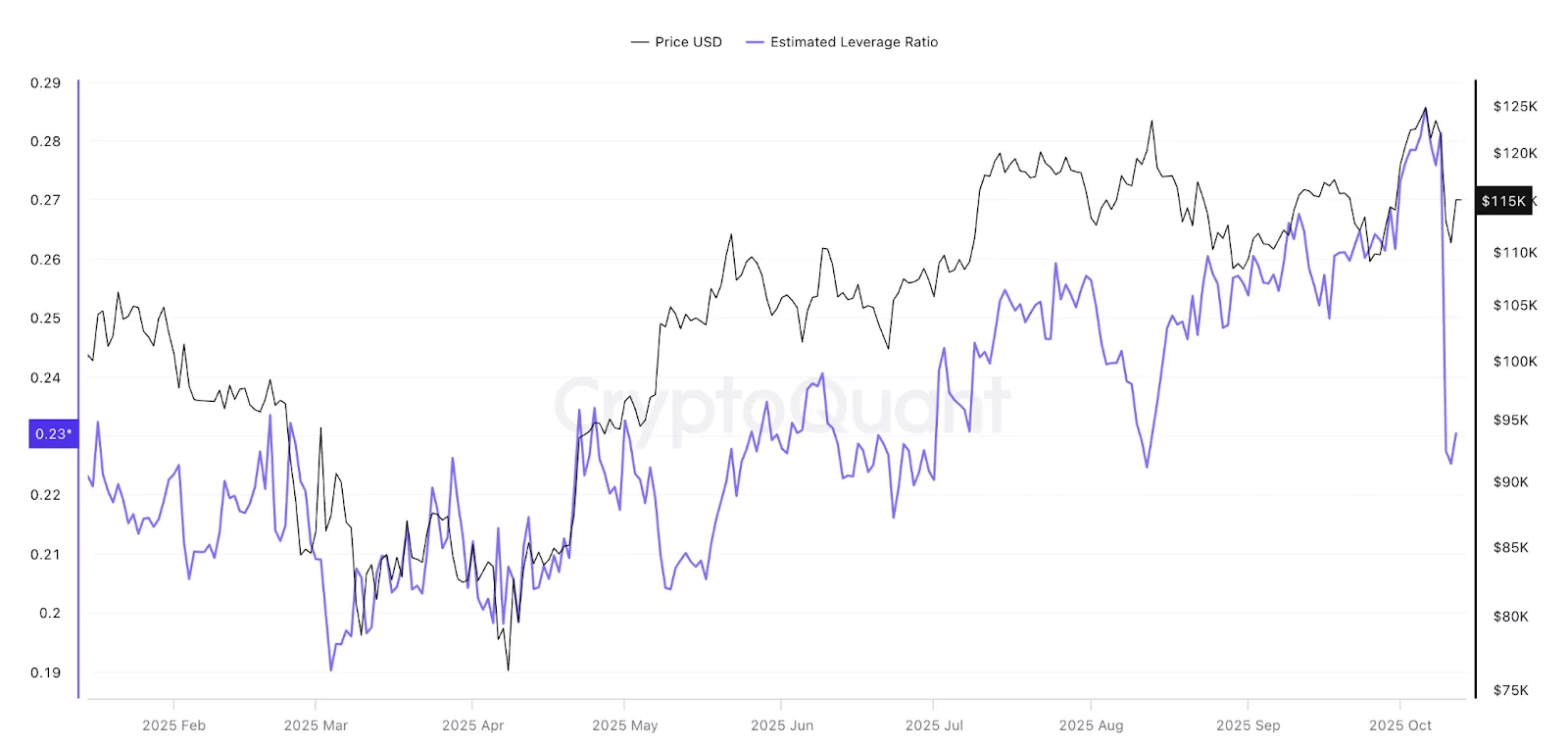 Bitcoin Estimated Leverage Ratio | Source: CryptoQuant
Meanwhile, the indicator comparing Bitcoin’s market cap to that of stablecoins, the Stablecoin Supply Ratio (SSR), has declined to its lowest level since April. A lower SSR means more stablecoin liquidity is sitting on the sidelines, potentially ready to flow into the asset once confidence returns.
Historically, large-scale deleveraging events like this have often taken place just before major price recoveries, suggesting that the recent reset could be a positive signal for the months ahead. At the same time, strong capital flows into the market are adding weight to this outlook.
Bitcoin leads $3b inflows amid Black Friday crypto crash
Digital asset investment products saw US$3.17 billion in inflows last week, pushing year-to-date inflows to a record US$48.7 billion. This shows that, even amid volatility triggered by US-China tariff tensions, investors continue to allocate capital to the crypto market.
BTC led the inflows with US$2.67 billion, bringing YTD inflows to US$30.2 billion. Ethereum ( ETH ) followed with US$338 million, while SOL ( SOL ) and XRP ( XRP ) recorded smaller inflows of US$93.3 million and US$61.6 million, respectively. Friday’s drop saw limited outflows, suggesting that traders treated the correction as a buying opportunity rather than a trigger for panic selling.
Trading activity also hit record levels. Weekly volumes on digital asset ETPs reached US$53 billion, double the 2025 weekly average, while Friday’s daily volume hit US$15.3 billion, the highest single-day level on record.
The strong inflows and elevated trading volumes indicate that market participants remain confident in Bitcoin and the broader market despite short-term volatility. Combined with high liquidity, this may support the current rebound and set the stage for a more sustained recovery in the weeks ahead.
Disclaimer: The content of this article solely reflects the author's opinion and does not represent the platform in any capacity. This article is not intended to serve as a reference for making investment decisions.
You may also like

Wall Street giants collectively raise rate hike forecasts, US Treasury futures continue to fall, gold drops over 1% to break 4000
After the US October CPI exceeded expectations, Goldman Sachs and Nomura added a forecast for an interest rate hike in March next year, while Deutsche Bank included a forecast for a rate hike in January next year. Currently, the market has fully priced in a 25 basis point rate hike in December, with a 13% probability for a 50 basis point hike. On Wednesday, the US Treasury spot market was closed, but Treasury futures continued to fall, with corresponding yields rising by about 2 to 4 basis points, and spot gold came under pressure, dropping by 1.1%.

No Need to Worry About the Cooling Down of AI Data Center Construction? The US Import Boom Is Unlikely to Subside in the Short Term, Real Impact May Come in 2029
It takes an average of 4.8 years from finalizing investment to starting construction of a data center project, and an additional 2.6 years from construction start to becoming operational. Servers usually cannot be installed until after the building structure and racks are completed. For trade partners such as Taiwan (China), South Korea, and Mexico who rely on US data center supply chain demand, the inertia in construction timelines provides at least a one- to two-year buffer for future exports.

Federal Reserve Major Debate: When Should the Tenure of “Number Three” Williams End?
The main point of contention is whether Williams should step down in June 2028, upon completing a full 10-year term, or in June 2027, when he reaches the mandatory retirement age of 65. Analysts point out that the Federal Reserve Board holds ultimate discretion; if he leaves early, Fed Chair Waller would be able to assert greater control over the appointment to this critical position. However, forcing Williams to shorten his term could easily be interpreted as political manipulation. Williams himself is expected to serve until June 2028.

Crypto prices
More


