
Bitcoin Price Nears $115,000 As Spot Investors Defy Market Fear

Bitcoin’s recovery is fueled by spot investors holding firm while traders stay cautious. A break above $115,000 could revive bullish momentum.
Bitcoin price is staging a steady recovery after the sharp crash on Friday that pulled it from $122,000 to $102,000 at its lowest point.
The rebound, however, has been driven not by leveraged traders but by spot holders showing remarkable resilience amid volatile conditions.
Bitcoin Holders Show Restraint
Despite the steep market decline, Bitcoin investors have shown strong conviction. Data from exchange net positions reveals that in the last three days, while BTC tumbled, only about 6,000 BTC—worth approximately $688 million—flowed into exchanges. This limited inflow indicates minimal selling activity from holders, even as volatility surged.
While many futures traders faced liquidations during the crash, spot investors held firm. Their decision to maintain positions rather than sell at a loss has acted as a stabilizing force, preventing a sharper downturn.
Want more token insights like this? Sign up for Editor Harsh Notariya’s Daily Crypto Newsletter here.
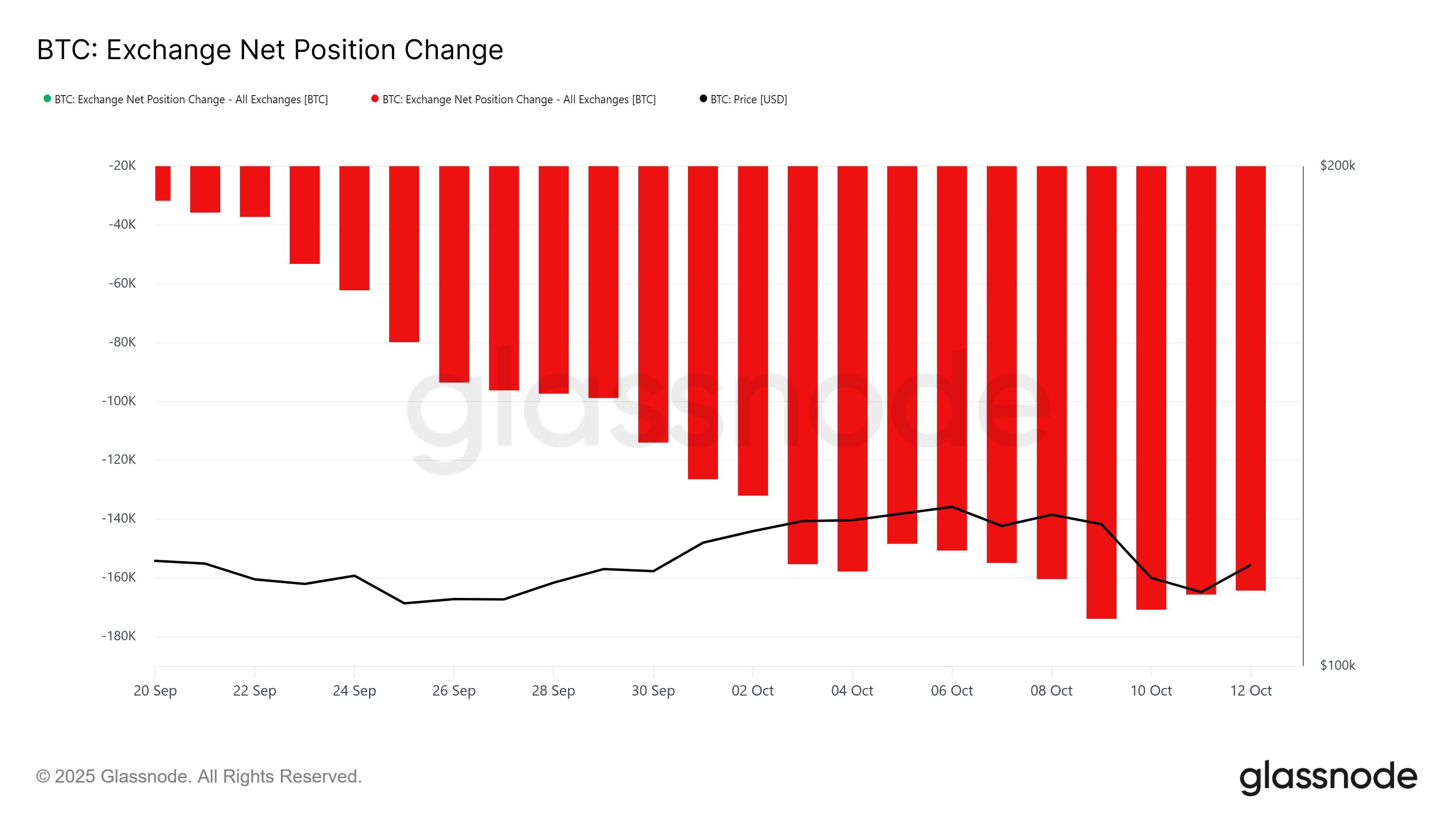 Bitcoin Exchange Net Position Change. Source:
Glassnode
The broader momentum in the market remains cautious. The Bitcoin Long/Short Bias chart, which measures the aggregate net positions of major BTC traders on Hyperliquid, showed a sharp increase in net shorts beginning October 6, days before the crash. This early shift signaled growing bearish sentiment among institutional traders.
Although some of these positions have since been reduced, the chart remains notably negative. This suggests that while recovery is underway, market sentiment has not fully shifted toward optimism.
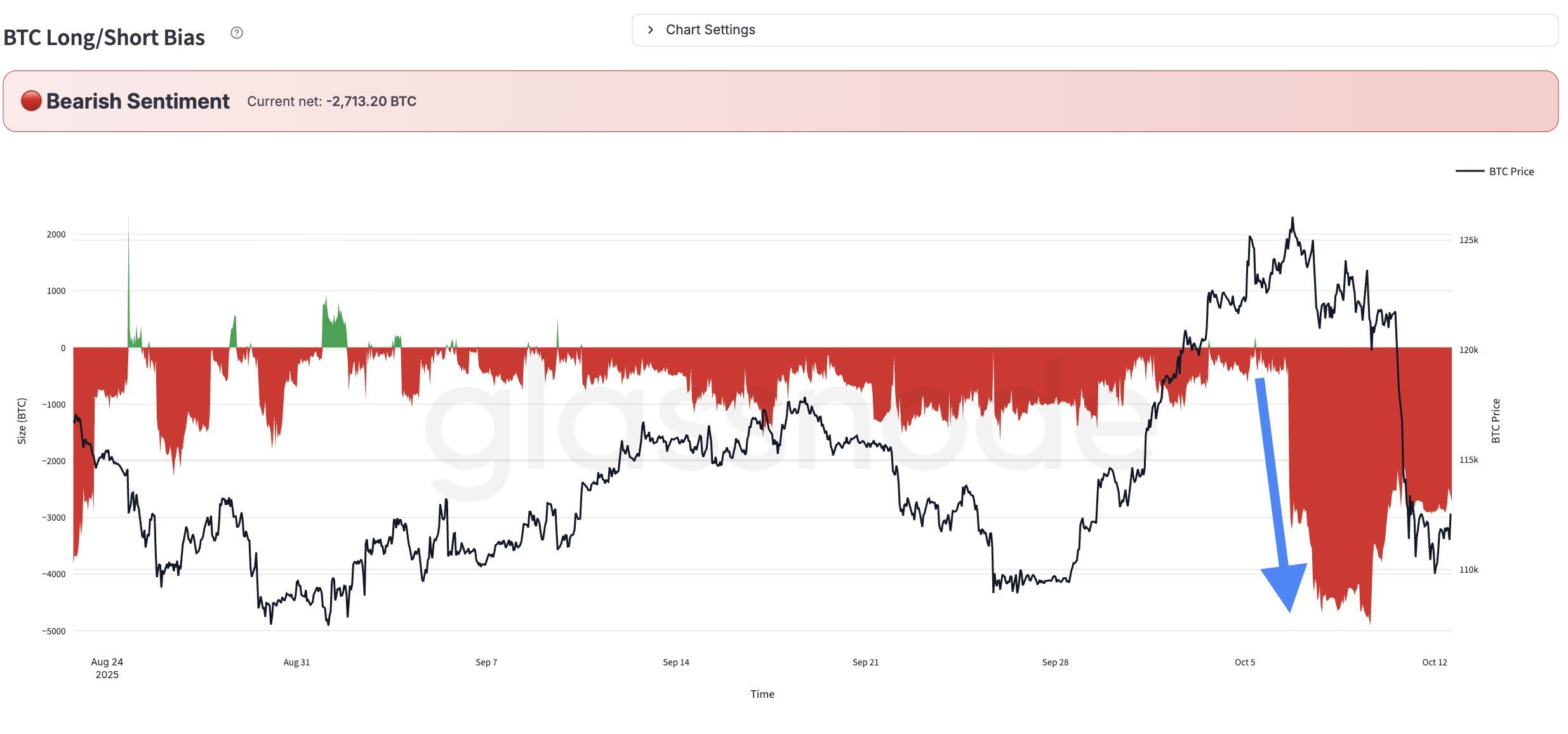 Bitcoin Long/Short Bias. Source:
Glassnode
BTC Price Is Attempting Recovery
Bitcoin is currently trading around $114,553, just below the critical $115,000 resistance level. It briefly surpassed this mark during the intra-day high but failed to maintain momentum, indicating ongoing selling pressure near this threshold.
In the short term, Bitcoin’s outlook remains cautiously bullish, supported by strong holder sentiment. A successful reclaim of $115,000 could pave the way toward $117,261 and eventually $120,000. However, a full recovery would require a sustained push back to $122,000.
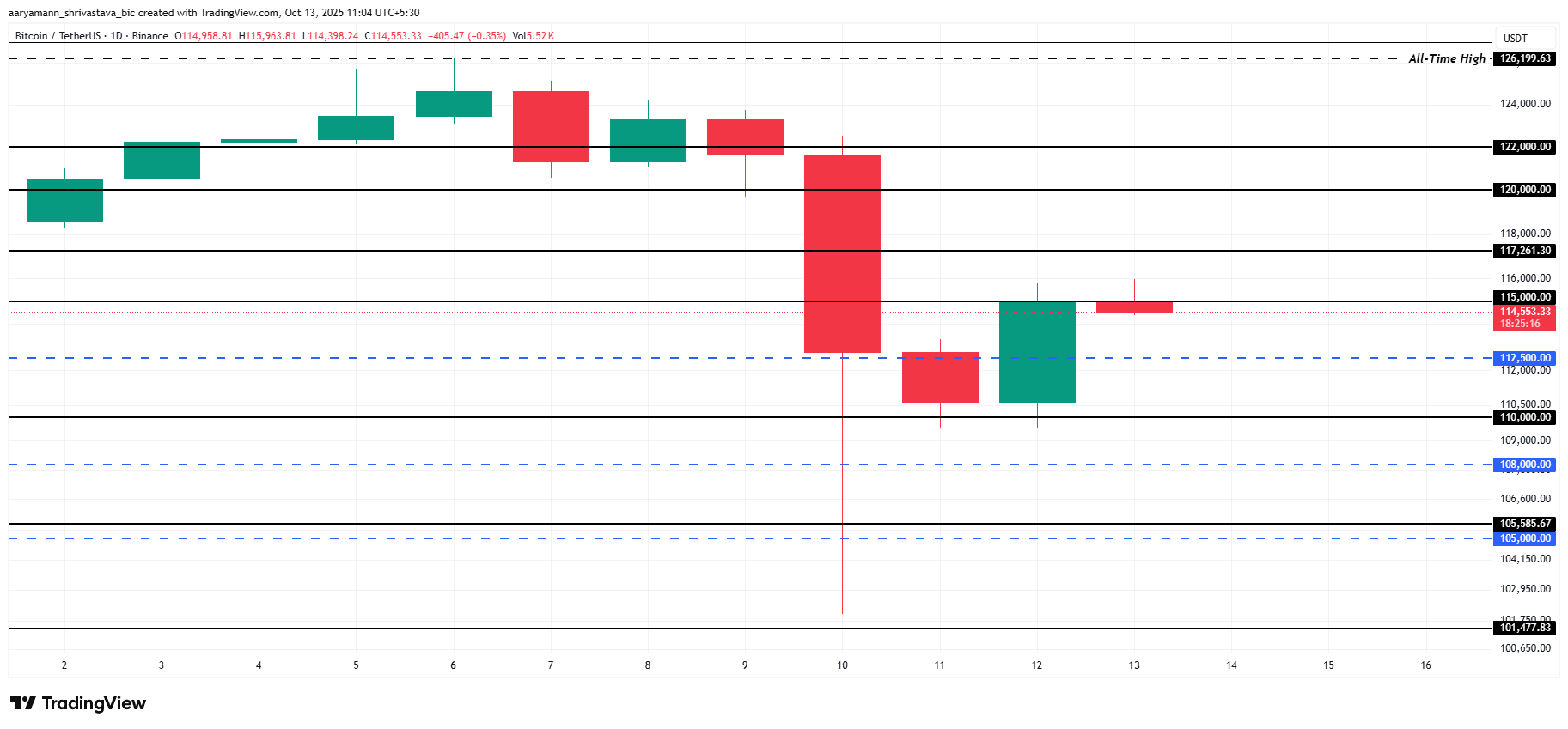 Bitcoin Price Analysis. Source:
TradingView
But if the bearish pressure from traders outweighs investor restraint, Bitcoin could slip below $112,500. This could result in the crypto king testing the $110,000 support level and invalidating the bullish outlook.
Disclaimer: The content of this article solely reflects the author's opinion and does not represent the platform in any capacity. This article is not intended to serve as a reference for making investment decisions.
You may also like

Wall Street giants collectively raise rate hike forecasts, US Treasury futures continue to fall, gold drops over 1% to break 4000
After the US October CPI exceeded expectations, Goldman Sachs and Nomura added a forecast for an interest rate hike in March next year, while Deutsche Bank included a forecast for a rate hike in January next year. Currently, the market has fully priced in a 25 basis point rate hike in December, with a 13% probability for a 50 basis point hike. On Wednesday, the US Treasury spot market was closed, but Treasury futures continued to fall, with corresponding yields rising by about 2 to 4 basis points, and spot gold came under pressure, dropping by 1.1%.

No Need to Worry About the Cooling Down of AI Data Center Construction? The US Import Boom Is Unlikely to Subside in the Short Term, Real Impact May Come in 2029
It takes an average of 4.8 years from finalizing investment to starting construction of a data center project, and an additional 2.6 years from construction start to becoming operational. Servers usually cannot be installed until after the building structure and racks are completed. For trade partners such as Taiwan (China), South Korea, and Mexico who rely on US data center supply chain demand, the inertia in construction timelines provides at least a one- to two-year buffer for future exports.

Federal Reserve Major Debate: When Should the Tenure of “Number Three” Williams End?
The main point of contention is whether Williams should step down in June 2028, upon completing a full 10-year term, or in June 2027, when he reaches the mandatory retirement age of 65. Analysts point out that the Federal Reserve Board holds ultimate discretion; if he leaves early, Fed Chair Waller would be able to assert greater control over the appointment to this critical position. However, forcing Williams to shorten his term could easily be interpreted as political manipulation. Williams himself is expected to serve until June 2028.

Crypto prices
More


