
Crypto ETFs enter an acceleration phase, what’s next for the market?

Author: Tristero Research
Translation: Plain Blockchain
Original Title: Farewell to the Long Wait, Crypto ETFs Enter the "Highway"
September 2025, the U.S. crypto market undergoes dramatic changes. For years, launching a new fund meant enduring up to 240 days of regulatory purgatory. Each product was a customized battle with the U.S. Securities and Exchange Commission (SEC). Then, with a single vote, the SEC replaced the old rulebook with a stopwatch.
By approving universal listing standards for commodity trust shares, the SEC has paved a fast track for crypto exchange-traded products (ETPs). What used to take eight months now takes only two. The result: a traffic jam before the deadline, with a dozen or so alternative token ETFs (altcoin ETFs) from Solana to Dogecoin all queued up in the same narrow window awaiting decisions.
Welcome to the Month of ETFs.
New Rules of the Game
Previously, crypto ETFs required a "19b-4" rule change—each one a customized request. The new system eliminates this step for assets that pass a clear, rules-based test. This "golden ticket"—the financial world’s equivalent of "TSA PreCheck"—is a futures market regulated by the U.S. Commodity Futures Trading Commission (CFTC) with at least six months of trading history.
This test has created a de facto caste system for cryptocurrencies:
First tier: Bitcoin and Ethereum, which already have blockbuster spot ETFs.
Second tier: Assets like Solana, XRP, and Cardano, which have futures markets and thus unlock the fast track.
Third tier: All other coins, still stuck in the slow lane.
This marks a shift from "regulation by enforcement" to "regulation by infrastructure." The SEC no longer debates a coin’s utility, but instead asks: Is it traded in a mature, monitored market?
October Schedule
The new rules have spawned a packed October schedule:
October 10: Grayscale trust conversions (Solana, Litecoin).
October 16: Spot Solana ETF decisions (21Shares, Bitwise).
October 18–25: XRP ETF expected approval, with at least one almost certain to get the green light.
Also in the queue: Cardano (Grayscale’s GADA), Dogecoin, Avalanche, Hedera.
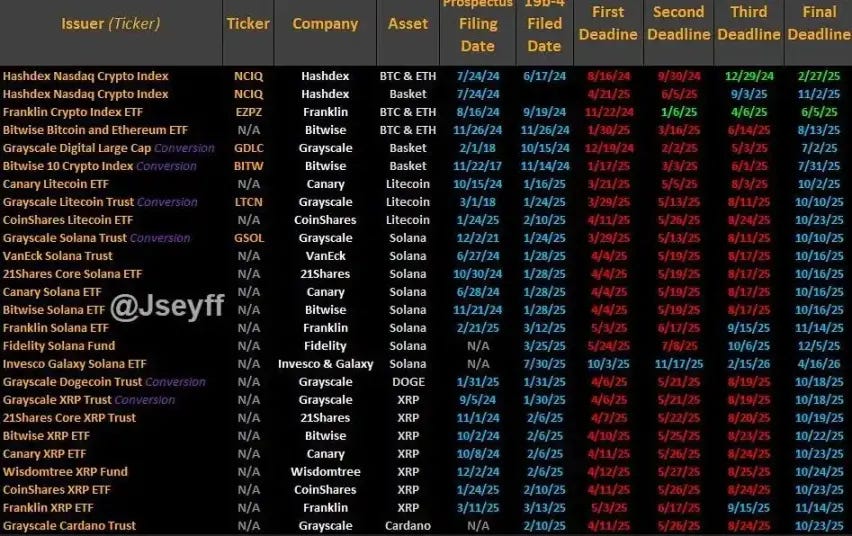
The biggest cultural signal is Dogecoin. Whether or not it’s a meme coin, DOGE qualifies because it has a regulated futures market. The new framework is neutral—it only cares about the data.

This first wave is also pushing the next regulatory frontier: staking. Several Solana application documents propose passing staking yields from fund assets to investors. If approved, ETFs would evolve from passive tracking tools to income-generating products—a direct bridge connecting Wall Street financial products with the on-chain economy.
Capital Flows
Funds are already moving, but not evenly. Institutional participants are positioning themselves; retail traders are hesitating.
Institutions: Open interest in XRP futures on the Chicago Mercantile Exchange (CME) has exceeded $1.1 billions, a classic sign of big money preparing for new investment tools.
Retail: Over $1.9 billions in XRP liquidations during the same period shows small traders repeatedly getting wiped out by volatility.
The conclusion: The early ETF wave will be a migration of existing institutional exposure into clearer, cheaper, regulated financial products. This wave of alternative token ETPs is more about optimizing market structure than unleashing new demand.
Global Race
The U.S. is not the only country opening up its crypto market—this is a global race.
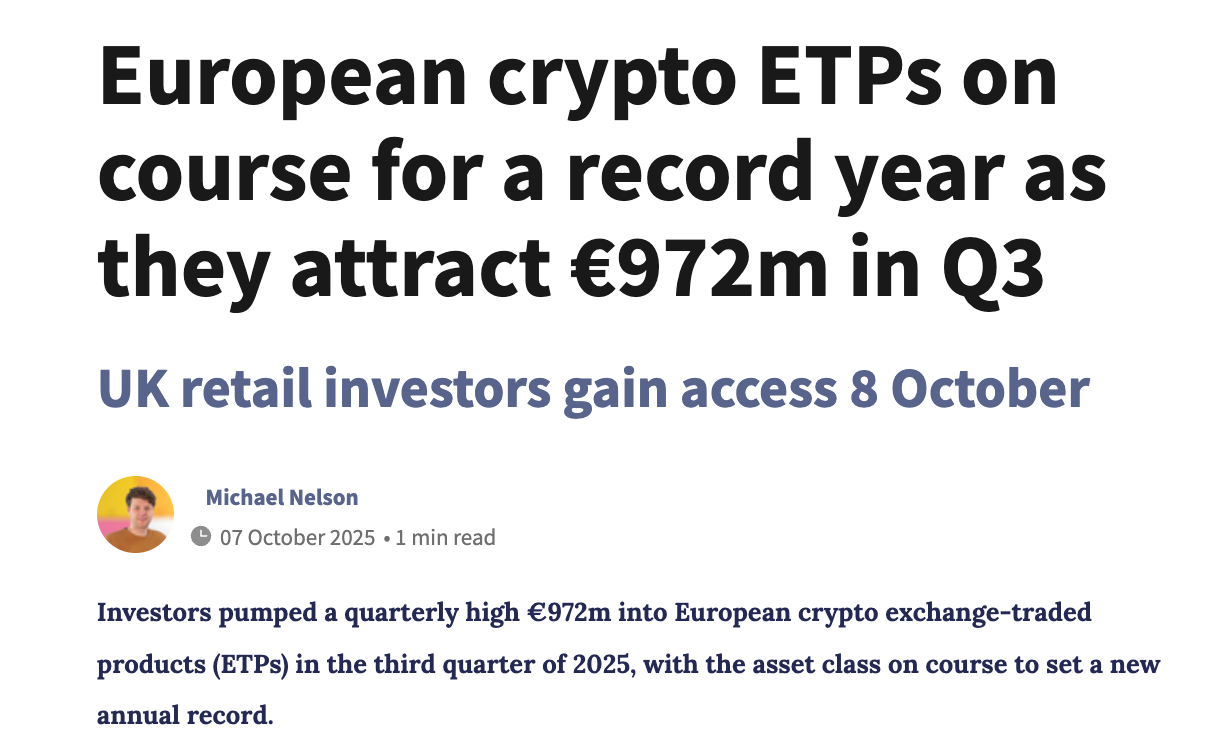
Europe: 21Shares and CoinShares have already been offering basket products and alternative token ETPs (Switzerland since 2018).
Hong Kong: Structurally an innovator, allowing "physical" creation and redemption (trading ETF shares with actual crypto). The U.S. initially banned this, but in July 2025 allowed physical creation and redemption for Bitcoin and Ethereum, marking convergence.

United States: Now leveraging its scale advantage, but setting entry barriers through regulated futures markets.
Potential Risks
This sudden expansion brings both opportunities and risks.
Dilution vs. Rising Tide
The launch of Bitcoin ETFs was the epitome of a "rising tide." But dozens of alternative token ETFs may disperse capital flows, with most capital concentrating in the cheapest, biggest-brand products. Smaller issuers risk being marginalized.
Liquidity Pressure
ETF liquidity ultimately depends on its underlying spot market. For smaller alternative tokens, redemption waves during market downturns could pressure market makers, causing ETF trading prices to deviate from their net asset value.
The Great Filter
ETP eligibility is rapidly becoming a badge of legitimacy. "Blue chip" coins with futures markets will attract institutional capital, while thousands of other coins are left out. This widens the gap between investable mainstream coins and speculative long-tail assets.
Conclusion: The Beginning of a New Era
October 2025 is a direct result of regulatory shifts, compressing years of product development into just a few weeks.
The Month of ETFs is the first proof of the new issuance mechanism. The U.S. crypto market has graduated from the Bitcoin/Ethereum era into a broader, more complex, and more accessible ecosystem.
The floodgates are open—and the battle for capital, liquidity, and legitimacy has only just begun.
Disclaimer: The content of this article solely reflects the author's opinion and does not represent the platform in any capacity. This article is not intended to serve as a reference for making investment decisions.
You may also like

Wall Street giants collectively raise rate hike forecasts, US Treasury futures continue to fall, gold drops over 1% to break 4000
After the US October CPI exceeded expectations, Goldman Sachs and Nomura added a forecast for an interest rate hike in March next year, while Deutsche Bank included a forecast for a rate hike in January next year. Currently, the market has fully priced in a 25 basis point rate hike in December, with a 13% probability for a 50 basis point hike. On Wednesday, the US Treasury spot market was closed, but Treasury futures continued to fall, with corresponding yields rising by about 2 to 4 basis points, and spot gold came under pressure, dropping by 1.1%.

No Need to Worry About the Cooling Down of AI Data Center Construction? The US Import Boom Is Unlikely to Subside in the Short Term, Real Impact May Come in 2029
It takes an average of 4.8 years from finalizing investment to starting construction of a data center project, and an additional 2.6 years from construction start to becoming operational. Servers usually cannot be installed until after the building structure and racks are completed. For trade partners such as Taiwan (China), South Korea, and Mexico who rely on US data center supply chain demand, the inertia in construction timelines provides at least a one- to two-year buffer for future exports.

Federal Reserve Major Debate: When Should the Tenure of “Number Three” Williams End?
The main point of contention is whether Williams should step down in June 2028, upon completing a full 10-year term, or in June 2027, when he reaches the mandatory retirement age of 65. Analysts point out that the Federal Reserve Board holds ultimate discretion; if he leaves early, Fed Chair Waller would be able to assert greater control over the appointment to this critical position. However, forcing Williams to shorten his term could easily be interpreted as political manipulation. Williams himself is expected to serve until June 2028.

Crypto prices
More


