
Crypto traders blame Trump’s tariffs in search of ‘singular event’: Santiment

Crypto retail traders were quick to blame Friday’s broader crypto market decline on US President Donald Trump announcing a 100% tariff on China, as they often look for something to point the finger at during downturns, according to Santiment.
Analysts, however, say the reason for the market slump runs deeper than the tariffs alone.
“This is typical 'rationalization' behavior from retailers, who need to point to a singular event as the reason for a cataclysmic downturn in crypto,” Santiment said in a report on Saturday.
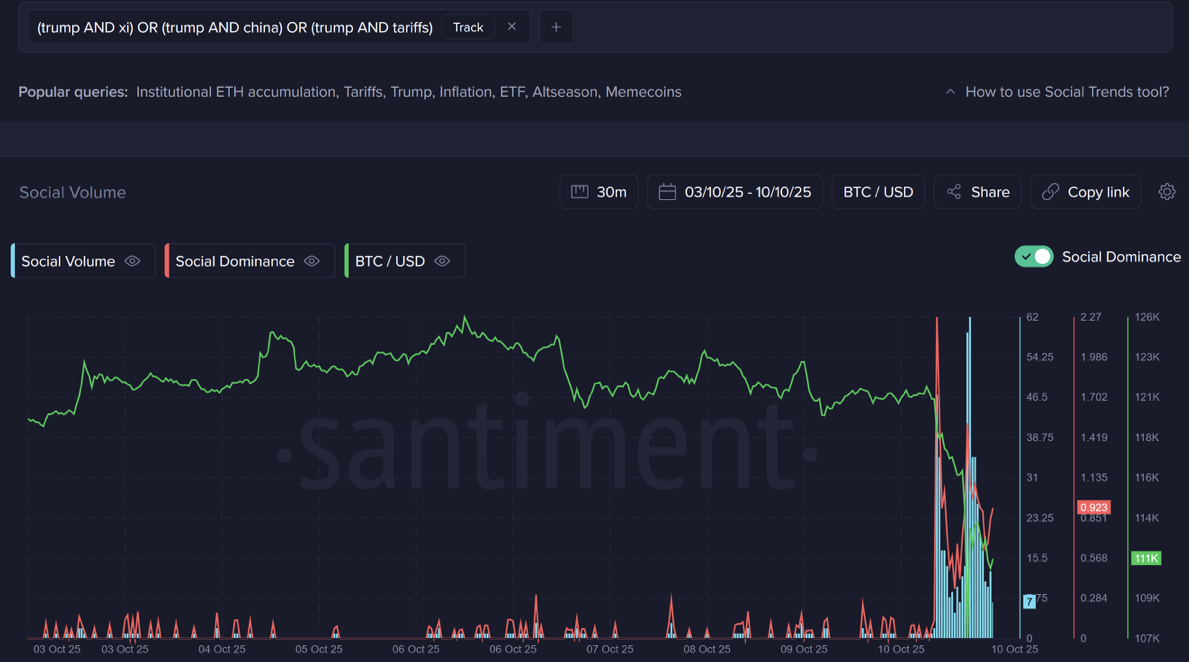
“After the crash, the crowd quickly jumped to collectively come to a consensus as to what the flush could be attributed to,” Santiment said, referring to the increase in social media discussions related to both the crypto market and US-China tariff concerns.
US and China developments will be vital for retail traders
Although the geopolitical event was a catalyst for the market decline, it wasn’t the only factor, according to analysts from The Kobeissi Letter, who also pointed to “excessive leverage and risk” in the crypto market. The analysts noted its heavy long bias, with around $16.7 billion in long positions liquidated versus just $2.5 billion in shorts, a ratio of nearly 7-to-1.
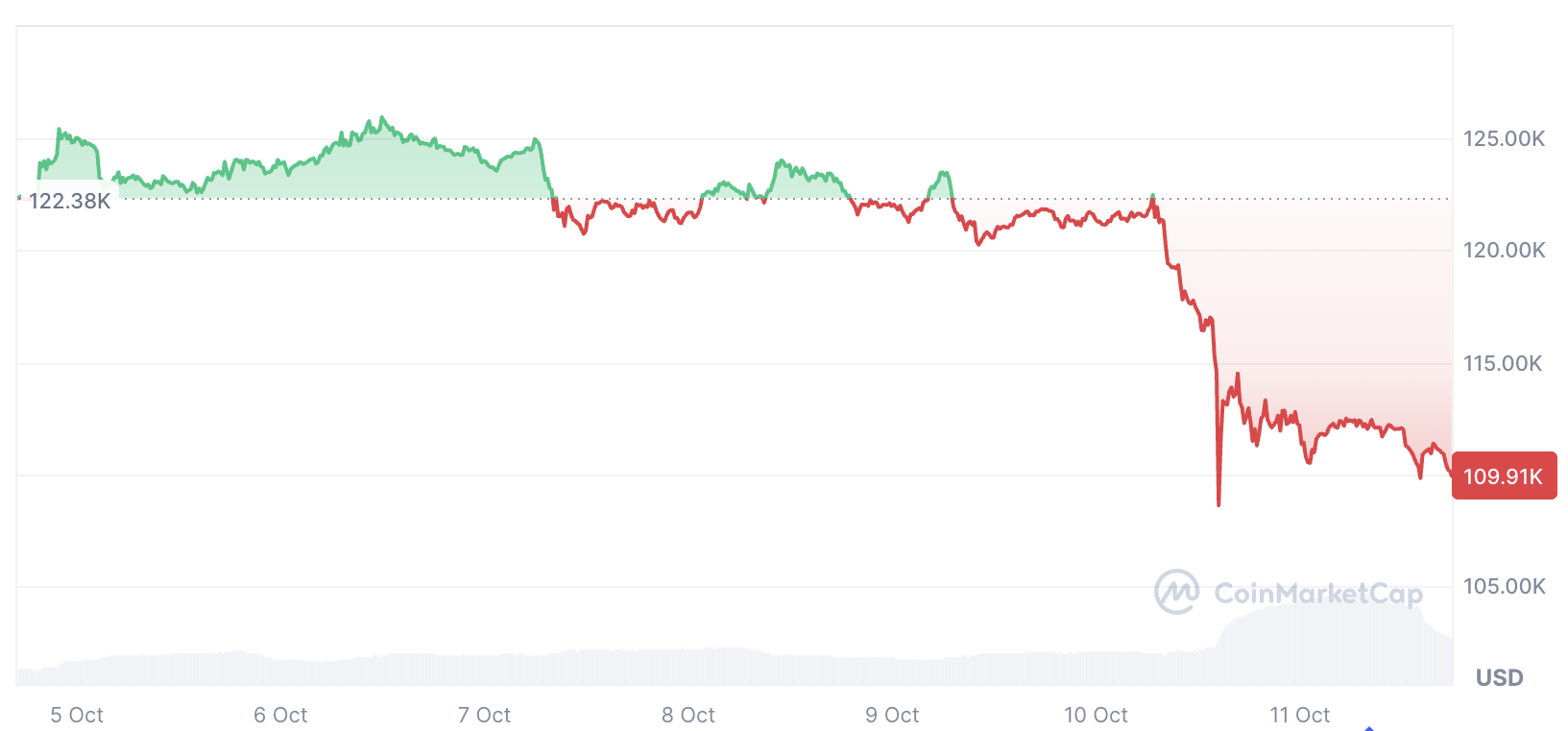
The significant liquidation event came as Bitcoin (BTC) fell more than 10% within 24 hours, with the BTC/USDT futures pair on Binance falling to as low as $102,000 following Trump’s tariff announcement.
Santiment said that developments between the US and China will “be central” in shaping crypto retail investors’ trading decisions, at least in the short term.
Bitcoin falling under $100,000 predictions may emerge
Santiment added that if talks between Trump and Xi improve and lead to “positive news,” retail sentiment toward crypto is likely to get better.
However, if tensions escalate, traders should brace for more pessimistic price forecasts. “Expect for the 'Bitcoin sub-100K' prediction floodgates to begin opening up,” Santiment said, adding:
“Bitcoin, whether we like it or not, is behaving more like a risk asset than a safe haven during times of country tensions.”
Sentiment plunged after the crypto market decline, with the Crypto Fear Greed Index, which measures overall crypto market sentiment, dropping to a “Fear” level of 27 in Saturday’s update.
That represents a sharp 37-point fall from Friday’s “Greed” reading of 64, its lowest level in nearly six months.
Disclaimer: The content of this article solely reflects the author's opinion and does not represent the platform in any capacity. This article is not intended to serve as a reference for making investment decisions.
You may also like

Wall Street giants collectively raise rate hike forecasts, US Treasury futures continue to fall, gold drops over 1% to break 4000
After the US October CPI exceeded expectations, Goldman Sachs and Nomura added a forecast for an interest rate hike in March next year, while Deutsche Bank included a forecast for a rate hike in January next year. Currently, the market has fully priced in a 25 basis point rate hike in December, with a 13% probability for a 50 basis point hike. On Wednesday, the US Treasury spot market was closed, but Treasury futures continued to fall, with corresponding yields rising by about 2 to 4 basis points, and spot gold came under pressure, dropping by 1.1%.

No Need to Worry About the Cooling Down of AI Data Center Construction? The US Import Boom Is Unlikely to Subside in the Short Term, Real Impact May Come in 2029
It takes an average of 4.8 years from finalizing investment to starting construction of a data center project, and an additional 2.6 years from construction start to becoming operational. Servers usually cannot be installed until after the building structure and racks are completed. For trade partners such as Taiwan (China), South Korea, and Mexico who rely on US data center supply chain demand, the inertia in construction timelines provides at least a one- to two-year buffer for future exports.

Federal Reserve Major Debate: When Should the Tenure of “Number Three” Williams End?
The main point of contention is whether Williams should step down in June 2028, upon completing a full 10-year term, or in June 2027, when he reaches the mandatory retirement age of 65. Analysts point out that the Federal Reserve Board holds ultimate discretion; if he leaves early, Fed Chair Waller would be able to assert greater control over the appointment to this critical position. However, forcing Williams to shorten his term could easily be interpreted as political manipulation. Williams himself is expected to serve until June 2028.

Crypto prices
More


