
XRP Rally Started 1 Year Ago – And Traders Lost $700 Million In a Flash

Analysts say XRP’s downturn reflects profit-taking and fading bullish momentum, though potential ETF approvals could restore investor confidence.
XRP has plunged to its lowest level in six months amid a widespread crypto sell-off that wiped out nearly $20 billion from the market in 24 hours.
According to BeInCrypto data, the token dropped more than 13% to as low as $1.53 before recovering slightly to $2.44 at press time. This marks the second time in 2025 that XRP has fallen below the $2 threshold.
Is XRP Bullish Momentum Exhausted?
Data from Coinglass shows that the sudden price decline triggered over $700 million in liquidations from traders speculating on XRP’s price performance.
Notably, more than $600 million in long positions were liquidated as traders betting on a price rebound were caught off guard by the sharp downturn.
The sell-off also saw XRP’s open interest drop from over $8 billion to around $5 billion, signaling a rapid unwinding of leveraged positions.
Despite this, derivatives activity surged, with XRP’s trading volume in futures and options exceeding $23 billion — its highest level since July. This spike suggests that traders rushed to hedge their positions or capitalize on short-term volatility.
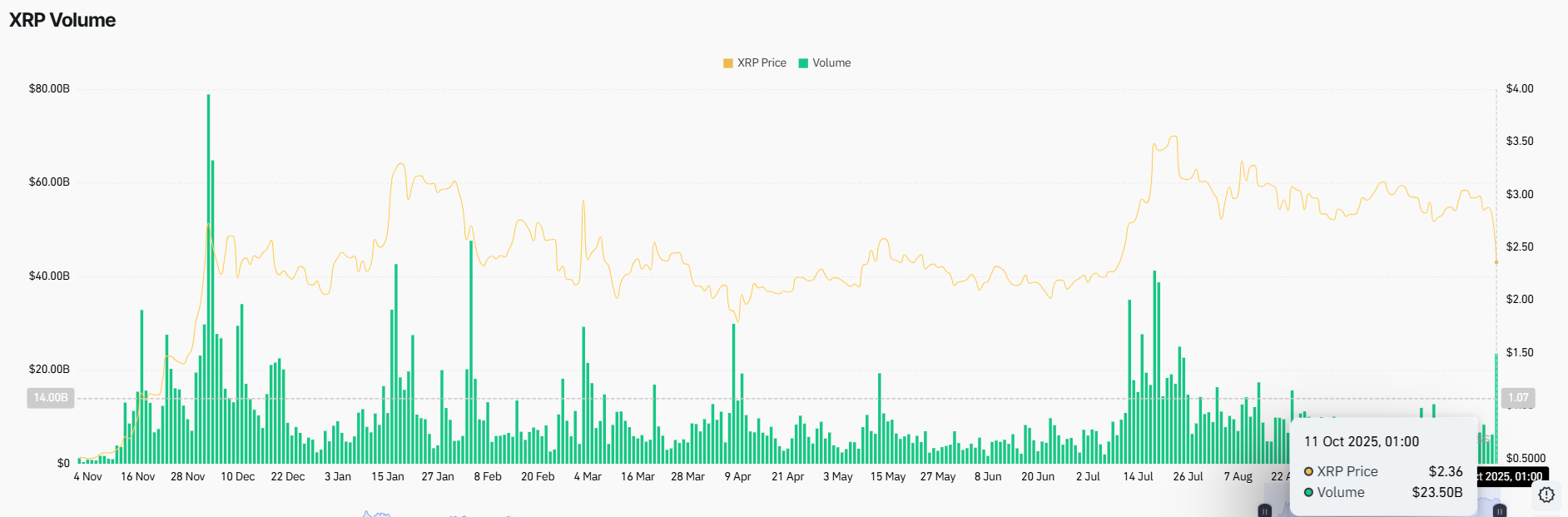 XRP’s Derivatives Volume. Source:
Coinglass
The market slump coincided with renewed macroeconomic tension following President Donald Trump’s announcement of a 100% tariff on Chinese goods. The move rattled risk assets, including cryptocurrencies, and fueled a wave of selling pressure.
Yet XRP’s decline also reflects internal market dynamics of the token.
Glassnode data indicates that the token’s bullish momentum has waned since late 2024 as investors who accumulated below $1 took profits during rallies above $2 and $3.
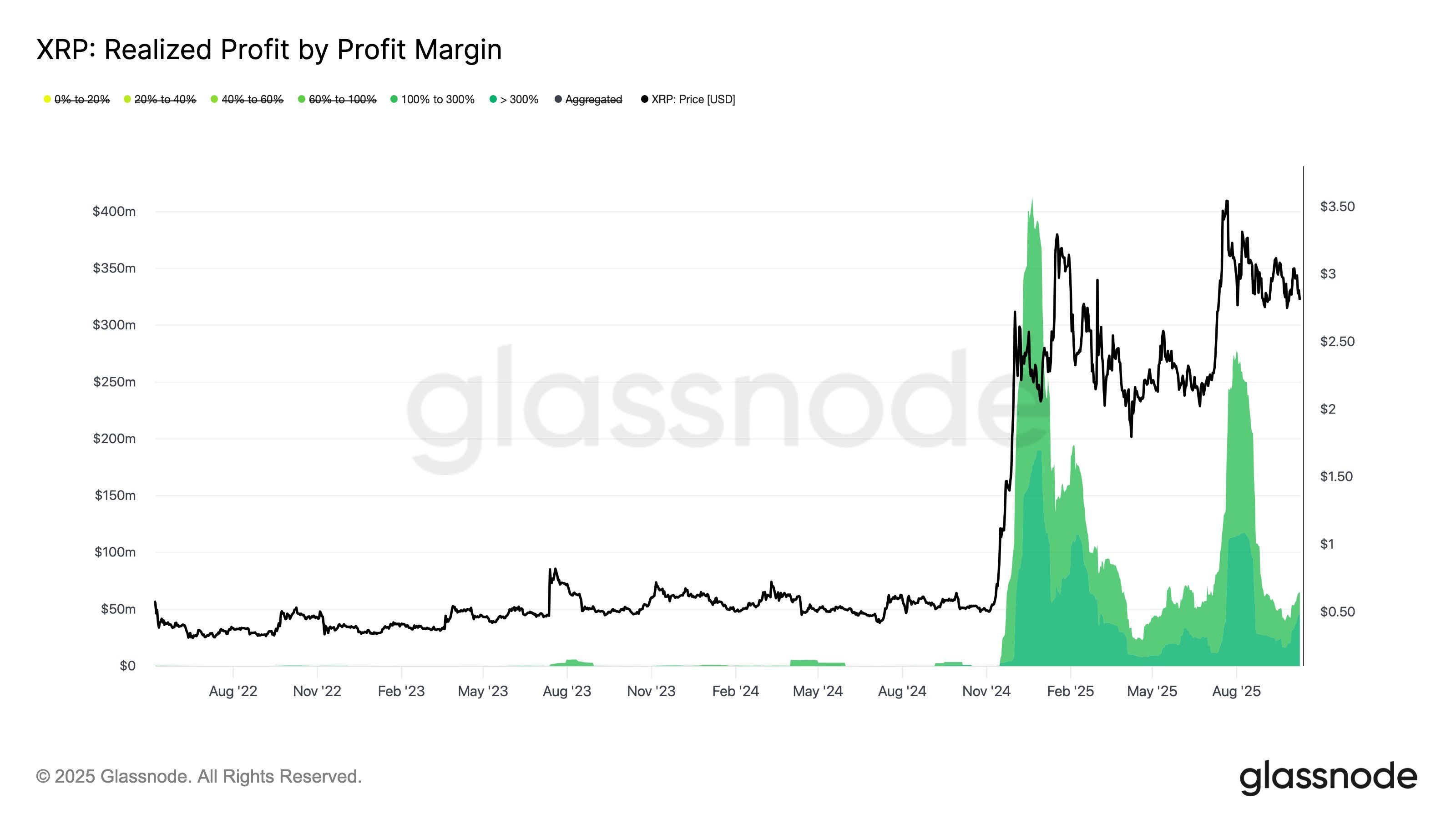 XRP’s Realized Profit Margin. Source:
Glassnode
Notably, the two profit-taking waves of December 2024 and July 2025 aligned with the asset’s price peaks and delivered over 300% gains for early holders.
Now, with those gains realized and broader market sentiment turning risk-averse, XRP appears to have entered a consolidation phase.
However, market analysts have pointed out that new catalysts, like the impending spot ETFs approval, could reignite investor confidence in the digital asset.
In addition, they noted that the continued growth and adoption of Ripple’s blockchain technology and XRP Ledger could also fuel the crypto token’s ascent.
Disclaimer: The content of this article solely reflects the author's opinion and does not represent the platform in any capacity. This article is not intended to serve as a reference for making investment decisions.
You may also like

Wall Street giants collectively raise rate hike forecasts, US Treasury futures continue to fall, gold drops over 1% to break 4000
After the US October CPI exceeded expectations, Goldman Sachs and Nomura added a forecast for an interest rate hike in March next year, while Deutsche Bank included a forecast for a rate hike in January next year. Currently, the market has fully priced in a 25 basis point rate hike in December, with a 13% probability for a 50 basis point hike. On Wednesday, the US Treasury spot market was closed, but Treasury futures continued to fall, with corresponding yields rising by about 2 to 4 basis points, and spot gold came under pressure, dropping by 1.1%.

No Need to Worry About the Cooling Down of AI Data Center Construction? The US Import Boom Is Unlikely to Subside in the Short Term, Real Impact May Come in 2029
It takes an average of 4.8 years from finalizing investment to starting construction of a data center project, and an additional 2.6 years from construction start to becoming operational. Servers usually cannot be installed until after the building structure and racks are completed. For trade partners such as Taiwan (China), South Korea, and Mexico who rely on US data center supply chain demand, the inertia in construction timelines provides at least a one- to two-year buffer for future exports.

Federal Reserve Major Debate: When Should the Tenure of “Number Three” Williams End?
The main point of contention is whether Williams should step down in June 2028, upon completing a full 10-year term, or in June 2027, when he reaches the mandatory retirement age of 65. Analysts point out that the Federal Reserve Board holds ultimate discretion; if he leaves early, Fed Chair Waller would be able to assert greater control over the appointment to this critical position. However, forcing Williams to shorten his term could easily be interpreted as political manipulation. Williams himself is expected to serve until June 2028.

Crypto prices
More


