
Whales and Retail Back Cardano (ADA) Price Rebound Despite Bearish Signals

Cardano (ADA) is down nearly 20% in 24 hours, but whales and retail traders are quietly adding to their positions. On-chain data shows growing conviction even as technical indicators flash warning signs. Can these two groups overpower bearish signals and drive the next ADA price rebound?
At present, Cardano (ADA) is down nearly 20% over the past 24 hours, extending its 30-day losses to 26.2%. The crash took ADA to its lowest point in weeks, but the token has since rebounded close to the $0.65 mark.
What’s driving this recovery attempt are two key groups — whales and retail traders — both adding exposure as prices slide. But can they overpower weak technical signals and spark a real rebound?
Whales and Retail Build Conviction Together
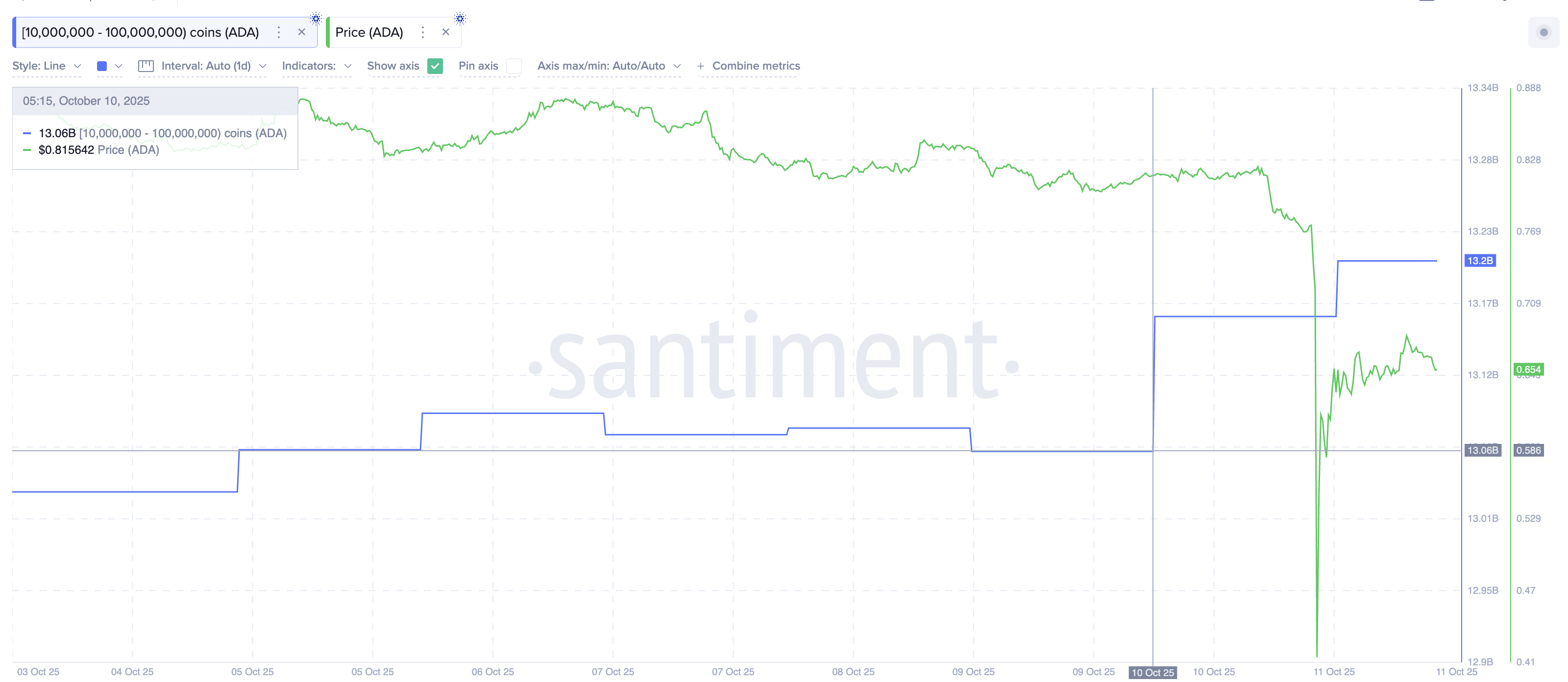
While most of the market panicked, Cardano whales were quietly adding. Santiment data shows that wallets holding 10 million to 100 million ADA increased their holdings from 13.06 billion on October 10 to 13.20 billion today — a gain of 0.14 billion ADA, worth about $89.6 million at the current price of $0.64.
Want more token insights like this? Sign up for Editor Harsh Notariya’s Daily Crypto Newsletter here.
 Cardano Whales:
Santiment
This buildup started just before the crash and hasn’t slowed since (they didn’t sell into the crash). That consistency during a market-wide selloff suggests these large holders are expecting stability or an eventual rebound.
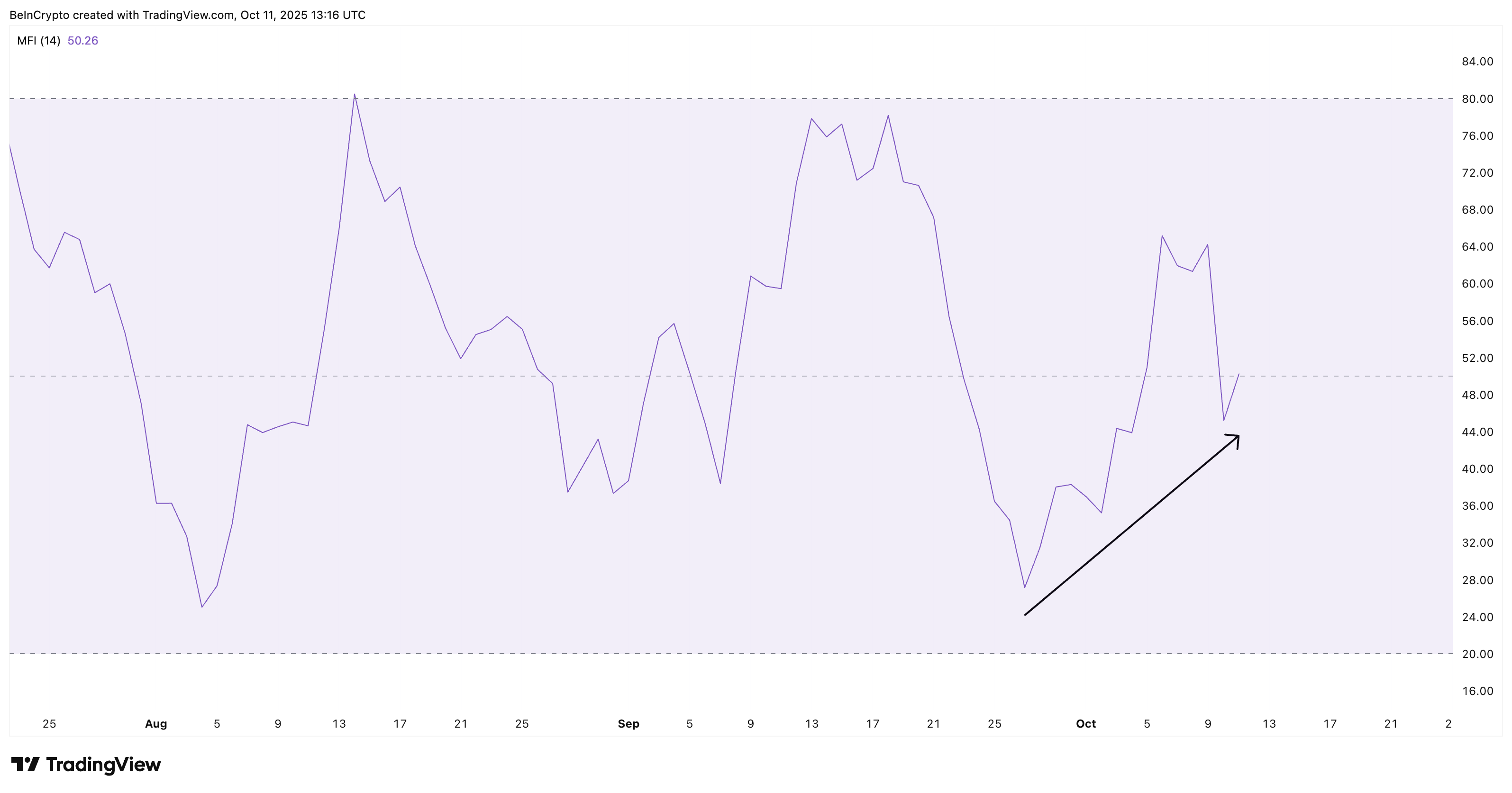
The Money Flow Index (MFI) — which tracks how much money flows in and out of an asset based on price and volume — supports that narrative. MFI has formed a higher low, showing capital inflows even as the price fell.
 Cardano Retail Joining The Action:
TradingView
This shows retail traders seem to be stepping in alongside whales, adding to the buying strength that could serve as a base for a gradual Cardano price recovery.
Three Technical Risks Still Haunt The Cardano Price Action
Despite the encouraging accumulation, three technical risks remain.
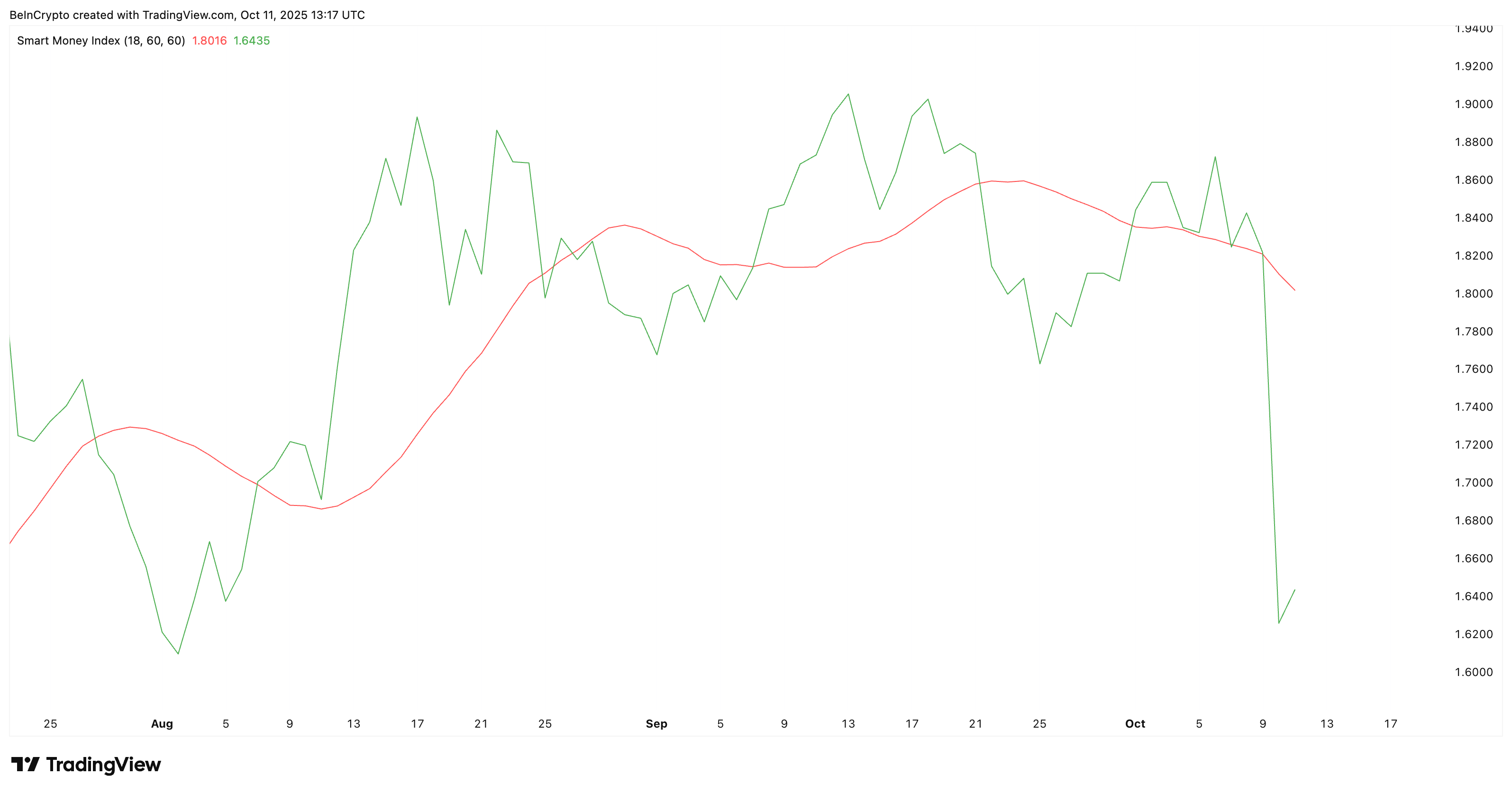
The Smart Money Index (SMI) — which measures professional trader-specific positioning — has dropped sharply and is yet to recover. Though it has slightly curled up, the move remains too weak to confirm a sustained comeback or rebound-hopeful traders.
 Smart Money Not Expecting A Cardano Rebound
TradingView
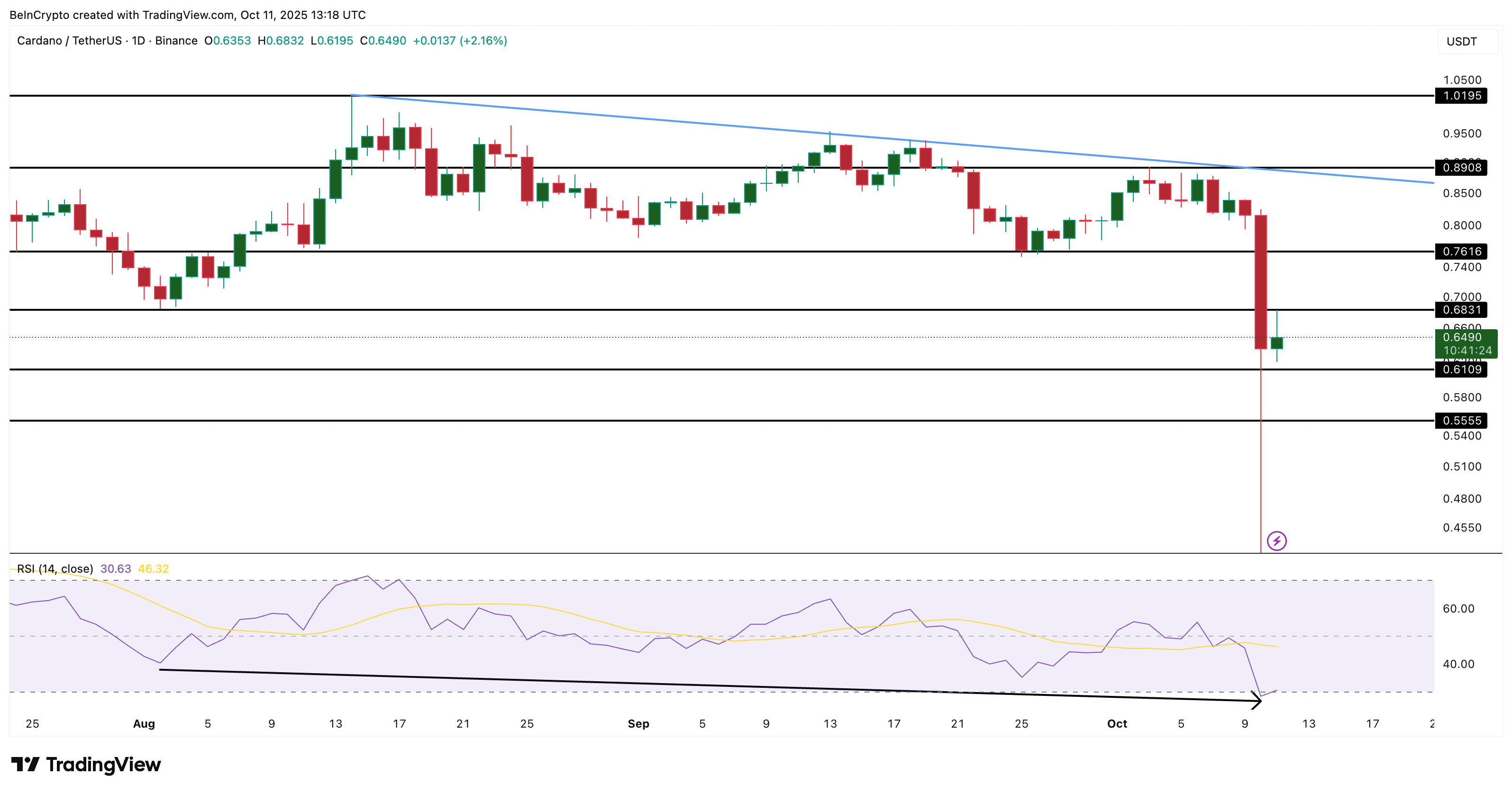
Similarly, RSI, which measures the strength of buying or selling momentum, shows no bullish divergence. While ADA’s price made a lower low during the crash, RSI followed with another lower low — meaning momentum hasn’t reversed yet.
 Cardano Price Analysis:
TradingView
At 30, RSI does show ADA is oversold, but without divergence, the rebound could be slower than other top altcoins.
Adding to this caution, ADA’s descending trendline continues to form a bearish triangle pattern on the daily chart. Without a bullish RSI divergence to counter it, the structure suggests that downside risk still exists — making this a potentially fragile rebound unless buyers sustain higher closes.
Currently, the Cardano price trades near $0.64. A daily close above $0.68 could prime the ADA price for a short-term recovery toward $0.76 and $0.89, while a break below $0.61 may drag it further down to $0.55.
Disclaimer: The content of this article solely reflects the author's opinion and does not represent the platform in any capacity. This article is not intended to serve as a reference for making investment decisions.
You may also like

Wall Street giants collectively raise rate hike forecasts, US Treasury futures continue to fall, gold drops over 1% to break 4000
After the US October CPI exceeded expectations, Goldman Sachs and Nomura added a forecast for an interest rate hike in March next year, while Deutsche Bank included a forecast for a rate hike in January next year. Currently, the market has fully priced in a 25 basis point rate hike in December, with a 13% probability for a 50 basis point hike. On Wednesday, the US Treasury spot market was closed, but Treasury futures continued to fall, with corresponding yields rising by about 2 to 4 basis points, and spot gold came under pressure, dropping by 1.1%.

No Need to Worry About the Cooling Down of AI Data Center Construction? The US Import Boom Is Unlikely to Subside in the Short Term, Real Impact May Come in 2029
It takes an average of 4.8 years from finalizing investment to starting construction of a data center project, and an additional 2.6 years from construction start to becoming operational. Servers usually cannot be installed until after the building structure and racks are completed. For trade partners such as Taiwan (China), South Korea, and Mexico who rely on US data center supply chain demand, the inertia in construction timelines provides at least a one- to two-year buffer for future exports.

Federal Reserve Major Debate: When Should the Tenure of “Number Three” Williams End?
The main point of contention is whether Williams should step down in June 2028, upon completing a full 10-year term, or in June 2027, when he reaches the mandatory retirement age of 65. Analysts point out that the Federal Reserve Board holds ultimate discretion; if he leaves early, Fed Chair Waller would be able to assert greater control over the appointment to this critical position. However, forcing Williams to shorten his term could easily be interpreted as political manipulation. Williams himself is expected to serve until June 2028.

Crypto prices
More


