
This Crypto Trader Made $160 Million Profit During Trump’s Market Bloodbath

The crypto whale's profit coincided with Trump’s announcement of 100% tariffs on Chinese imports, which triggered a $20 billion liquidation across crypto markets.
A crypto whale has pocketed over $160 million in profits after correctly betting on Bitcoin and Ethereum’s recent price decline.
On October 11, blockchain analysis platform Lookonchain reported that a long-term Bitcoin holder had opened more than $1.1 billion in short positions on the top two cryptocurrencies by market capitalization.
How Bitcoin Crash Made This Trader $160 Million Richer
The trader effectively wagered that both assets would drop in value despite their recent bullish momentum.
Within just 30 hours, that prediction proved right—Bitcoin and Ethereum prices fell sharply, earning the trader an estimated $160 million in realized profit.
Insane — over $160M profit in just 30 hours! 😱This #BitcoinOG has closed most of his $BTC and $ETH shorts, leaving only 821.6 $BTC($92M) short, making a profit of more than $160M!
Following the sell-off, the trader began closing most of the positions, retaining only 821.6 BTC worth about $92 million.
The timing of this move has fueled speculation about whether the whale had early insight into upcoming macroeconomic shifts that triggered the broader market decline.
On Friday, Trump announced a 100% tariff on Chinese imports and new export controls targeting critical software industries.
The tariff, scheduled to take effect on November 1, spooked investors in both traditional and crypto markets, sparking widespread sell-offs in risk assets.
According to BeInCrypto data, Bitcoin’s price dropped to as low as $105,262 before recovering to $111,052 as of press time.
Other major assets such as Ethereum, Solana, Dogecoin, and XRP followed similar trajectories. Their sharp declines triggered the highest daily liquidation figures ever recorded.
Indeed, more than 1.6 million traders were liquidated, wiping out $19.31 billion in positions within 24 hours, according to CoinGlass data.
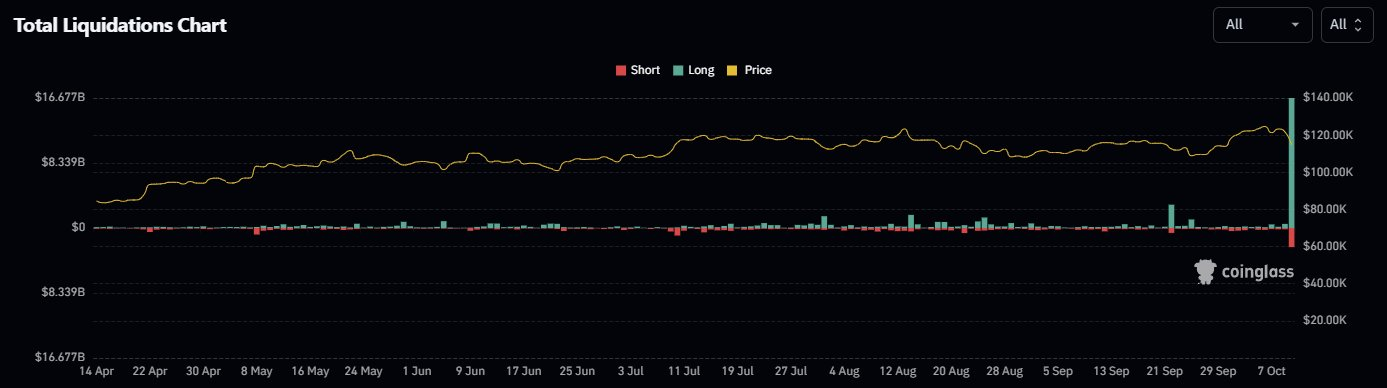 Crypto Market Record Liquidation. Source:
Long traders—those expecting further price gains—absorbed the bulk of the losses, totaling $16.82 billion. Short traders, despite the downturn, lost an additional $2.5 billion.
Bitcoin accounted for $5.37 billion of the total liquidations, followed by Ethereum with $4.43 billion. Solana traders lost $2 billion, while HYPE and XRP traders lost $890.37 million and $708.24 million, respectively.
Amid the volatility, decentralized exchange Hyperliquid emerged as the largest liquidation venue, handling $10.3 billion or about 53% of all liquidations. Bybit followed with $4.65 billion, while Binance and OKX recorded $2.39 billion and $1.21 billion, respectively.
The episode underscores how geopolitical shocks and whale-scale trades can swiftly reshape crypto market dynamics. In such situations, even seasoned traders can be exposed to massive losses or extraordinary gains.
Disclaimer: The content of this article solely reflects the author's opinion and does not represent the platform in any capacity. This article is not intended to serve as a reference for making investment decisions.
You may also like

Wall Street giants collectively raise rate hike forecasts, US Treasury futures continue to fall, gold drops over 1% to break 4000
After the US October CPI exceeded expectations, Goldman Sachs and Nomura added a forecast for an interest rate hike in March next year, while Deutsche Bank included a forecast for a rate hike in January next year. Currently, the market has fully priced in a 25 basis point rate hike in December, with a 13% probability for a 50 basis point hike. On Wednesday, the US Treasury spot market was closed, but Treasury futures continued to fall, with corresponding yields rising by about 2 to 4 basis points, and spot gold came under pressure, dropping by 1.1%.

No Need to Worry About the Cooling Down of AI Data Center Construction? The US Import Boom Is Unlikely to Subside in the Short Term, Real Impact May Come in 2029
It takes an average of 4.8 years from finalizing investment to starting construction of a data center project, and an additional 2.6 years from construction start to becoming operational. Servers usually cannot be installed until after the building structure and racks are completed. For trade partners such as Taiwan (China), South Korea, and Mexico who rely on US data center supply chain demand, the inertia in construction timelines provides at least a one- to two-year buffer for future exports.

Federal Reserve Major Debate: When Should the Tenure of “Number Three” Williams End?
The main point of contention is whether Williams should step down in June 2028, upon completing a full 10-year term, or in June 2027, when he reaches the mandatory retirement age of 65. Analysts point out that the Federal Reserve Board holds ultimate discretion; if he leaves early, Fed Chair Waller would be able to assert greater control over the appointment to this critical position. However, forcing Williams to shorten his term could easily be interpreted as political manipulation. Williams himself is expected to serve until June 2028.

Crypto prices
More


