
S&P 500 Extends Losses as Bitcoin Melts to $102; Altcoins Lose Over 10%

- Trump announces 100% tariff on Chinese goods
- Bitcoin Falls to $102 amid Global Pressure
- Altcoins record losses over 10%
Current US President Donald Trump increased tensions with China by declaring on Friday (10) that the US will apply an additional 100% tariff on Chinese products starting November 1, 2025. The measure was announced on his official Truth Social account, with the argument that China has been adopting an “extraordinarily aggressive” stance in global trade.
Trump stated that the new package of restrictions, including limitations on Chinese access to critical software, will take effect on the same date. He also indicated that the timeline could be brought forward, depending on China's reaction. Beijing's retaliation includes new tariffs on American ships, a suspension of soybean purchases, and the opening of an antitrust investigation into Qualcomm, which intensifies the impasse.
The impact on the market was immediate. US stock markets fell sharply, with the S&P 500 index leading the decline following the announcements. Sectors linked to international trade and technology were particularly hard hit, reflecting fears of a new wave of global economic slowdown.
Additionally, some specific tariffs are already in effect. Starting October 1st, tariffs on kitchen cabinets and vanities came into effect. On October 14th, new tariffs on lumber and furniture come into effect. The suspension of tariffs on Mexican products is expected to end in early November.
In the legal arena, the U.S. Supreme Court will rule in early November on the validity of the "reciprocal" tariffs imposed by Trump. A contrary ruling could significantly alter the economic strategy adopted by his administration.
Cryptocurrency market today
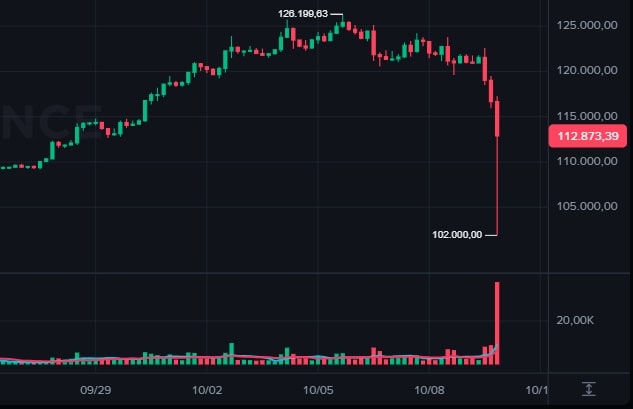
Cryptocurrencies followed the negative sentiment of traditional markets and are trading sharply lower this Friday. Bitcoin plunged to the $102.000 region but partially recovered and stabilized above $112.000. The market's leading cryptocurrency is down 6,95% on the day.
Ethereum also fell significantly, trading at $3.898, down 10,86%. Binance Coin (BNB) is down 11,78%, trading at $1.104,10. Solana (SOL) is down 12,82%, trading at $192,17.
Other altcoins followed the same trend. XRP fell to $2,34 (-16,89%), Dogecoin (DOGE) to $0,1910 (-23,12%), Cardano (ADA) to $0,632 (-22,40%), and TRON (TRX) to $0,32 (-4,55%).
Disclaimer: The content of this article solely reflects the author's opinion and does not represent the platform in any capacity. This article is not intended to serve as a reference for making investment decisions.
You may also like

Wall Street giants collectively raise rate hike forecasts, US Treasury futures continue to fall, gold drops over 1% to break 4000
After the US October CPI exceeded expectations, Goldman Sachs and Nomura added a forecast for an interest rate hike in March next year, while Deutsche Bank included a forecast for a rate hike in January next year. Currently, the market has fully priced in a 25 basis point rate hike in December, with a 13% probability for a 50 basis point hike. On Wednesday, the US Treasury spot market was closed, but Treasury futures continued to fall, with corresponding yields rising by about 2 to 4 basis points, and spot gold came under pressure, dropping by 1.1%.

No Need to Worry About the Cooling Down of AI Data Center Construction? The US Import Boom Is Unlikely to Subside in the Short Term, Real Impact May Come in 2029
It takes an average of 4.8 years from finalizing investment to starting construction of a data center project, and an additional 2.6 years from construction start to becoming operational. Servers usually cannot be installed until after the building structure and racks are completed. For trade partners such as Taiwan (China), South Korea, and Mexico who rely on US data center supply chain demand, the inertia in construction timelines provides at least a one- to two-year buffer for future exports.

Federal Reserve Major Debate: When Should the Tenure of “Number Three” Williams End?
The main point of contention is whether Williams should step down in June 2028, upon completing a full 10-year term, or in June 2027, when he reaches the mandatory retirement age of 65. Analysts point out that the Federal Reserve Board holds ultimate discretion; if he leaves early, Fed Chair Waller would be able to assert greater control over the appointment to this critical position. However, forcing Williams to shorten his term could easily be interpreted as political manipulation. Williams himself is expected to serve until June 2028.

Crypto prices
More


