
US–China Tariff Fears Hit Bitcoin Treasury Stocks

Donald Trump announced that he would impose an additional 100% tariff on Chinese products starting Nov. 1, in strong retaliation against China’s decision to restrict exports of rare earth materials essential for high-tech manufacturing.
Markets reacted sharply to the announcement, with the S&P 500 index falling 2.7% from the previous day. The news triggered widespread volatility across global equities, leading crypto-related stocks to post steep declines as investor risk appetite weakened.
Crypto Stocks Lead Double-Digit Market Sell-Off
The renewed trade tensions between the US and China sparked a broad market sell-off that directly hit crypto-related stocks. As of Friday’s market close in New York, leading digital-asset companies saw sharp declines across the board.
Global cryptocurrency exchange Coinbase (COIN) closed at $357.01, down 7.75% from the previous close of $387. The stock opened at $387.66 and fell as low as $351.63 during the session, reflecting investors’ growing risk aversion.
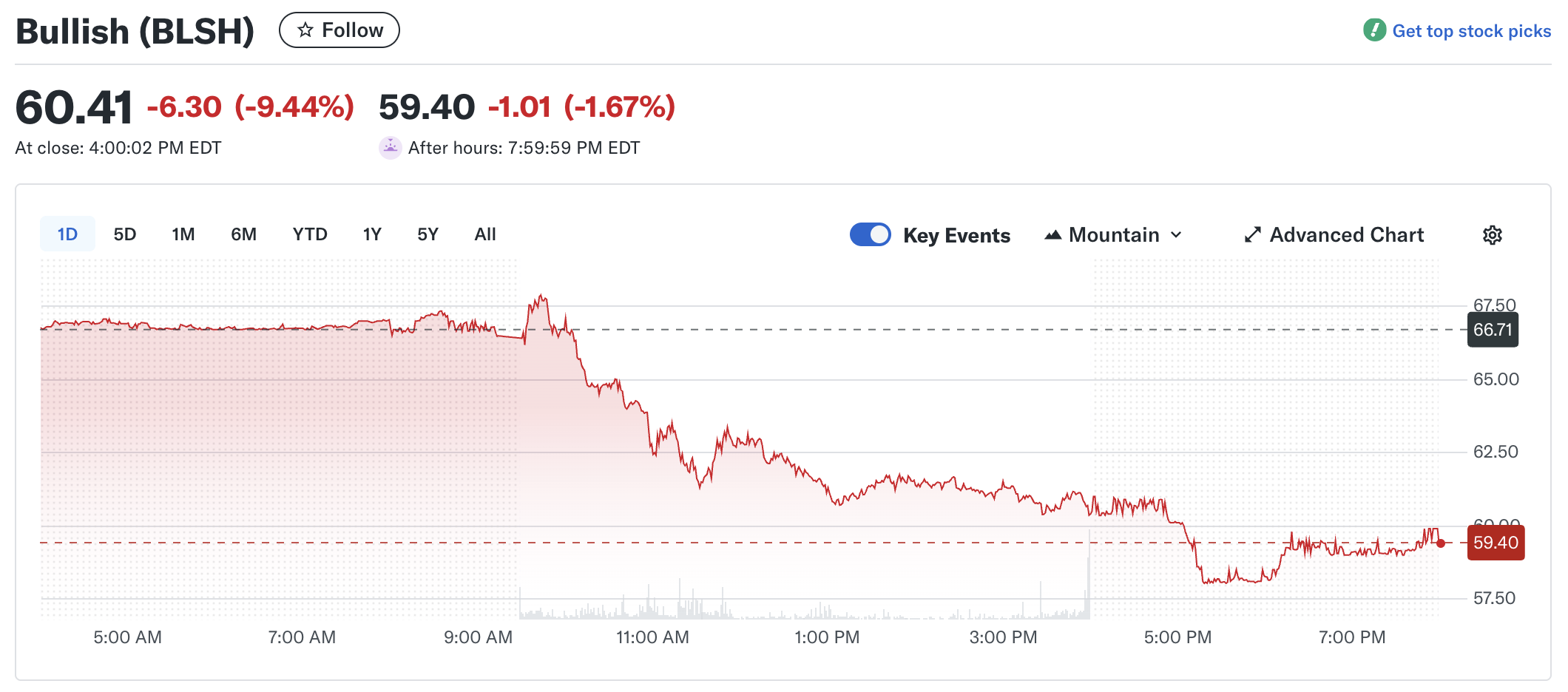
Crypto financial-services firm Bullish (BLSH) also posted steep losses, dropping 9.42% to $60.37 from the prior close of $66.65. The stock briefly touched $68 earlier in the day but fell to $60.25 amid broader market weakness.
Japan-based Bitcoin treasury company Metaplanet (MTPLF) ended 2.25% lower at $3.48, compared with the previous close of $3.56. Although it rose to $3.65 intraday, the gains were short-lived as the stock turned lower later in the session.
Bitcoin mining firm MARA Holdings, Inc. (MARA) suffered one of the steepest declines, finishing down 7.67% at $18.65. The stock plunged sharply around 11 am after an early rebound attempt and continued to weaken in after-hours trading, falling another 1.72% to $18.33, indicating lingering investor anxiety.
BREAKING: 🇺🇸 $1.2 TRILLION HAS BEEN WIPED OUT FROM THE STOCK MARKET TODAY.
— Ash Crypto (@Ashcryptoreal) October 10, 2025
PRAY FOR CRYPTO. pic.twitter.com/TiGFJBzSfb
Strategy’s mNAV Highlights Bitcoin Treasury Risks
Leading Bitcoin treasury company Strategy (MSTR) was also hit hard by the sell-off. The stock closed at $304.79 on the same day, down 4.84% from the previous day’s $320.29. During the session, it fluctuated between a high of $323.43 and a low of $303.57, showing high volatility.
More importantly, the focus has shifted beyond the short-term stock decline to the deepening concern over the company’s fundamental valuation metrics. Analysts reported that the company’s multiple-to-net asset value (mNAV) has dropped below 1.180, marking its lowest level in nearly two years (19 months).
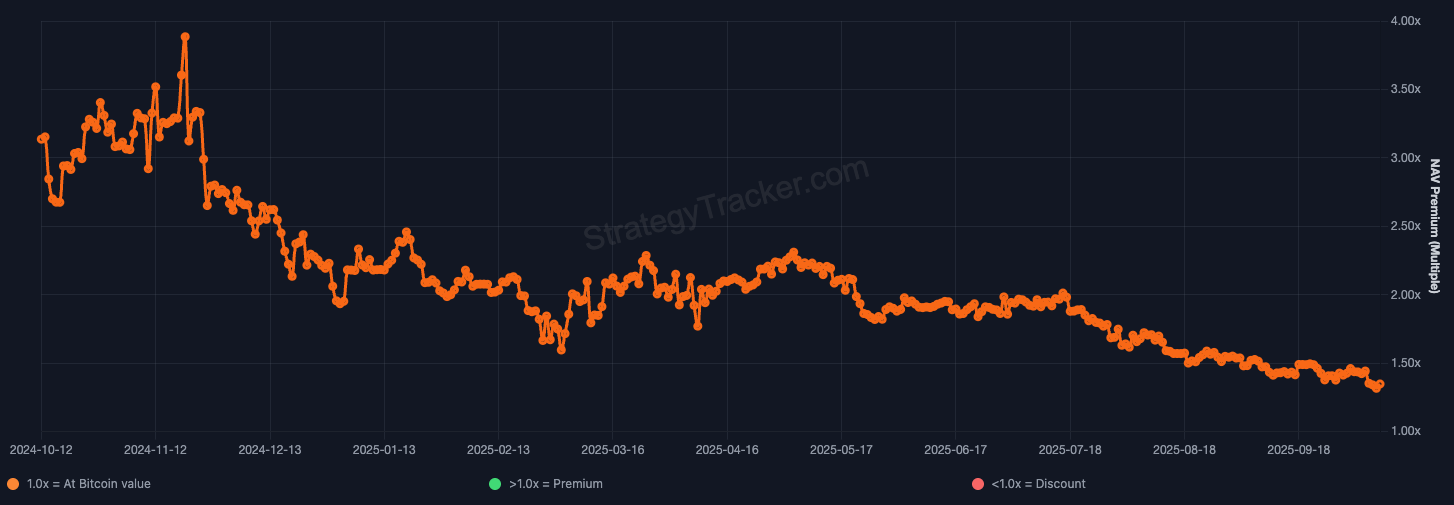
Geoffrey Kendrick, Head of Digital Assets Research at Standard Chartered, warned that maintaining an mNAV above 1.0 is essential for digital-asset treasury (DAT) companies to expand their holdings. Values below that threshold, he said, indicate weakened balance sheets and rising consolidation pressure across the industry.
Strategy and similar firms are also facing growing pressure from PIPE (Private Investment in Public Equity) financing structures used to fund their Bitcoin acquisitions. According to a CryptoQuant report last month, Bitcoin treasury stocks tend to converge toward their discounted PIPE issuance prices. This pattern has left some early investors facing losses of up to 55%.
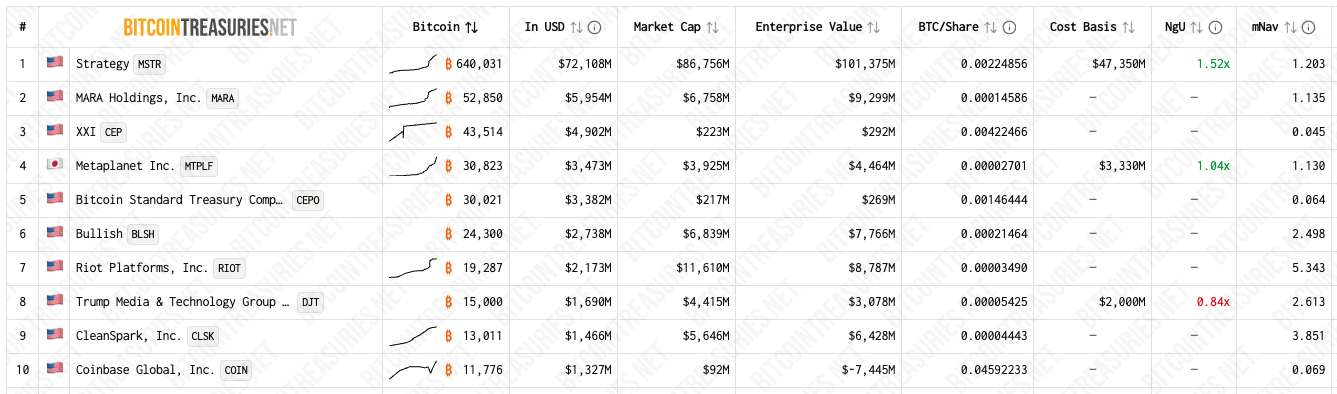
Strategy currently holds about $78 billion worth of BTC, while its market capitalization stands at $94 billion, implying a $16 billion premium. However, given that the company’s total profit over the past 12 months was under $350 million, most analysts view this premium as reflecting investor optimism tied to founder Michael Saylor’s efforts to promote Bitcoin-backed debt and investment products.
The post US–China Tariff Fears Hit Bitcoin Treasury Stocks appeared first on BeInCrypto.
Disclaimer: The content of this article solely reflects the author's opinion and does not represent the platform in any capacity. This article is not intended to serve as a reference for making investment decisions.
You may also like

Wall Street giants collectively raise rate hike forecasts, US Treasury futures continue to fall, gold drops over 1% to break 4000
After the US October CPI exceeded expectations, Goldman Sachs and Nomura added a forecast for an interest rate hike in March next year, while Deutsche Bank included a forecast for a rate hike in January next year. Currently, the market has fully priced in a 25 basis point rate hike in December, with a 13% probability for a 50 basis point hike. On Wednesday, the US Treasury spot market was closed, but Treasury futures continued to fall, with corresponding yields rising by about 2 to 4 basis points, and spot gold came under pressure, dropping by 1.1%.

No Need to Worry About the Cooling Down of AI Data Center Construction? The US Import Boom Is Unlikely to Subside in the Short Term, Real Impact May Come in 2029
It takes an average of 4.8 years from finalizing investment to starting construction of a data center project, and an additional 2.6 years from construction start to becoming operational. Servers usually cannot be installed until after the building structure and racks are completed. For trade partners such as Taiwan (China), South Korea, and Mexico who rely on US data center supply chain demand, the inertia in construction timelines provides at least a one- to two-year buffer for future exports.

Federal Reserve Major Debate: When Should the Tenure of “Number Three” Williams End?
The main point of contention is whether Williams should step down in June 2028, upon completing a full 10-year term, or in June 2027, when he reaches the mandatory retirement age of 65. Analysts point out that the Federal Reserve Board holds ultimate discretion; if he leaves early, Fed Chair Waller would be able to assert greater control over the appointment to this critical position. However, forcing Williams to shorten his term could easily be interpreted as political manipulation. Williams himself is expected to serve until June 2028.

Crypto prices
More


