
LTC Price Soars 11% to $129: Analysts Eye $135 Breakout as ETF Approval Buzz Grows

Litecoin (LTC) ripped as much as 11% to $129–$131, outpacing Bitcoin and Ethereum during a market pullback as fresh spot ETF momentum stoked bids. Trading volume exploded 143% to $1.66B, while futures open interest jumped 25% to $1.21B, signaling new leverage and renewed directional conviction.
The catalyst is linked to the growing confidence that a U.S.-listed spot Litecoin ETF could be near the finish line. Canary Capital’s updated S-1 now includes ticker LTCC and a 0.95% fee, the kind of last-mile filing detail ETF watchers say typically appears “before go-time.”
With Grayscale and CoinShares also in the hunt, analysts argue LTC’s commodity-like profile and long proof-of-work history make it one of the cleaner alt candidates for regulated fund access once the SEC resumes normal operations.
Litecoin Technical setup: $130 reclaim tees up $135–$138
On the charts, Litecoin blasted through the $127.45 swing high and reclaimed stacked moving averages (7- and 30-day SMAs), turning the multi-month range from ceiling to potential floor. RSI (68) shows strong momentum without a blow-off, and MACD remains firmly positive.
Immediate resistance sits at $130–$131; a daily close above opens a path to $134–$135, then $138 and $150. Should FOMO follow an ETF headline, bulls point to a broader vacuum up to the $150–$160 zone, Litecoin’s highest region since early 2022.
On higher time frames, some technicians note a breakout from a year-long diagonal that, if confirmed, preserves a stretch target toward $275 over the coming months; that scenario likely requires sustained ETF-driven inflows.
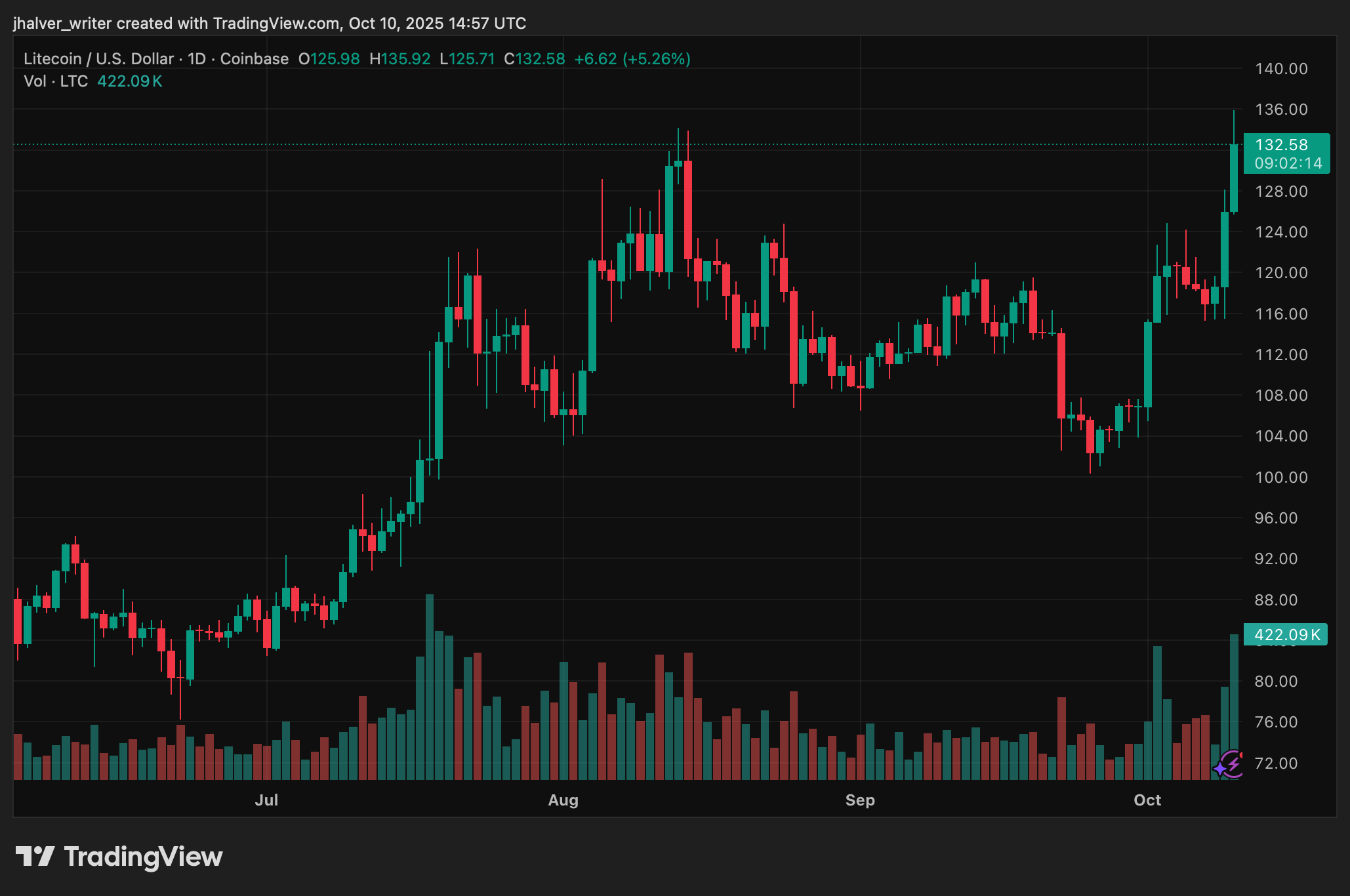
LTC's price trends to the upside on the daily chart. Source: LTCUSD on Tradingview
LTC Levels That Matter, And What Could Invalidate
For momentum traders, the line in the sand is $125: lose it decisively and swift profit-taking could drag LTC back into $122–$125 support, with $115–$118 as a deeper retest.
Hold above $125 and reclaim $130 with volume, and bulls keep control into $135–$138. Macro remains a swing factor; government shutdown timing, SEC throughput, and broader crypto risk appetite can still inject volatility.
As long as $125 holds and $130 flips to support, the $135–$138 breakout looks within reach, while a green light for LTCC could be the spark that extends the move toward $150–$160 next. For searchers tracking the Litecoin price, keep your eyes on $130: it’s the path to the next leg.
Cover image from ChatGPT, LTCUSD chart from Tradingview
Disclaimer: The content of this article solely reflects the author's opinion and does not represent the platform in any capacity. This article is not intended to serve as a reference for making investment decisions.
You may also like

Wall Street giants collectively raise rate hike forecasts, US Treasury futures continue to fall, gold drops over 1% to break 4000
After the US October CPI exceeded expectations, Goldman Sachs and Nomura added a forecast for an interest rate hike in March next year, while Deutsche Bank included a forecast for a rate hike in January next year. Currently, the market has fully priced in a 25 basis point rate hike in December, with a 13% probability for a 50 basis point hike. On Wednesday, the US Treasury spot market was closed, but Treasury futures continued to fall, with corresponding yields rising by about 2 to 4 basis points, and spot gold came under pressure, dropping by 1.1%.

No Need to Worry About the Cooling Down of AI Data Center Construction? The US Import Boom Is Unlikely to Subside in the Short Term, Real Impact May Come in 2029
It takes an average of 4.8 years from finalizing investment to starting construction of a data center project, and an additional 2.6 years from construction start to becoming operational. Servers usually cannot be installed until after the building structure and racks are completed. For trade partners such as Taiwan (China), South Korea, and Mexico who rely on US data center supply chain demand, the inertia in construction timelines provides at least a one- to two-year buffer for future exports.

Federal Reserve Major Debate: When Should the Tenure of “Number Three” Williams End?
The main point of contention is whether Williams should step down in June 2028, upon completing a full 10-year term, or in June 2027, when he reaches the mandatory retirement age of 65. Analysts point out that the Federal Reserve Board holds ultimate discretion; if he leaves early, Fed Chair Waller would be able to assert greater control over the appointment to this critical position. However, forcing Williams to shorten his term could easily be interpreted as political manipulation. Williams himself is expected to serve until June 2028.

Crypto prices
More


