
United Nations Southeast Asia Crime Report Released, Bitrace Contributes Key Data and Cases

On October 7, 2024, the United Nations Office on Drugs and Crime (UNODC) released a report titled "Transnational..."
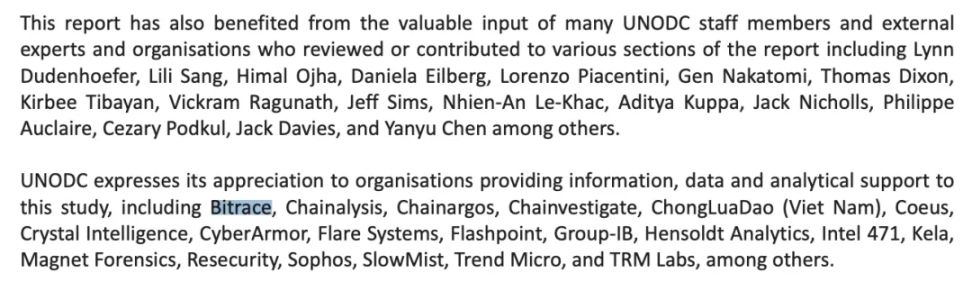
On October 7, 2024, the United Nations Office on Drugs and Crime (hereinafter referred to as UNODC) released a report titled "The Convergence of Transnational Organized Crime with Online Fraud, Underground Banking and Technological Innovation: The Evolving Threat Landscape." The report cited cases and crypto analysis in which Bitrace had participated in investigations in the past.
The report describes the mechanisms, complexity, and driving factors of transnational organized crime in Southeast Asia, mentioning that organized crime groups are coming together to exploit various vulnerabilities, and the situation is developing so rapidly that it has outpaced the government's ability to contain it. Leveraging technological advancements, criminal groups are creating larger-scale and harder-to-detect fraud, money laundering, underground banking, and online scams, leading to the emergence of a criminal services economy. The region (referring to Southeast Asia) has now become an important testing ground for transnational criminal networks seeking to expand their influence and develop new business lines.
As an emerging economic paradigm, the crypto industry based on blockchain technology is also highlighted in the report. Among them—
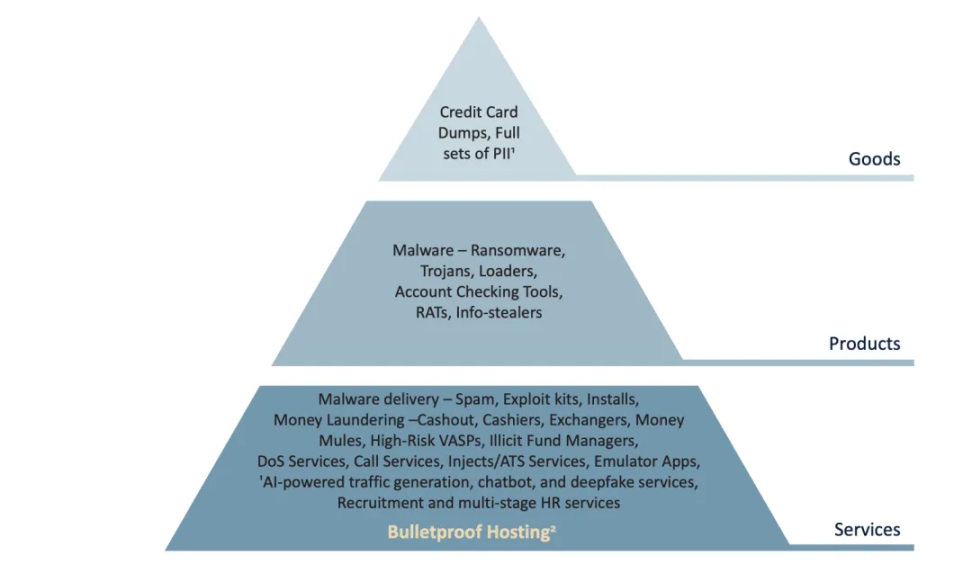
The report mentions the use of cryptocurrencies—especially USD stablecoins—in various criminal scenarios, including extortion, fraud, theft, illegal online gambling, and other illicit activities, as well as upstream and downstream crimes that support these illegal activities. In the past, these activities mainly settled funds in fiat currency, but after 2020, a significant share has been replaced by cryptocurrencies.
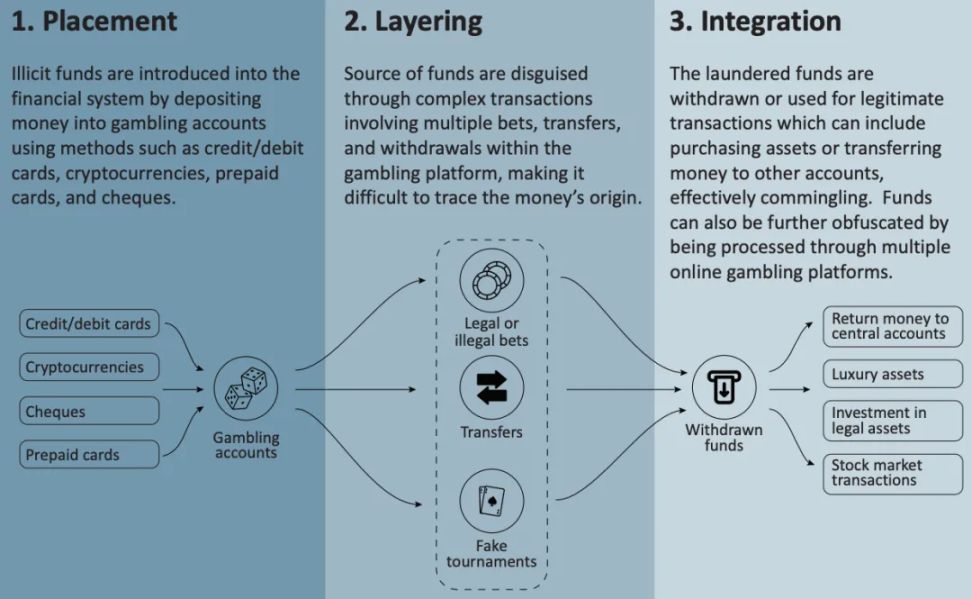
The report also discusses the use of cryptocurrencies in money laundering in Southeast Asia, using the money laundering model based on online gambling platforms as an example. The report states that illegal industries related to cryptocurrencies have achieved "overwhelming success" in Southeast Asia. These illicit cryptocurrencies, along with other involved fiat currencies, enter personal accounts on online gambling platforms, are then laundered through legal or illegal betting activities, and finally withdrawn from the platform after the laundering process is complete.

The report also mentions escrow platforms that provide laundering services for involved cryptocurrencies, stating that such companies usually maintain a central Telegram channel and act as guarantors and custodians for all transactions to prevent fraud within the illegal economy. The market also accepts other payment and settlement options, but lists the USD-pegged Tether (USDT) as the preferred payment method.
Throughout the report, the author repeatedly cites Bitrace's views and data, including—
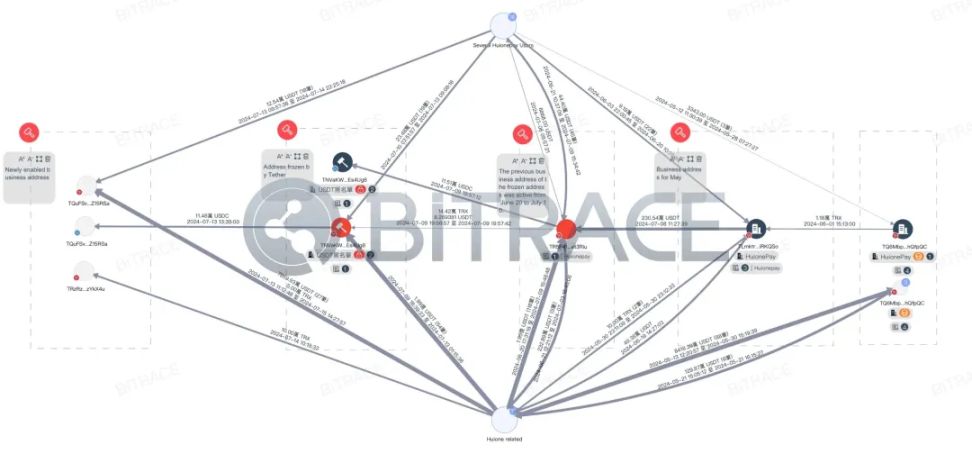
On July 13, 2024, a Tron address under the jurisdiction of Cambodia's Huiwang Group was blacklisted by Tether, resulting in over 29M USDT being unable to be transferred. After Bitrace's investigation, it was found that the blacklisting may be related to the address receiving stolen funds from DMM and Polonix.

There is also the long-standing QR code scam in the crypto industry, where scammers impersonate celebrities or well-known institutions, claiming that scanning the code allows participation in "double return" investment activities, which are actually scams. Based on extensive case investigation experience, Bitrace has created a series of anti-fraud educational articles.
Outside of the report, Bitrace also maintains intelligence and data collaboration with UNODC researchers. As a regulatory technology company focused on crypto risk data analysis, Bitrace has extensive experience in crypto crime investigation. Over the past several years, based on our understanding of criminal business models, we have provided Web3 industry expertise and perspectives to researchers or institutions, including UNODC.
Finally, the use of cryptocurrencies by criminal groups for illegal activities has caused widespread harm to groups including ordinary people, Web3 institutions, crypto investors, and government departments. To more effectively address this threat, Bitrace is committed to using AI and big data technologies to more accurately and efficiently identify and monitor on-chain risks and criminal activities. Currently, Bitrace has collaborated and connected with law enforcement agencies and Web3 companies in multiple countries, completed thousands of case service supports, monitored hundreds of billions in risky funds, and successfully recovered billions of dollars in losses.
Report link:
Disclaimer: The content of this article solely reflects the author's opinion and does not represent the platform in any capacity. This article is not intended to serve as a reference for making investment decisions.
You may also like

Wall Street giants collectively raise rate hike forecasts, US Treasury futures continue to fall, gold drops over 1% to break 4000
After the US October CPI exceeded expectations, Goldman Sachs and Nomura added a forecast for an interest rate hike in March next year, while Deutsche Bank included a forecast for a rate hike in January next year. Currently, the market has fully priced in a 25 basis point rate hike in December, with a 13% probability for a 50 basis point hike. On Wednesday, the US Treasury spot market was closed, but Treasury futures continued to fall, with corresponding yields rising by about 2 to 4 basis points, and spot gold came under pressure, dropping by 1.1%.

No Need to Worry About the Cooling Down of AI Data Center Construction? The US Import Boom Is Unlikely to Subside in the Short Term, Real Impact May Come in 2029
It takes an average of 4.8 years from finalizing investment to starting construction of a data center project, and an additional 2.6 years from construction start to becoming operational. Servers usually cannot be installed until after the building structure and racks are completed. For trade partners such as Taiwan (China), South Korea, and Mexico who rely on US data center supply chain demand, the inertia in construction timelines provides at least a one- to two-year buffer for future exports.

Federal Reserve Major Debate: When Should the Tenure of “Number Three” Williams End?
The main point of contention is whether Williams should step down in June 2028, upon completing a full 10-year term, or in June 2027, when he reaches the mandatory retirement age of 65. Analysts point out that the Federal Reserve Board holds ultimate discretion; if he leaves early, Fed Chair Waller would be able to assert greater control over the appointment to this critical position. However, forcing Williams to shorten his term could easily be interpreted as political manipulation. Williams himself is expected to serve until June 2028.

Crypto prices
More


