
Nosana: Driving the Future of AI with Accessible GPU Computing Power and Exceptional Experience

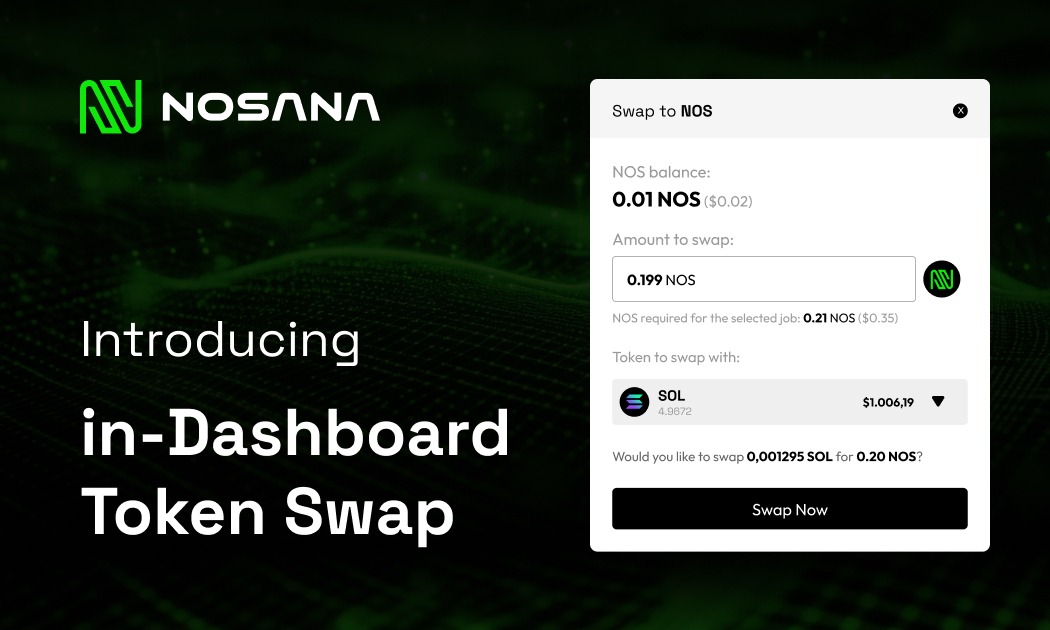
Brand new features launched: In-dashboard token swap and dynamic priority fees, further lowering the usage threshold and improving trading stability.
Currently, artificial intelligence is developing rapidly, but one of its core underlying resources—GPU computing power—is facing a global shortage and high price issues. The high cost of hardware and limited supply of computing power have become major obstacles for enterprises and developers on the road to AI innovation. The birth of Nosana is precisely to solve this key problem. We are committed to building a decentralized GPU computing power marketplace, transforming idle consumer-grade and data center GPU resources worldwide into a flexible, efficient, and shareable public infrastructure, making AI computing more economical, inclusive, and sustainable.
What is Nosana?
Nosana is a decentralized GPU marketplace based on blockchain technology, connecting two core roles:
Hosts: Individual users or data centers with idle GPU computing power;
Clients: Enterprises and developers who need on-demand GPU computing power to run AI inference and other computational tasks.
Through this innovative model, Nosana reactivates previously underutilized GPU resources, turning them into a powerful driving force for the implementation of AI applications. Whether it’s model inference, data processing, or large-scale AI training, you can obtain cost-effective and flexible computing power support on the Nosana platform. Our mission is to make AI computing as accessible as water and electricity, becoming a readily available public resource, while helping to reduce electronic waste, lower operational costs, and promote green AI and technological democratization.
Two brand new features launched, optimizing experience and supporting innovation
To further lower the user threshold, improve trading stability, and enhance the overall experience, Nosana officially introduces the following two important feature upgrades:
Feature 1: In-dashboard token swap, easily acquire NOS without switching pages
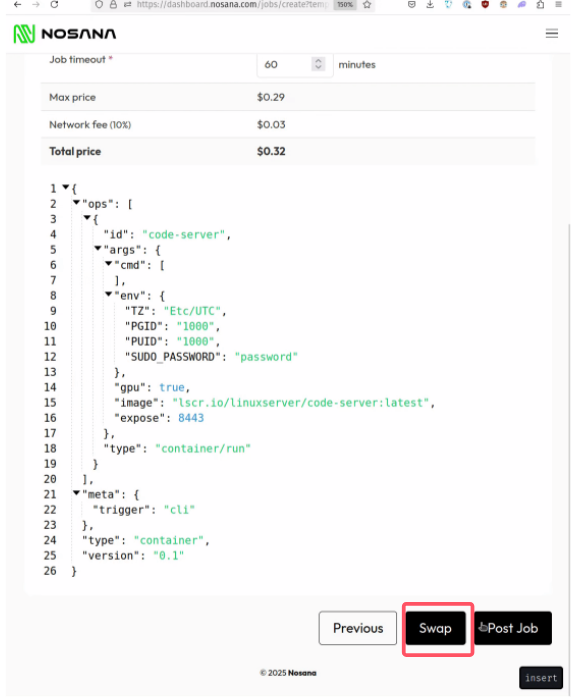
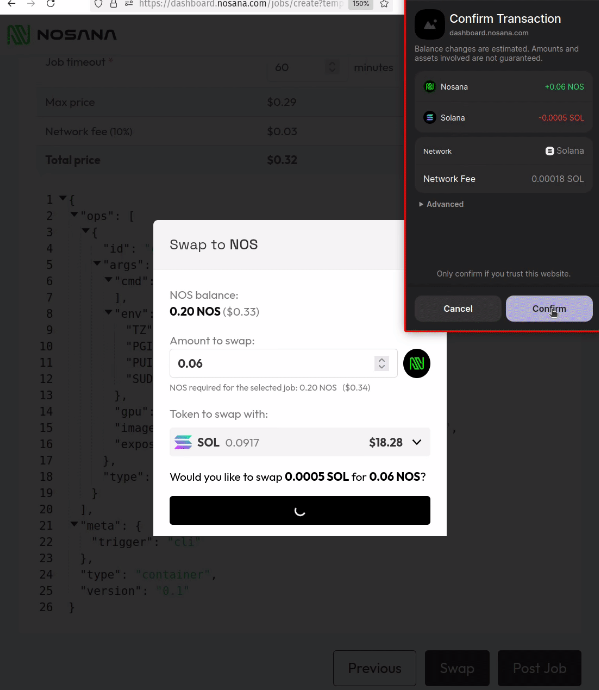
Previously, users who wanted to run AI tasks on the Nosana platform had to first purchase NOS tokens through external exchanges or manually perform complex token swaps in their wallets. This process was not only cumbersome but also confusing for new users. Now, we bring a simpler and more intuitive solution: directly swap SOL, USDC, or USDT for NOS within the Nosana dashboard. No need to leave the platform or jump to third-party websites. From selecting task templates and connecting your wallet to swapping tokens and paying task fees, the entire process is seamlessly integrated in one step. We have integrated the industry-leading Jupiter swap aggregator to ensure you always get the best real-time exchange rate and optimal trading path for every swap—safe, fast, and worry-free. How to operate: Open the Nosana dashboard and go to the template page; select the AI or computational task template that suits your needs; connect your crypto wallet; directly swap SOL, USDC, or USDT for NOS within the platform; pay the task fee and start running your AI workload.
Feature 2: Dynamic priority fees, worry-free congestion, more reliable transactions
On the Solana blockchain, when the network is congested (such as during large-scale NFT minting or popular airdrops), transactions without additional incentives may be dropped by validator nodes, resulting in transaction failures, with common prompts like “Solana network congestion.” To address this pain point, Nosana has now fully introduced the “dynamic priority fee” mechanism. What is a priority fee? It is similar to a tip for blockchain validator nodes, used to incentivize nodes to prioritize your transaction, improving transaction success rates, especially during busy network periods. Nosana’s dynamic priority fee has two major advantages:
Smart adjustment: Automatically adjusts the priority fee based on real-time congestion on the Solana network, ensuring your transaction always has higher processing priority;
Stable experience: Significantly reduces transaction failures caused by network congestion, so users no longer have to worry about stuck transactions, ensuring smooth workflow.
Whether it’s publishing tasks or purchasing NOS, every key operation is now more reliable, helping users focus on innovation without being distracted by technical obstacles.
About Nosana
Nosana is committed to building an open, efficient, and sustainable GPU computing ecosystem, making AI computing no longer a privilege for a few, but a basic resource easily accessible to all developers and enterprises. By connecting idle GPU resources worldwide with urgent AI workload demands, we are driving a computing power revolution: lowering AI inference costs, improving resource utilization, reducing electronic waste, and accelerating the large-scale implementation of AI technology. We believe that the future of AI should be available to everyone, everywhere.
Disclaimer: The content of this article solely reflects the author's opinion and does not represent the platform in any capacity. This article is not intended to serve as a reference for making investment decisions.
You may also like

Wall Street giants collectively raise rate hike forecasts, US Treasury futures continue to fall, gold drops over 1% to break 4000
After the US October CPI exceeded expectations, Goldman Sachs and Nomura added a forecast for an interest rate hike in March next year, while Deutsche Bank included a forecast for a rate hike in January next year. Currently, the market has fully priced in a 25 basis point rate hike in December, with a 13% probability for a 50 basis point hike. On Wednesday, the US Treasury spot market was closed, but Treasury futures continued to fall, with corresponding yields rising by about 2 to 4 basis points, and spot gold came under pressure, dropping by 1.1%.

No Need to Worry About the Cooling Down of AI Data Center Construction? The US Import Boom Is Unlikely to Subside in the Short Term, Real Impact May Come in 2029
It takes an average of 4.8 years from finalizing investment to starting construction of a data center project, and an additional 2.6 years from construction start to becoming operational. Servers usually cannot be installed until after the building structure and racks are completed. For trade partners such as Taiwan (China), South Korea, and Mexico who rely on US data center supply chain demand, the inertia in construction timelines provides at least a one- to two-year buffer for future exports.

Federal Reserve Major Debate: When Should the Tenure of “Number Three” Williams End?
The main point of contention is whether Williams should step down in June 2028, upon completing a full 10-year term, or in June 2027, when he reaches the mandatory retirement age of 65. Analysts point out that the Federal Reserve Board holds ultimate discretion; if he leaves early, Fed Chair Waller would be able to assert greater control over the appointment to this critical position. However, forcing Williams to shorten his term could easily be interpreted as political manipulation. Williams himself is expected to serve until June 2028.

Crypto prices
More


