Bitget App
Trade smarter
Buy cryptoMarketsTradeFuturesStocksEarnInstitutionAI & More
Chainalysis Flags $75B in Illicit Crypto as Governments Eye Strategic Reserves

Chainalysis Flags $75B in Illicit Crypto as Governments Eye Strategic Reserves

CoinspeakerCoinspeaker2025/10/08 16:00
By:By Ibrahim Ajibade Editor Marco T. Lanz

Blockchain analytics firm Chainalysis reports criminal-linked wallets hold $75 billion in crypto, with darknet operators controlling $46 billion of it.

Key Notes

  • Illicit crypto flows to exchanges dropped from $14B annually to $7B in H1 2025 as criminals avoid fiat conversion.
  • Darknet administrators control over $46 billion in digital assets, representing the majority of illicit blockchain holdings.
  • Coordinated government seizures could strengthen national treasuries as countries establish strategic crypto reserves.

Blockchain analytics firm Chainalysis says more than $75 billion in illicit crypto sits untouched across public blockchains.

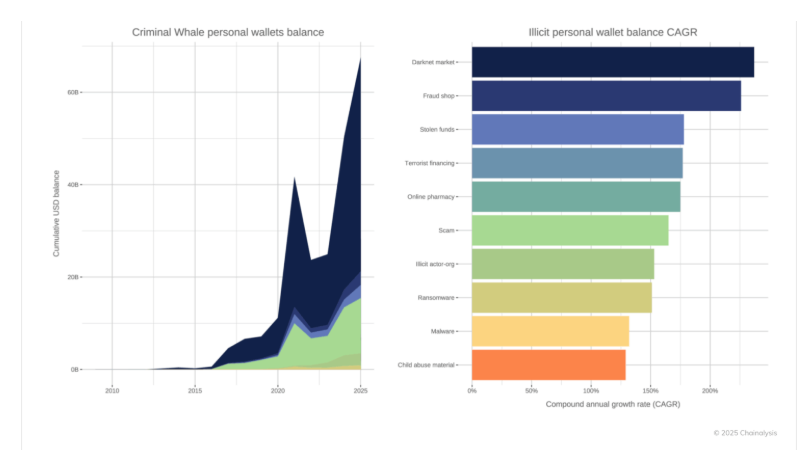
According to the firm’s latest report , criminal-linked wallets currently hold nearly $15 billion in digital assets, with another $60 billion in wallets connected indirectly to scams, hacks, or darknet markets .
Chainalysis Flags $75B in Illicit Crypto as Governments Eye Strategic Reserves image 0

Criminal wallet balances | Source: Chainalysis

Chainalysis also found darknet administrators alone control over $46 billion in crypto, accounting for the bulk of the shadow economy.

While Bitcoin BTC $120 823 24h volatility: 2.5% Market cap: $2.41 T Vol. 24h: $70.07 B remains the dominant asset held by illicit actors by value, Ethereum ETH $4 323 24h volatility: 4.7% Market cap: $521.51 B Vol. 24h: $43.19 B and stablecoin balances have grown rapidly due to their rising adoption and relative price stability.

Governments Could Target Illicit Crypto For Strategic Reserves

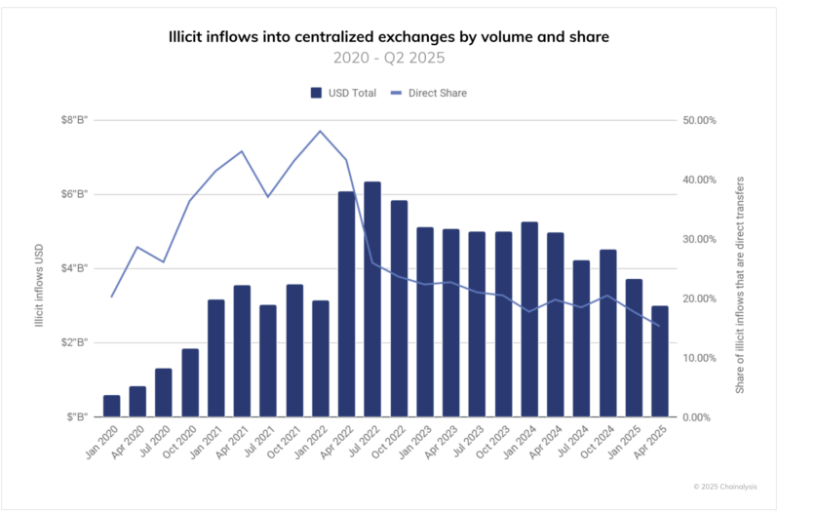
Chainalysis data shows inflows from illicit sources to centralized crypto exchanges (CEXs) have averaged $14 billion annually since 2020 but are trending downward. In the first half of 2025 alone, about $7 billion in illegal crypto funds hit exchanges, a sharp decline from 2022 levels.
Chainalysis Flags $75B in Illicit Crypto as Governments Eye Strategic Reserves image 1

Illicit Fund Flows on Centralized Exchanges | Source: Chainalysis

The report attributes this to criminals increasingly using crypto as a payment method and store of value, avoiding fiat conversion. Direct transfers to exchanges have plummeted from 40% in July 2022 to 15% in 2025, as illicit actors turn to crypto mixers and cross-chain bridges.

Stablecoins , which can be frozen by issuers, are the least concentrated, as criminals diversify holdings to avoid total losses from asset freezes.

Trump issued executive orders to establish the US Strategic Bitcoin Reserve (SBR) and Digital Asset Stockpile (DAS), creating frameworks for the government to confiscate and manage seized crypto funds.

With sovereign nations like El Salvador and Bhutan officially adopting crypto reserves in recent years, Chainalysis argues that coordinated seizures of illicit crypto could strengthen the national treasury.

The firm has already helped global authorities including Spain and  the US seize $12.6 billion in illegal funds through forensic investigations.

Chainalysis Investigates Illicit Actors

As Chainalysis investigations aid governments to clamp down on illicit actors, improved market sentiment has seen traders rotate toward early-stage projects focusing on meme-driven ecosystems with high leverage offerings.


Chainalysis Flags $75B in Illicit Crypto as Governments Eye Strategic Reserves image 2

0
0

Disclaimer: The content of this article solely reflects the author's opinion and does not represent the platform in any capacity. This article is not intended to serve as a reference for making investment decisions.

Understand the market, then trade.
Bitget offers one-stop trading for cryptocurrencies, stocks, and gold.
Trade now!

You may also like

Wall Street giants collectively raise rate hike forecasts, US Treasury futures continue to fall, gold drops over 1% to break 4000

After the US October CPI exceeded expectations, Goldman Sachs and Nomura added a forecast for an interest rate hike in March next year, while Deutsche Bank included a forecast for a rate hike in January next year. Currently, the market has fully priced in a 25 basis point rate hike in December, with a 13% probability for a 50 basis point hike. On Wednesday, the US Treasury spot market was closed, but Treasury futures continued to fall, with corresponding yields rising by about 2 to 4 basis points, and spot gold came under pressure, dropping by 1.1%.

华尔街见闻•2026/11/11 21:18
Wall Street giants collectively raise rate hike forecasts, US Treasury futures continue to fall, gold drops over 1% to break 4000

No Need to Worry About the Cooling Down of AI Data Center Construction? The US Import Boom Is Unlikely to Subside in the Short Term, Real Impact May Come in 2029

It takes an average of 4.8 years from finalizing investment to starting construction of a data center project, and an additional 2.6 years from construction start to becoming operational. Servers usually cannot be installed until after the building structure and racks are completed. For trade partners such as Taiwan (China), South Korea, and Mexico who rely on US data center supply chain demand, the inertia in construction timelines provides at least a one- to two-year buffer for future exports.

华尔街见闻•2026/11/11 21:18
No Need to Worry About the Cooling Down of AI Data Center Construction? The US Import Boom Is Unlikely to Subside in the Short Term, Real Impact May Come in 2029

Federal Reserve Major Debate: When Should the Tenure of “Number Three” Williams End?

The main point of contention is whether Williams should step down in June 2028, upon completing a full 10-year term, or in June 2027, when he reaches the mandatory retirement age of 65. Analysts point out that the Federal Reserve Board holds ultimate discretion; if he leaves early, Fed Chair Waller would be able to assert greater control over the appointment to this critical position. However, forcing Williams to shorten his term could easily be interpreted as political manipulation. Williams himself is expected to serve until June 2028.

华尔街见闻•2026/11/11 21:18
Federal Reserve Major Debate: When Should the Tenure of “Number Three” Williams End?


