
Young Crypto Voters Could Decide The 2026 Midterms In The US, New Poll Shows

A new poll shows crypto investors could shape the 2026 midterms, with younger voters and major firms aligning behind pro-crypto GOP candidates.
A poll of 800 digital asset investors found that more than half consider a political candidate’s stance on crypto important in their voting decisions.
While the investor base leaned slightly higher in Democratic registration, their voting behavior is fluid. A majority of the responders are currently planning to back Republicans on the generic congressional ballot.
Crypto Vote Tilts GOP
Politicians’ stance on crypto is gearing up to be critical to their success ahead of the upcoming US midterm elections.
A recent poll by consulting firm McLaughlin & Associates, in partnership with American advocacy group The Digital Chamber, measured the voting preferences of 800 young, demographically diverse cryptocurrency investors.
Although these voters lean slightly Democratic and identify more as liberal than conservative, a plurality are planning to vote for the Republican Party in the upcoming elections.
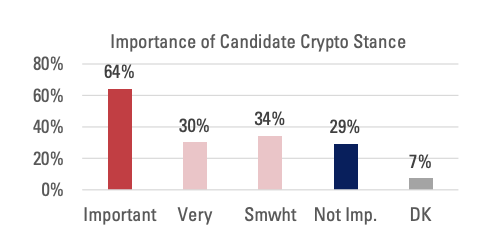 Most voters believe a candidate’s crypto stance to be important. Source:
McLaughlin & Associates.
The poll results indicated overwhelming bipartisan support for US President Donald Trump’s decision to scale back Biden-era cryptocurrency regulations and enforcement. Consistent with this, most responders said a candidate’s crypto stance significantly influences their vote.
“Crypto voters are clearly engaged, single-issue voters despite diverse profiles and political beliefs and that can swing elections,” Cody Carbone, CEO of The Digital Chamber, told BeInCrypto. “With so many issues that will require Congressional action when the government reopens, a clear economic win is to support crypto legislation that offers clarity and confidence for innovators and investors.”
The results of this poll are specific to cryptocurrency investors and should not be used to generalize the voting behaviors of the overall American public across party lines. Nonetheless, the results show how increasingly important digital assets policy is for political success.
A Growing Voter Block
According to a July Gallup poll, 14% of US adults currently own cryptocurrencies, with another 4% reporting that they will likely buy them in the near future.
An additional 17% admitted they were intrigued by the investment but are not planning to buy it anytime soon.
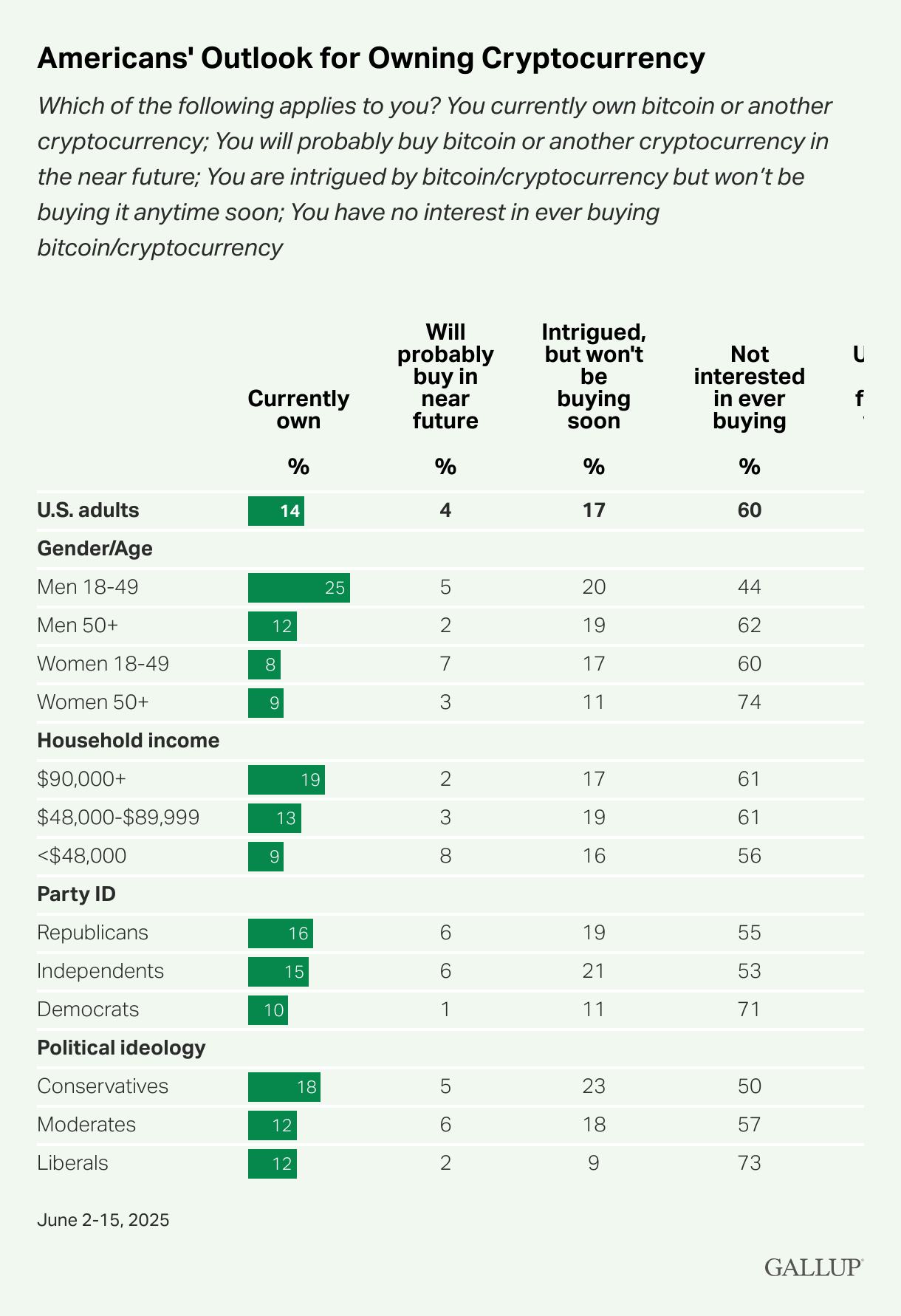 Crypto ownership among Americans. Source:
Gallup.
From one perspective, the results indicate that cryptocurrency still has limited broad appeal. However, cryptocurrency adoption is growing compared to similar polls from the past. According to Gallup, Americans’ crypto ownership has increased from single digits in 2021.
This demographic is a powerful force for candidates in the 2026 midterms, not only due to its voting tendencies but also because of the significant political lobbying that has recently favored the Republican Party.
An earlier BeInCrypto investigation revealed that crypto firms are leading the Republican push. Giants like Ripple and Coinbase have already donated more than $56 million to Trump-backed political action committees (PACs).
Campaign financing trends in the current election cycle contrast sharply with those of 2024. Before the federal elections, crypto companies and individual donors spread their contributions across the Republican and Democratic parties.
Disclaimer: The content of this article solely reflects the author's opinion and does not represent the platform in any capacity. This article is not intended to serve as a reference for making investment decisions.
You may also like

Wall Street giants collectively raise rate hike forecasts, US Treasury futures continue to fall, gold drops over 1% to break 4000
After the US October CPI exceeded expectations, Goldman Sachs and Nomura added a forecast for an interest rate hike in March next year, while Deutsche Bank included a forecast for a rate hike in January next year. Currently, the market has fully priced in a 25 basis point rate hike in December, with a 13% probability for a 50 basis point hike. On Wednesday, the US Treasury spot market was closed, but Treasury futures continued to fall, with corresponding yields rising by about 2 to 4 basis points, and spot gold came under pressure, dropping by 1.1%.

No Need to Worry About the Cooling Down of AI Data Center Construction? The US Import Boom Is Unlikely to Subside in the Short Term, Real Impact May Come in 2029
It takes an average of 4.8 years from finalizing investment to starting construction of a data center project, and an additional 2.6 years from construction start to becoming operational. Servers usually cannot be installed until after the building structure and racks are completed. For trade partners such as Taiwan (China), South Korea, and Mexico who rely on US data center supply chain demand, the inertia in construction timelines provides at least a one- to two-year buffer for future exports.

Federal Reserve Major Debate: When Should the Tenure of “Number Three” Williams End?
The main point of contention is whether Williams should step down in June 2028, upon completing a full 10-year term, or in June 2027, when he reaches the mandatory retirement age of 65. Analysts point out that the Federal Reserve Board holds ultimate discretion; if he leaves early, Fed Chair Waller would be able to assert greater control over the appointment to this critical position. However, forcing Williams to shorten his term could easily be interpreted as political manipulation. Williams himself is expected to serve until June 2028.

Crypto prices
More


