
Why did the NYSE parent company bet $2 billion on the prediction market Polymarket?

Author: 1912212.eth, Foresight News
Original Title: $2 Billion Financing, 1.3 Million Traders, Polymarket is Making History
Recently, a massive financing round has shaken the entire crypto community. Polymarket has confirmed that Intercontinental Exchange (ICE), the parent company of the New York Stock Exchange, will make a strategic investment of $2 billion, bringing its post-investment valuation to $9 billion. This is one of the largest financing amounts received by a crypto project in recent years, and its nearly $10 billion valuation has pushed the potential and popularity of prediction markets to center stage.
Intercontinental Exchange (ICE): The World’s Fourth Largest Exchange Group
Intercontinental Exchange (ICE) is a global leader in financial infrastructure and data services, and is the parent company of the New York Stock Exchange (NYSE). ICE was founded in May 2000 by Jeffrey C. Sprecher in Atlanta, USA, initially focusing on electronic trading of energy derivatives. In 2007, it acquired the New York Board of Trade (NYBOT), expanding into agricultural and metal futures.
In 2013, ICE acquired NYSE Euronext for $8.2 billion, gaining ownership of the New York Stock Exchange and expanding its business into equities and options trading, becoming the world’s first exchange group to simultaneously control both commodities and equities trading.
ICE’s global business layout is extensive, operating 14 exchanges worldwide, including ICE Futures Europe (London), ICE Futures U.S. (New York), ICE Futures Singapore (Singapore), covering energy, agricultural products, metals, and other commodity markets. Through NYSE and Liffe, it is also involved in equities and equity index futures trading. In addition, it provides clearing, data services, and mortgage services.
As of now, ICE’s market capitalization exceeds $50 billion, ranking it as the world’s fourth largest exchange group.
Polymarket Returns to the United States
According to Decrypt, prediction market Polymarket is about to reopen to U.S. users, nearly four years after it was effectively banned by the U.S. Commodity Futures Trading Commission (CFTC).

Polymarket previously acquired CFTC-licensed trading platform QCX LLC for $112 million and has begun self-certifying event contracts, including those for sports and election markets.
The crypto market has become an important part of the global financial markets. As a global leader in financial infrastructure, ICE’s investment in Polymarket marks an important move into the crypto prediction market.
ICE can leverage its experience and resources from traditional financial markets to the crypto market, promoting the deep integration of prediction markets and crypto technology, thereby opening up new business areas and revenue streams.
Over 1 Million Traders, Total Trading Volume Exceeds $18.9 Billion
Since Polymarket made headlines during last year’s U.S. presidential election, both its capital and user numbers have surged dramatically. Although the hype has since cooled, its trading volume has remained at a strong level.
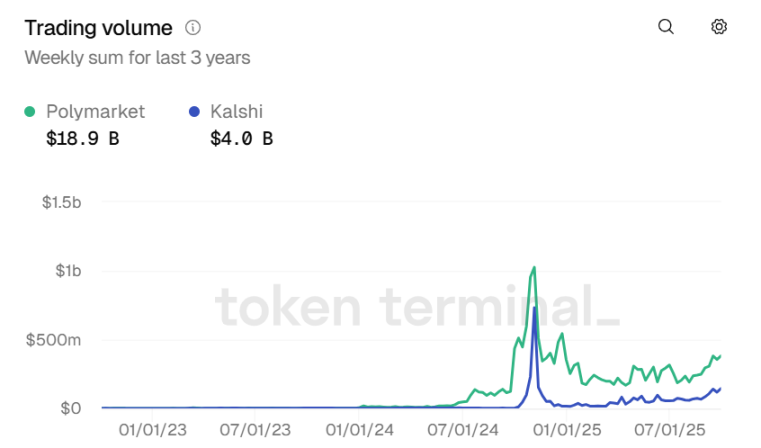
According to the latest data from tokentermina, its total trading volume has risen to $18.9 billion, far ahead of its competitor Kalshi.
Its TVL has risen to $169.2 million, and trading volume in the past 30 days has reached $1.5 billion, an increase of 42.2%.
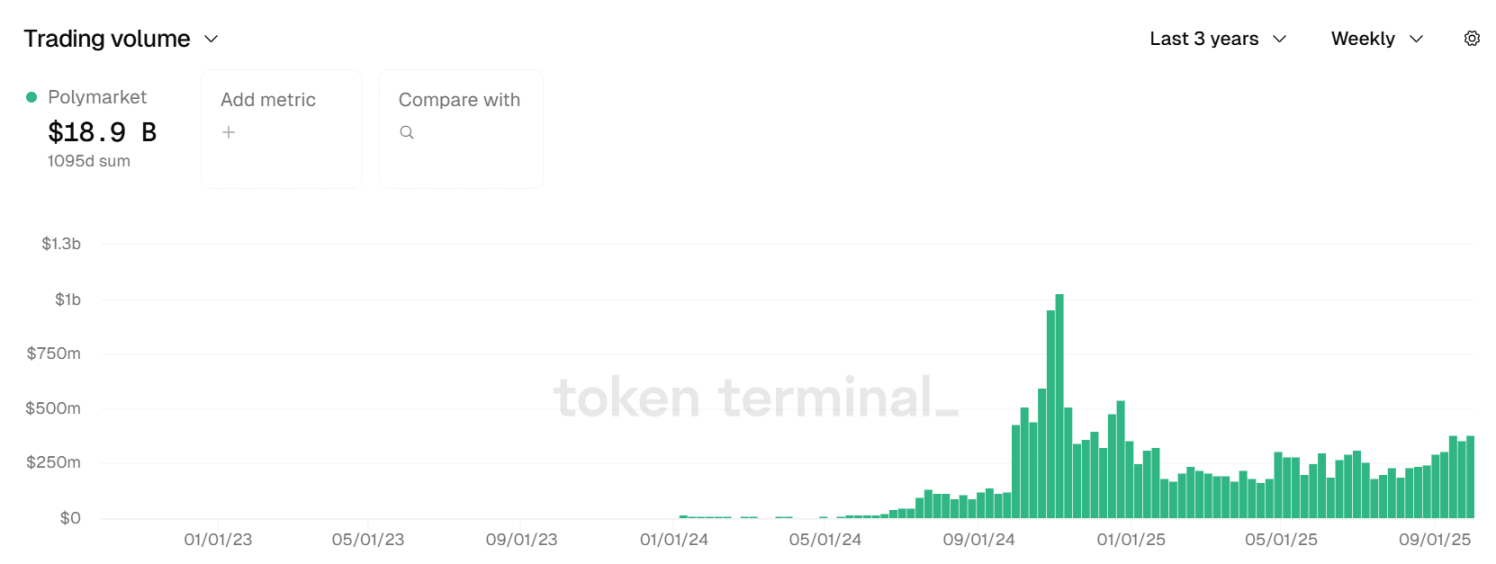
Its monthly active users have also seen a significant increase. The current number of active users has reached 263,800, up 26.8% month-on-month.
According to the latest data from Polymarketanalytics, its total number of traders is 1,349,740, and the number of prediction markets is 46,995. Although Polymarket leads significantly in total trading volume, it lags behind Kalshi in total markets and total open interest.

Token Issuance Rumors
As early as after the 2024 U.S. presidential election, Polymarket, in order to retain capital, hinted on its official website that there might be a future token airdrop.
According to the SEC EDGAR database, Polymarket’s operating entity Blockratize Inc. submitted a Form D document on August 1, 2025, which mentioned other warrants or other rights terms. Such wording is often seen as a signal for future token issuance.
Since the legal status of tokens in the U.S. remains unclear, companies usually cannot directly mention token issuance plans in SEC documents, so they use terms like “warrants” to reserve the right for investors to receive tokens in the future. This has become a common practice for crypto companies conducting traditional equity financing.
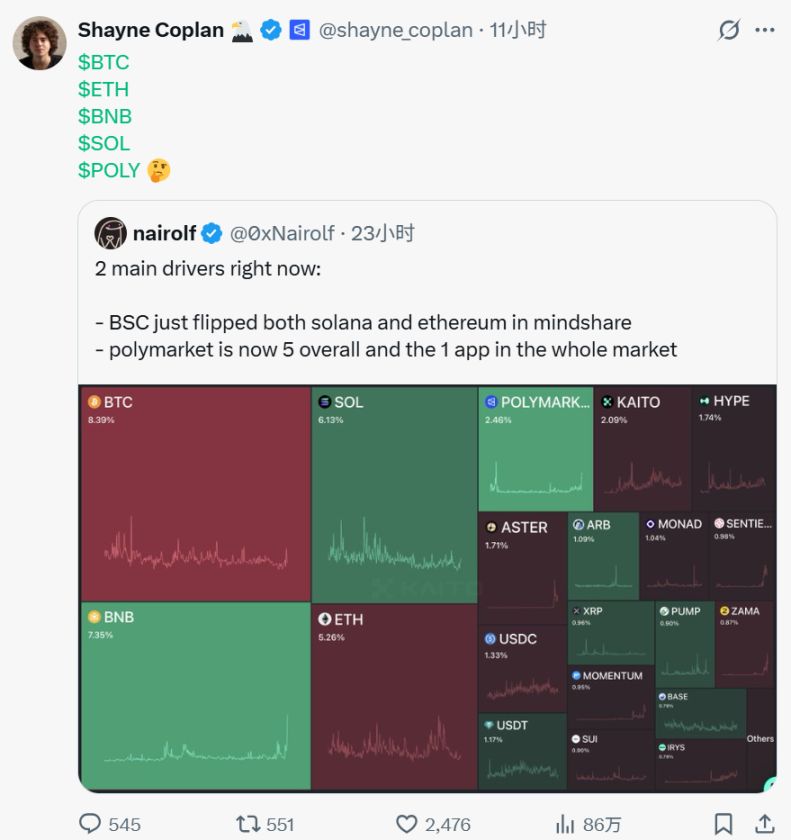
On October 8, Polymarket founder Shayne Coplan, when retweeting, listed the token symbol POLY after BTC, ETH, BNB, and SOL, hinting that Polymarket’s token name might be POLY. However, the issuance date remains unknown.
Disclaimer: The content of this article solely reflects the author's opinion and does not represent the platform in any capacity. This article is not intended to serve as a reference for making investment decisions.
You may also like

Wall Street giants collectively raise rate hike forecasts, US Treasury futures continue to fall, gold drops over 1% to break 4000
After the US October CPI exceeded expectations, Goldman Sachs and Nomura added a forecast for an interest rate hike in March next year, while Deutsche Bank included a forecast for a rate hike in January next year. Currently, the market has fully priced in a 25 basis point rate hike in December, with a 13% probability for a 50 basis point hike. On Wednesday, the US Treasury spot market was closed, but Treasury futures continued to fall, with corresponding yields rising by about 2 to 4 basis points, and spot gold came under pressure, dropping by 1.1%.

No Need to Worry About the Cooling Down of AI Data Center Construction? The US Import Boom Is Unlikely to Subside in the Short Term, Real Impact May Come in 2029
It takes an average of 4.8 years from finalizing investment to starting construction of a data center project, and an additional 2.6 years from construction start to becoming operational. Servers usually cannot be installed until after the building structure and racks are completed. For trade partners such as Taiwan (China), South Korea, and Mexico who rely on US data center supply chain demand, the inertia in construction timelines provides at least a one- to two-year buffer for future exports.

Federal Reserve Major Debate: When Should the Tenure of “Number Three” Williams End?
The main point of contention is whether Williams should step down in June 2028, upon completing a full 10-year term, or in June 2027, when he reaches the mandatory retirement age of 65. Analysts point out that the Federal Reserve Board holds ultimate discretion; if he leaves early, Fed Chair Waller would be able to assert greater control over the appointment to this critical position. However, forcing Williams to shorten his term could easily be interpreted as political manipulation. Williams himself is expected to serve until June 2028.

Crypto prices
More


