
Panic Grips ASTER After DeFiLlama Delisting: Whales and Smart Money Exit Fast

Aster’s delisting from DeFiLlama has shaken market confidence, with whales and smart money exiting positions. The altcoin now hovers near critical support, facing mounting bearish pressure unless trust and demand return.
Aster’s recent delisting from DeFiLlama has triggered a pullback in demand for its native token, ASTER.
Following the DEX’s removal and mounting doubts over its data accuracy, ASTER’s price performance has flattened, reflecting uncertainty in the market. With key investors reducing their holdings, the altcoin might soon witness a move to the downside as sentiment weakens.
ASTER Faces Confidence Crisis After DeFiLlama Delisting
On October 5, the founder of leading decentralized finance (DeFi) analytics platform DeFiLlama0xngmi announced on X that Aster’s reported volumes appeared to mirror those of Binance’s perpetuals market, raising red flags about the accuracy of its data.
This revelation has prompted DeFiLlama to remove Aster from its listings, triggering debate over whether Aster’s meteoric rise in trading volume was organic or artificially inflated.
Since the DEX delisting, its native token, ASTER, has suffered. The altcoin has traded sideways, showing a relative balance between buying and selling pressures as the controversy continues.
However, on-chain data reveals that whales have been distributing their holdings significantly, a clear sign that large investors are turning bearish. According to Nansen, whale wallets with ASTER holdings valued above $1 million have decreased their token supply by 12% since Sunday.
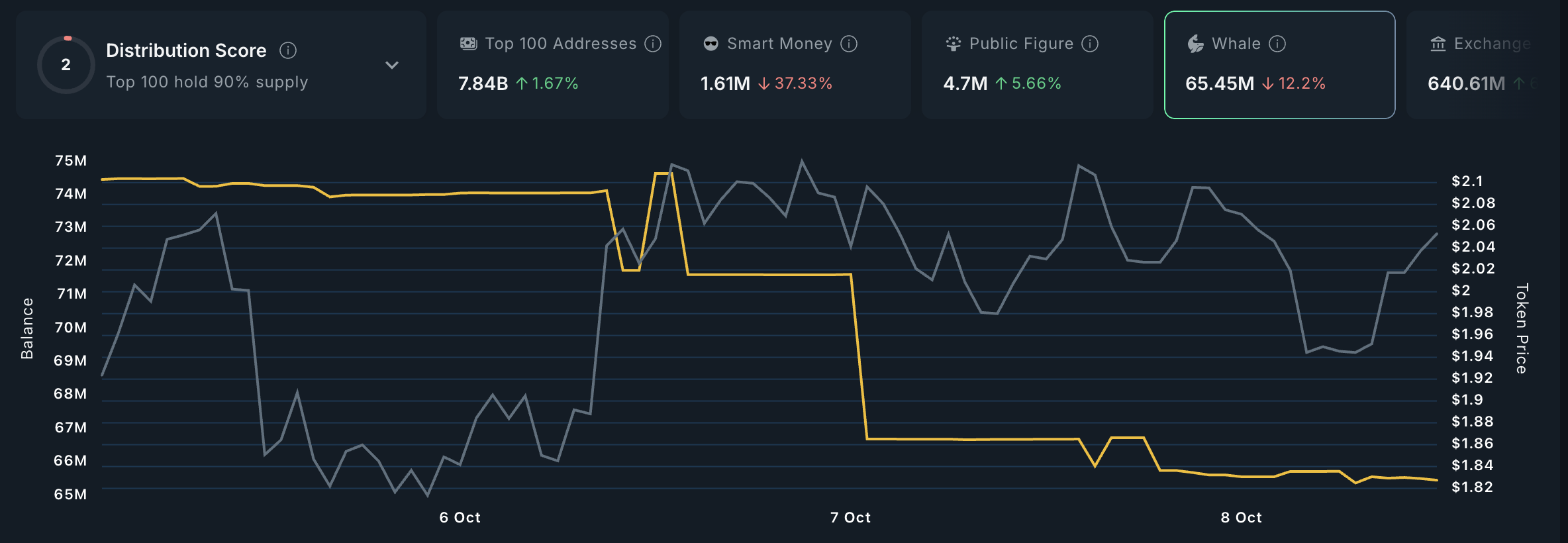 ASTER Whale Holding. Source:
Nansen
This dip in whale accumulation strengthens the bearish sentiment against ASTER and could drive a dip below its narrow range in the near term.
Further, smart money investors have also begun scaling back exposure. This signals that major holders are focused on preventing further losses rather than accumulating. Per Nansen, this cohort of ASTER holders has reduced their supply by 37% since the DEX’s delisting.
The data provider defines “smart money” as experienced investors, institutions, and high-performing traders whose on-chain activity often signals early market trends and high-conviction opportunities.
Therefore, this reduction in their ASTER holdings could further erode trader confidence, setting the stage for a potential price dip.
ASTER Price on the Brink — Can Bulls Defend $2.03
Restoring trust in its data may prove critical to stabilizing ASTER’s price and preventing a deeper market slide. The altcoin trades near the support floor at press time at $2.0303.
If the bearish pressure gains momentum, ASTER could slide downward, break this support level, and fall toward $1.7119.
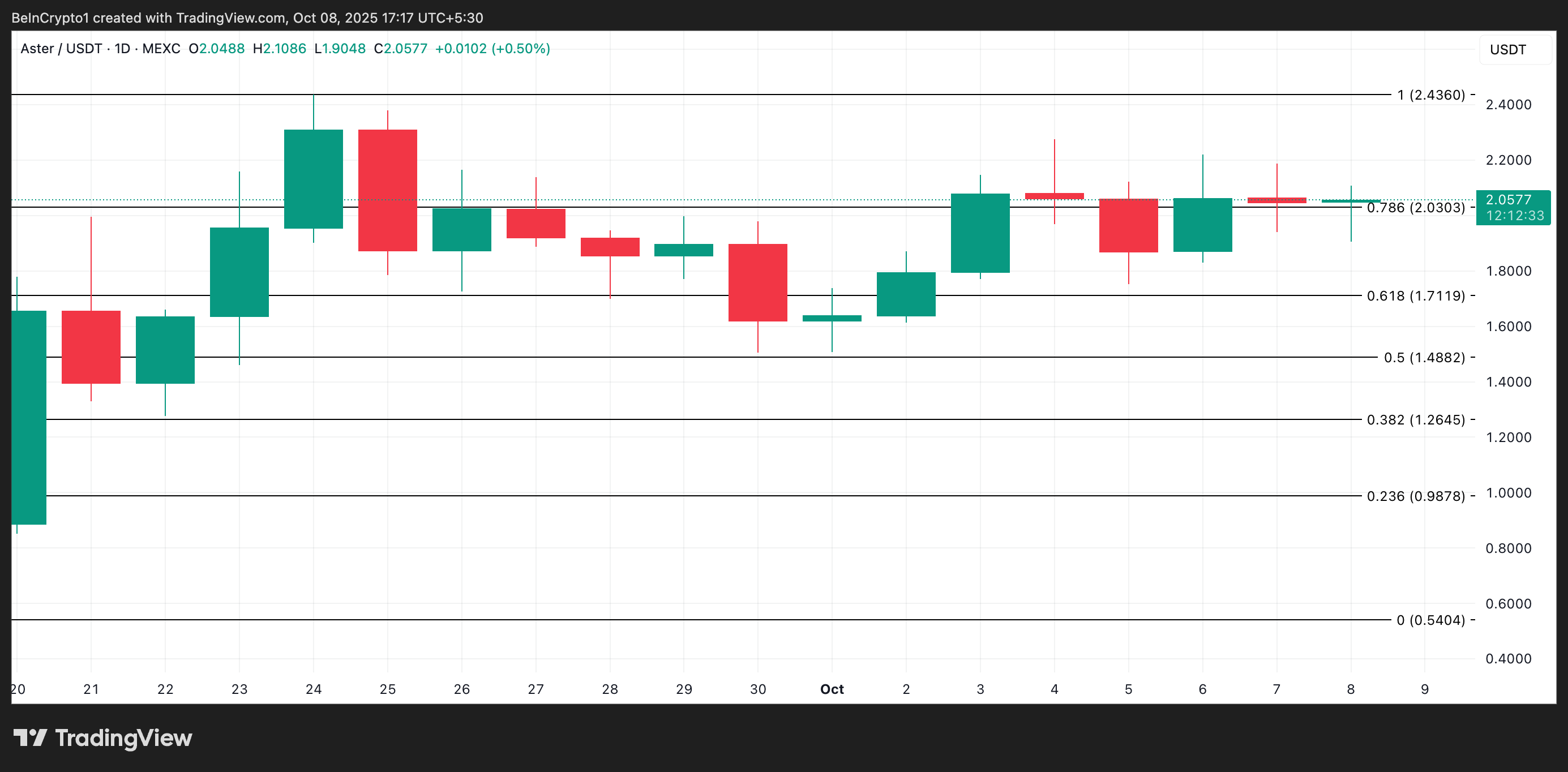 ASTER Price Analysis. Source:
TradingView
However, if demand returns to the market, ASTER could attempt to revisit its all-time high of $2.4360.
Disclaimer: The content of this article solely reflects the author's opinion and does not represent the platform in any capacity. This article is not intended to serve as a reference for making investment decisions.
You may also like

Wall Street giants collectively raise rate hike forecasts, US Treasury futures continue to fall, gold drops over 1% to break 4000
After the US October CPI exceeded expectations, Goldman Sachs and Nomura added a forecast for an interest rate hike in March next year, while Deutsche Bank included a forecast for a rate hike in January next year. Currently, the market has fully priced in a 25 basis point rate hike in December, with a 13% probability for a 50 basis point hike. On Wednesday, the US Treasury spot market was closed, but Treasury futures continued to fall, with corresponding yields rising by about 2 to 4 basis points, and spot gold came under pressure, dropping by 1.1%.

No Need to Worry About the Cooling Down of AI Data Center Construction? The US Import Boom Is Unlikely to Subside in the Short Term, Real Impact May Come in 2029
It takes an average of 4.8 years from finalizing investment to starting construction of a data center project, and an additional 2.6 years from construction start to becoming operational. Servers usually cannot be installed until after the building structure and racks are completed. For trade partners such as Taiwan (China), South Korea, and Mexico who rely on US data center supply chain demand, the inertia in construction timelines provides at least a one- to two-year buffer for future exports.

Federal Reserve Major Debate: When Should the Tenure of “Number Three” Williams End?
The main point of contention is whether Williams should step down in June 2028, upon completing a full 10-year term, or in June 2027, when he reaches the mandatory retirement age of 65. Analysts point out that the Federal Reserve Board holds ultimate discretion; if he leaves early, Fed Chair Waller would be able to assert greater control over the appointment to this critical position. However, forcing Williams to shorten his term could easily be interpreted as political manipulation. Williams himself is expected to serve until June 2028.

Crypto prices
More


