
Ethereum Slips Below $4,500 Despite Grayscale Staking 300,000 ETH

Grayscale’s announcement that its Grayscale Ethereum Trust ETF became the first US-listed spot crypto ETF allowing staking helped push ETH’s price above $4,700 in October.
However, Grayscale’s ETH staking activity has not been strong enough to keep prices above that level for long.
Grayscale Staked Over 300,000 ETH, But Selling Pressure Is Greater
On October 6, Grayscale said its Ethereum Trust ETFs (ETHE, ETH) and Solana Trust (GSOL) now allow investors to earn staking yields directly through traditional brokerage accounts.
Industry leaders expressed optimism about the news, calling it a bullish signal for ETH and the broader Ethereum ecosystem.
“It’s great news that Grayscale’s ETH ETFs are now able to stake their $ETH. This is a major milestone for the ecosystem and bullish for Ethereum overall. Having worked on BlackRock’s Bitcoin and Ethereum ETFs, I’ve seen how powerful these vehicles are for institutional access and adoption,” Joseph Chalom, co-founder of SharpLink (SBET), said.
Despite this, ETH’s price fell below $4,500, lower than when the news was announced.
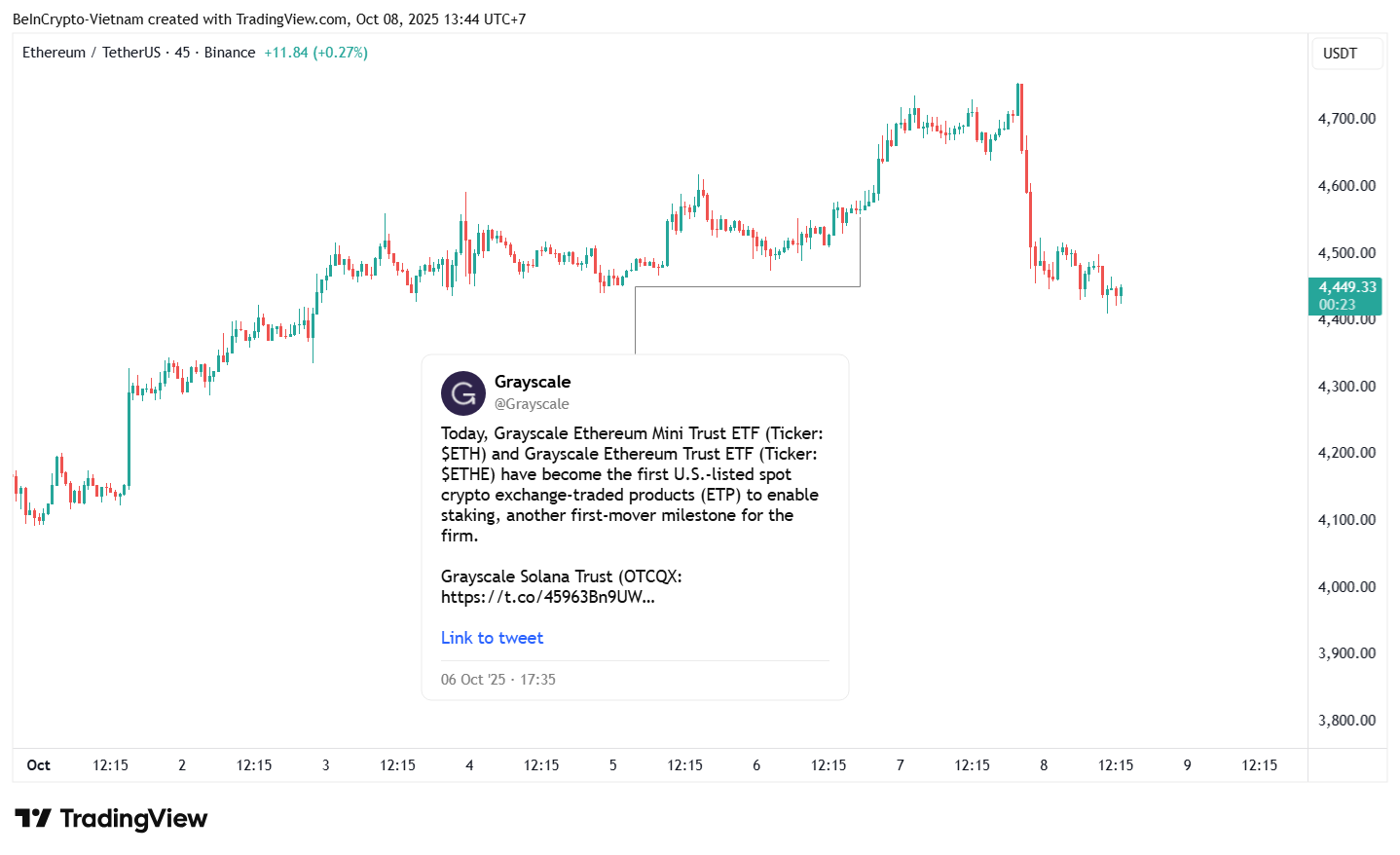
According to the on-chain analytics account EmberCN, since receiving staking approval, Grayscale has staked 304,000 ETH, worth over $1.3 billion.
This move demonstrates Grayscale’s strong commitment to supporting the Ethereum network. Reducing the circulating supply could also help stabilize ETH’s price.
However, current Ethereum network data suggests this effort may not be enough to create a strong positive impact.
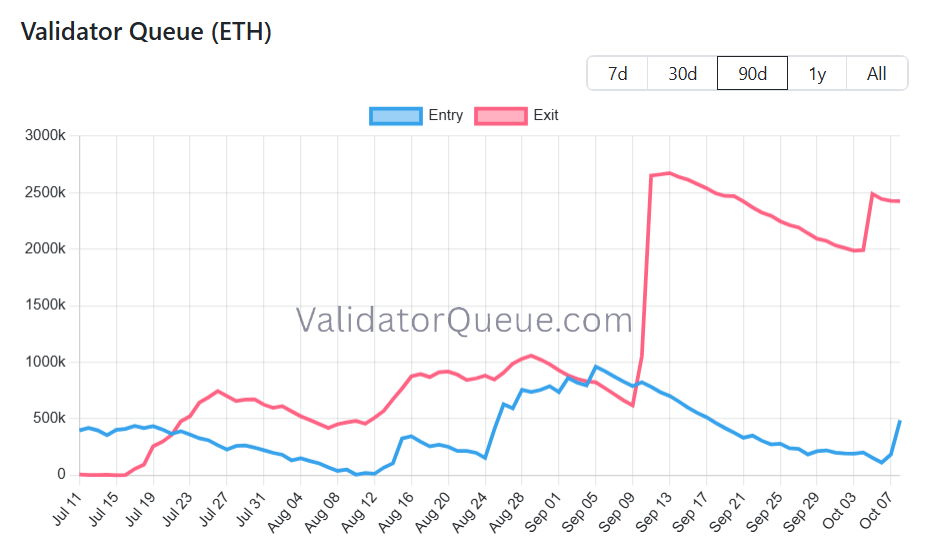
Data from ValidatorQueue shows that about 489,000 ETH are waiting to be staked, most of which belong to Grayscale. In contrast, the amount of ETH waiting to unstake is much higher and has been rising since early October, with over 2.4 million ETH queued for withdrawal.
This large imbalance signals potential selling pressure, which could increase ETH’s circulating supply and put downward pressure on prices.
Long-Dormant Ethereum Whales Awaken, Adding More Selling Pressure
Meanwhile, several long-time Ethereum whales have started to move and sell their holdings.
- According to Lookonchain, one whale wallet woke up after four years of inactivity, selling 1,800 ETH for a profit of about $8.12 million. Four years ago, the wallet had withdrawn 5,999 ETH from Kraken at just $2,523 per ETH.
- Similarly, SpotOnChain reported another dormant whale transferring 15,000 ETH (worth roughly $68.2 million) to Bitfinex after five years of inactivity.
A similar pattern is emerging among Bitcoin OG wallets, reflecting a general profit-taking sentiment among long-term and large-scale investors.
The combination of reactivated Ethereum whales and the rising unstaking queue in October could weaken the positive impact of Grayscale’s staking efforts.
While staking more ETH helps strengthen network security and generate staking rewards, the selling pressure from unstaking activity and whale movements may outweigh these benefits — making it difficult for ETH’s price to sustain its upward momentum.
The post Ethereum Slips Below $4,500 Despite Grayscale Staking 300,000 ETH appeared first on BeInCrypto.
Disclaimer: The content of this article solely reflects the author's opinion and does not represent the platform in any capacity. This article is not intended to serve as a reference for making investment decisions.
You may also like

Wall Street giants collectively raise rate hike forecasts, US Treasury futures continue to fall, gold drops over 1% to break 4000
After the US October CPI exceeded expectations, Goldman Sachs and Nomura added a forecast for an interest rate hike in March next year, while Deutsche Bank included a forecast for a rate hike in January next year. Currently, the market has fully priced in a 25 basis point rate hike in December, with a 13% probability for a 50 basis point hike. On Wednesday, the US Treasury spot market was closed, but Treasury futures continued to fall, with corresponding yields rising by about 2 to 4 basis points, and spot gold came under pressure, dropping by 1.1%.

No Need to Worry About the Cooling Down of AI Data Center Construction? The US Import Boom Is Unlikely to Subside in the Short Term, Real Impact May Come in 2029
It takes an average of 4.8 years from finalizing investment to starting construction of a data center project, and an additional 2.6 years from construction start to becoming operational. Servers usually cannot be installed until after the building structure and racks are completed. For trade partners such as Taiwan (China), South Korea, and Mexico who rely on US data center supply chain demand, the inertia in construction timelines provides at least a one- to two-year buffer for future exports.

Federal Reserve Major Debate: When Should the Tenure of “Number Three” Williams End?
The main point of contention is whether Williams should step down in June 2028, upon completing a full 10-year term, or in June 2027, when he reaches the mandatory retirement age of 65. Analysts point out that the Federal Reserve Board holds ultimate discretion; if he leaves early, Fed Chair Waller would be able to assert greater control over the appointment to this critical position. However, forcing Williams to shorten his term could easily be interpreted as political manipulation. Williams himself is expected to serve until June 2028.

Crypto prices
More


