
Crypto Spot Trading Slumps as Bitcoin ETFs Surge with Record Institutional Inflows

Spot trading activity across crypto exchanges slowed in September, hitting its weakest level in months, even as institutional demand for Bitcoin surged through exchange-traded funds. The contrasting trends highlight a shift in market behavior, with speculative trading losing momentum while long-term investment flows gain strength.

In brief
- Global crypto spot trading dropped to $1.67T in September, marking a 9.7% decline from August’s $1.85T total.
- Binance led trading with $636.5B but saw declining volumes, reflecting a broader market slowdown.
- DEX volumes dipped slightly, though PancakeSwap bucked the trend with a surge to $79.8B in trades.
- U.S. Bitcoin ETFs saw $3.53B in September inflows, led by BlackRock’s IBIT with $1.8B in new investments.
Crypto Exchange Trading Volumes Hit Three-Month Low
Global cryptocurrency exchanges experienced a slowdown in trading activity in September, with total spot volumes declining to $1.67 trillion. According to insights from The Block, this figure stands as the lowest level since June. In addition, it represents a 9.7% decline from August’s $1.85 trillion and signals a pause in momentum after two months of steady trading.
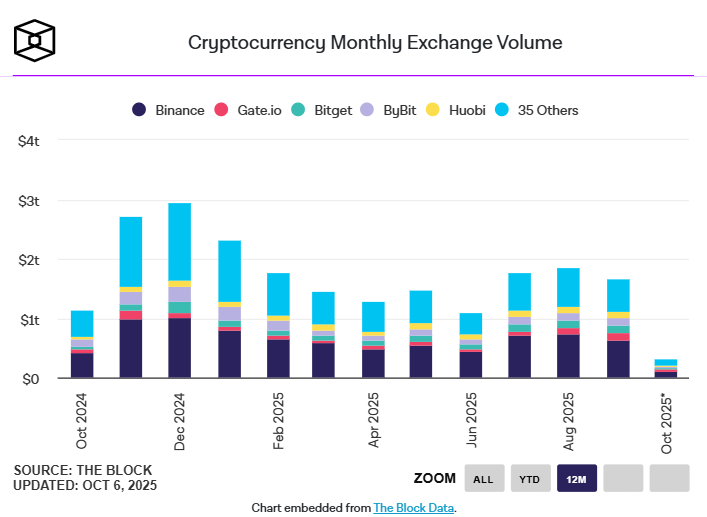
Binance remained the dominant exchange, handling $636.5 billion in trades during September, down from $737.1 billion in August. Bybit followed with $132.1 billion, while Gate.io and Bitget posted $124 billion and $117.9 billion, respectively. Despite Binance’s continued lead, its declining volume reflected a broader market cooldown affecting both centralized and decentralized platforms.
Trading on decentralized exchanges (DEXs) also dipped slightly. Total DEX volume reached $363.4 billion in September , a marginal drop from $368.8 billion the previous month. Uniswap, the largest decentralized platform, saw its volume fall sharply from $143 billion to $106.5 billion. PancakeSwap, however, bucked the trend, rising to $79.8 billion from $58.7 billion, marking one of the few platforms to see growth during the period.
U.S. Bitcoin ETFs Attract $3.24B Amid Renewed Institutional Demand
While exchange trading volumes softened, U.S. spot Bitcoin exchange-traded funds (ETFs) showed renewed investor interest. After recording net outflows of $751.1 million in August, U.S. spot Bitcoin ETFs saw net inflows of $3.53 billion in September , according to SoSoValue data. The reversal signaled growing institutional confidence in the asset class.
Notably, this strong momentum carried into October. In just the past week, spot Bitcoin ETFs attracted $3.24 billion in new capital —the second-largest weekly inflow since their launch in January 2024.
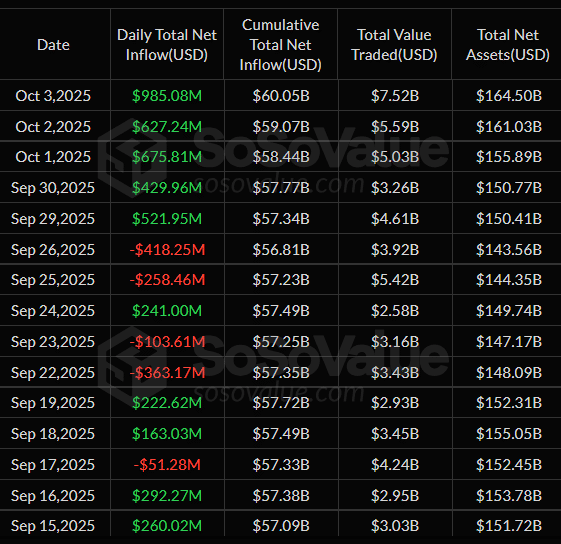
The only week with higher inflows was the one ending November 22, 2024, at $3.38 billion. The strong demand reversed the prior week’s $902 million in outflows, bringing total four-week inflows close to $4 billion.
BlackRock’s iShares Bitcoin Trust (IBIT) led the surge, capturing $1.8 billion of last week’s inflows. IBIT now manages $96.2 billion in assets, maintaining its lead over competitors. Fidelity’s Wise Origin Bitcoin Fund (FBTC) followed with $692 million in new investments, representing about 38% of IBIT’s total.
Trading activity was also concentrated in IBIT, which recorded several billion dollars in daily share transactions, compared with FBTC’s peak of $715 million. The influx of ETF investment came as Bitcoin touched a fresh all-time high of $125,000 on Sunday, surpassing its previous record of around $124,000.
The rally reinforced the Uptober narrative , with Bitcoin already up more than 10% for the month. Friday alone saw $985 million in ETF inflows, the second-highest daily total on record, underscoring growing market enthusiasm.
Disclaimer: The content of this article solely reflects the author's opinion and does not represent the platform in any capacity. This article is not intended to serve as a reference for making investment decisions.
You may also like

Wall Street giants collectively raise rate hike forecasts, US Treasury futures continue to fall, gold drops over 1% to break 4000
After the US October CPI exceeded expectations, Goldman Sachs and Nomura added a forecast for an interest rate hike in March next year, while Deutsche Bank included a forecast for a rate hike in January next year. Currently, the market has fully priced in a 25 basis point rate hike in December, with a 13% probability for a 50 basis point hike. On Wednesday, the US Treasury spot market was closed, but Treasury futures continued to fall, with corresponding yields rising by about 2 to 4 basis points, and spot gold came under pressure, dropping by 1.1%.

No Need to Worry About the Cooling Down of AI Data Center Construction? The US Import Boom Is Unlikely to Subside in the Short Term, Real Impact May Come in 2029
It takes an average of 4.8 years from finalizing investment to starting construction of a data center project, and an additional 2.6 years from construction start to becoming operational. Servers usually cannot be installed until after the building structure and racks are completed. For trade partners such as Taiwan (China), South Korea, and Mexico who rely on US data center supply chain demand, the inertia in construction timelines provides at least a one- to two-year buffer for future exports.

Federal Reserve Major Debate: When Should the Tenure of “Number Three” Williams End?
The main point of contention is whether Williams should step down in June 2028, upon completing a full 10-year term, or in June 2027, when he reaches the mandatory retirement age of 65. Analysts point out that the Federal Reserve Board holds ultimate discretion; if he leaves early, Fed Chair Waller would be able to assert greater control over the appointment to this critical position. However, forcing Williams to shorten his term could easily be interpreted as political manipulation. Williams himself is expected to serve until June 2028.

Crypto prices
More


