
Why Dogecoin’s Rally May Falter Amid Bearish Divergence and Dropping Whale Demand

Dogecoin’s recent gains may not hold for long. Despite a steady climb, weakening inflows and falling whale demand point to a potential correction unless new buyers step in.
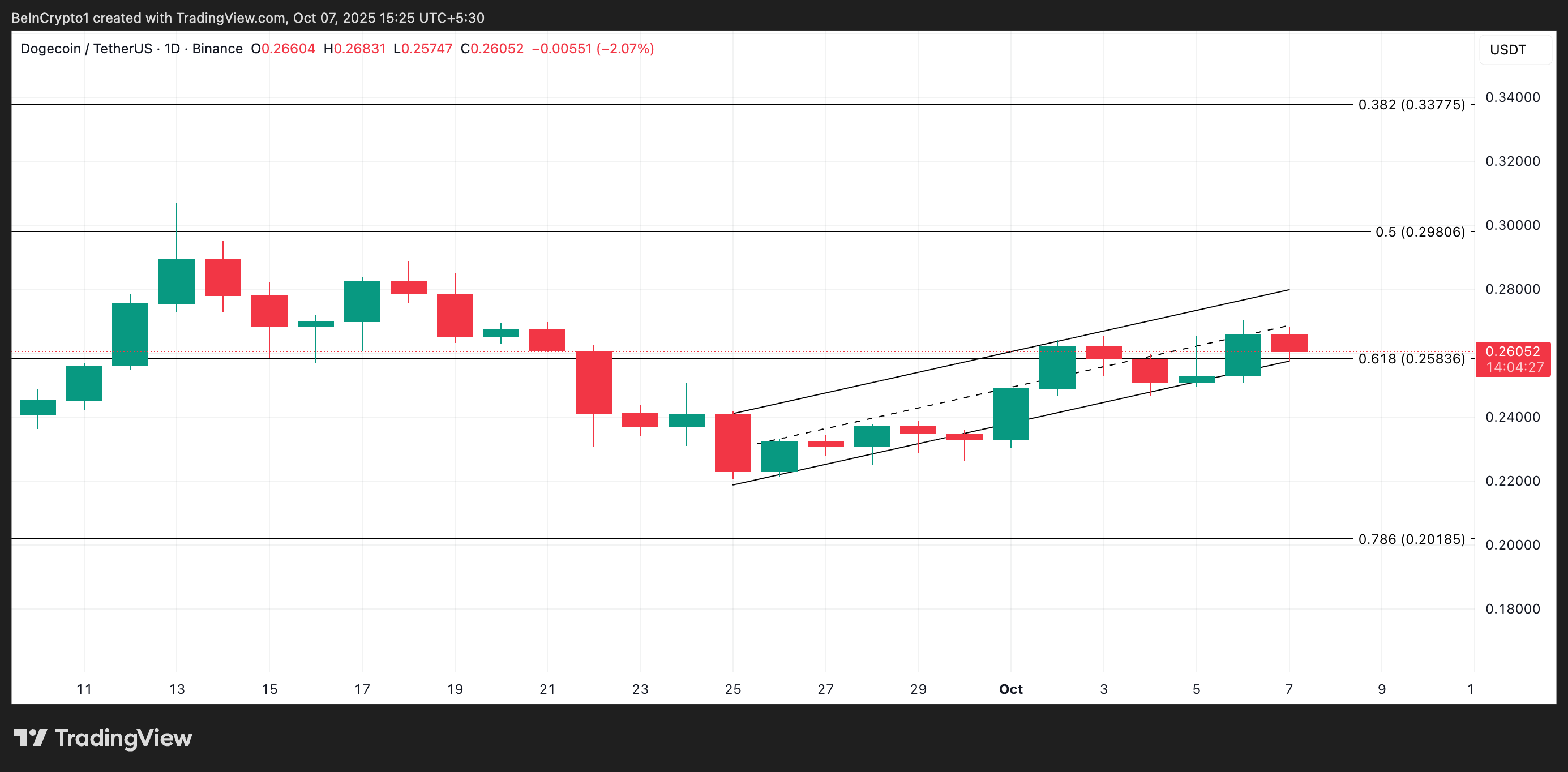
Leading meme asset Dogecoin (DOGE) has seen a steady price rise over the past two weeks, trading within an ascending parallel channel on the daily chart. Currently priced at $0.2605, the coin’s value has climbed 17% in the past 14 days, extending optimism across the meme coin market.
However, there’s a catch. A key momentum indicator has formed a bearish divergence, signaling that DOGE’s rally may lack organic support and could be due for a correction. Meanwhile, large holders, known as whales, appear to be slowing down their accumulation, further dampening the bullish outlook.
DOGE Price Strength Faces Test
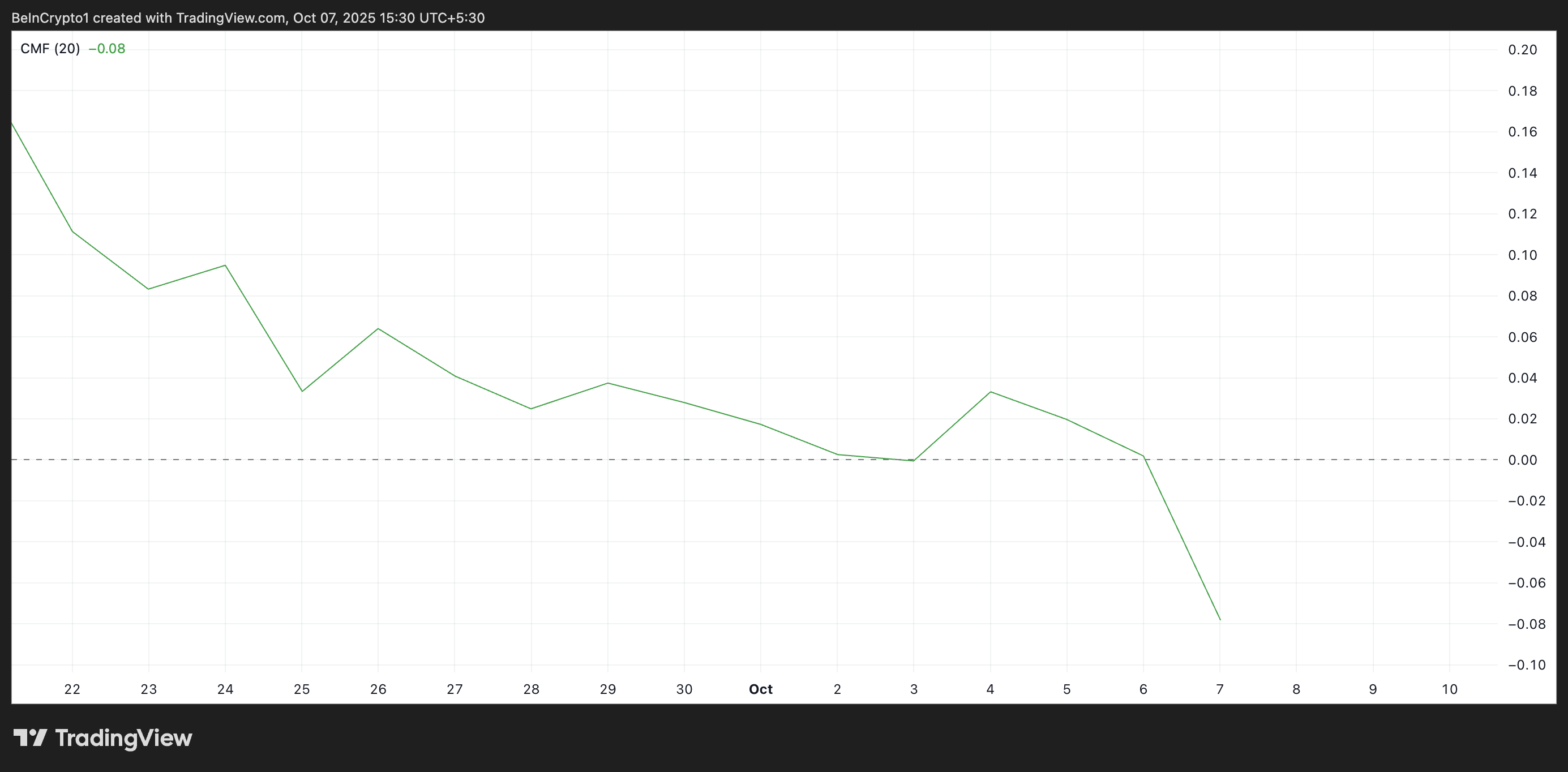
While DOGE has posted double-digit gains in the past two weeks, its Chaikin Money Flow (CMF), a key indicator that tracks capital inflows and outflows, has declined, forming a bearish divergence. This momentum indicator is below the zero line at -0.08 at press time.
For token TA and market updates: Want more token insights like this? Sign up for Editor Harsh Notariya’s Daily Crypto Newsletter here.
 DOGE CMF. Source:
TradingView
A bearish divergence occurs when an asset’s price continues to climb while its CMF indicator trends downward. This means that less capital flows into the asset despite the price growth.
Such divergences typically precede pullbacks, suggesting that DOGE’s short-term momentum could weaken if buying activity does not recover.
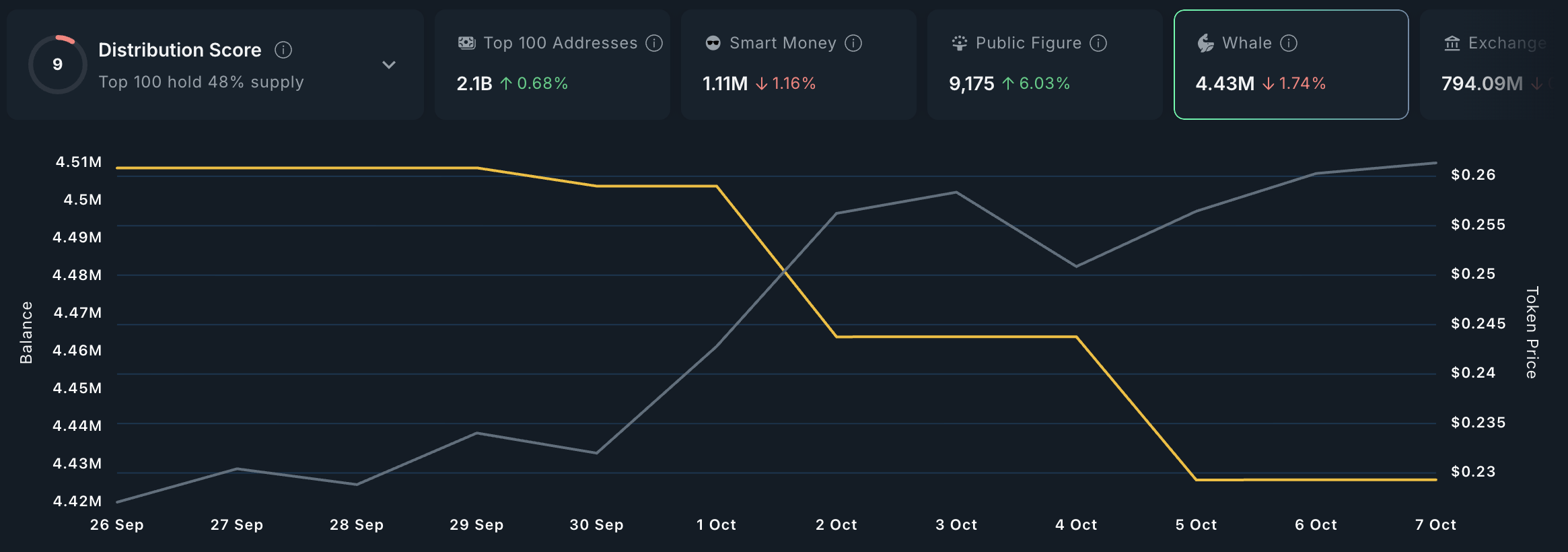
In addition, on-chain data has revealed a drop in whale activity. According to Nansen data, large investors holding DOGE coins worth more than $1 million have reduced their supply by 1% in the past two weeks. At press time, this cohort of DOGE investors holds 4.43 million DOGE.
 Dogecoin Whale Activity. Source:
Nansen
Whales play a crucial role in sustaining market momentum. When their demand declines during a rally, it often reflects a lack of conviction behind the price move. This could be a red flag for traders banking on continued upside.
Can New Demand Save the Meme Coin?
If buying pressure continues to wane, DOGE could face a short-term correction toward the lower boundary of its ascending parallel channel, potentially testing $0.2574 as near-term support. If this price floor gives way, the meme coin’s price could experience a deeper decline toward $0.2018.
 Dogecoin Price Analysis. Source:
TradingView
On the other hand, if new demand enters the market, the coin could break above the upper line of its current channel, which forms resistance at $0.2797. If successful, DOGE price could reach for $0.2980.
Disclaimer: The content of this article solely reflects the author's opinion and does not represent the platform in any capacity. This article is not intended to serve as a reference for making investment decisions.
You may also like
Bitcoin’s MA200 at $73,200 — Inverse H&S Neckline Is the Only Level Left

Bitcoin Supply Velocity Hits 10-Year Low as ETH Supply Diverges

Just bet on AI and already faced a market blow! Berkshire reports earnings tonight, Abel faces a major test in his transformation
Greg Abel has been leading Berkshire Hathaway for less than a year, yet he has already made a bet of over $10.9 billion on the AI sector, marking a complete break from Buffett’s traditional avoidance of tech stocks. However, Alphabet’s stock price has fallen below their initial purchase cost, and Bending Spoons continues to decline, putting this bold AI gamble to the test. At the same time, third-quarter earnings per share are expected to drop 6% year-over-year, and the share repurchase program is likely to plummet from $4.5 billion to $1.6 billion. How to deploy $358 billion in cash will be a major challenge for the new leader’s capital allocation skills.

Has the AI bubble burst? Goldman Sachs: It's more like 1998 than 2000 right now
The Goldman Sachs trading desk stated that the current wave of sell-offs resembles the 1998 liquidity crisis more than the bursting of the 2000 bubble. It is a forced deleveraging rather than a refutation of business fundamentals. The market is drastically repricing construction financing and timeline expectations, rather than underlying demand. Moreover, the issues currently drawing the most attention from the market—electricity and licensing—are actually the least important, as limited supply does not equate to disappearing demand. The real question that needs to be answered is whether long-term revenues can ultimately justify the capital invested.

Crypto prices
More


