
Standard Chartered Predicts $1 Trillion Stablecoin Expansion by 2028

- $1 trillion could migrate from banks to stablecoins
- Emerging markets lead growth in digital savings
- Dollar-pegged stablecoins attract businesses and families
Standard Chartered projects that up to $1 trillion could flow from emerging market bank deposits into stablecoins by the end of 2028. According to the bank, the combination of local instability, the search for liquidity, and the appeal of digital currencies pegged to the US dollar will drive a new wave of adoption in countries outside the developed world.
Stablecoins—dollar-pegged tokens backed by cash and U.S. Treasury bonds—are emerging as accessible, low-cost alternatives for families and businesses seeking protection against currency devaluation. According to Geoffrey Kendrick, global head of digital asset research at Standard Chartered, and global economist Madhur Jha, these tokens already function, in practice, as "U.S. dollar-based bank accounts" in many emerging markets.
According to the study, the global market value of stablecoins is expected to reach $2 trillion by 2028, with two-thirds of that amount functioning as digital savings accounts in emerging markets. The bank estimates that these "savings accounts" could jump from the current $173 billion to $1,22 trillion, redirecting capital previously held in local banks.
Even with the US GENIUS Act, which prohibits regulated stablecoin issuers from paying direct yields, analysts believe demand will continue to grow.
“Return on capital matters more than return on capital,”
Kendrick and Jha highlighted, emphasizing investors' preference for the security of the tokenized dollar.
The research identifies Egypt, Pakistan, Colombia, Bangladesh, and Sri Lanka as the countries most vulnerable to bank deposit outflows, followed by Turkey, India, China, Brazil, South Africa, and Kenya. The report suggests that the impact may vary depending on factors such as inflation, monetary stability, and access to digital payment infrastructure.
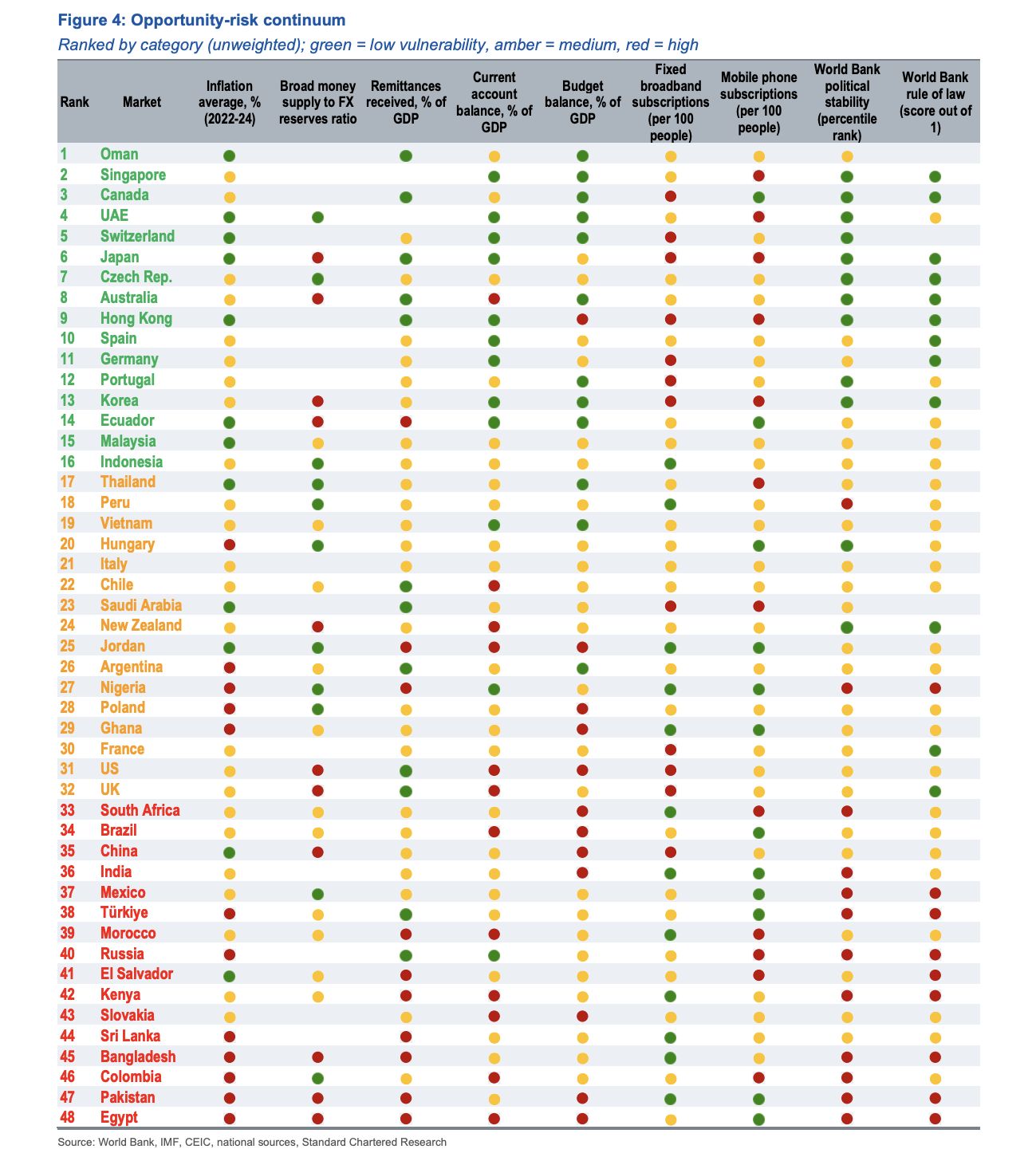 Image: Standard Chartered
The bank also warns that the growth of stablecoins could put pressure on traditional banking revenues, especially in international payments and foreign exchange. However, financial institutions could mitigate the impact by acting as reserve custodians for issuers or incorporating stablecoins into their treasury and settlement operations.
The study was published amid the global expansion of the sector, whose capitalization has surpassed US$300 billion, driven by USDT and USDC, and reinforces the prediction that stablecoins are becoming a structural part of the global digital economy.
Disclaimer: The content of this article solely reflects the author's opinion and does not represent the platform in any capacity. This article is not intended to serve as a reference for making investment decisions.
You may also like

Wall Street giants collectively raise rate hike forecasts, US Treasury futures continue to fall, gold drops over 1% to break 4000
After the US October CPI exceeded expectations, Goldman Sachs and Nomura added a forecast for an interest rate hike in March next year, while Deutsche Bank included a forecast for a rate hike in January next year. Currently, the market has fully priced in a 25 basis point rate hike in December, with a 13% probability for a 50 basis point hike. On Wednesday, the US Treasury spot market was closed, but Treasury futures continued to fall, with corresponding yields rising by about 2 to 4 basis points, and spot gold came under pressure, dropping by 1.1%.

No Need to Worry About the Cooling Down of AI Data Center Construction? The US Import Boom Is Unlikely to Subside in the Short Term, Real Impact May Come in 2029
It takes an average of 4.8 years from finalizing investment to starting construction of a data center project, and an additional 2.6 years from construction start to becoming operational. Servers usually cannot be installed until after the building structure and racks are completed. For trade partners such as Taiwan (China), South Korea, and Mexico who rely on US data center supply chain demand, the inertia in construction timelines provides at least a one- to two-year buffer for future exports.

Federal Reserve Major Debate: When Should the Tenure of “Number Three” Williams End?
The main point of contention is whether Williams should step down in June 2028, upon completing a full 10-year term, or in June 2027, when he reaches the mandatory retirement age of 65. Analysts point out that the Federal Reserve Board holds ultimate discretion; if he leaves early, Fed Chair Waller would be able to assert greater control over the appointment to this critical position. However, forcing Williams to shorten his term could easily be interpreted as political manipulation. Williams himself is expected to serve until June 2028.

Crypto prices
More


