
US Government Shutdown Drives Record $6 Billion Crypto Inflows

Institutional investors poured nearly $6 billion into crypto last week as Fed rate cuts and US political turmoil drove record inflows led by Bitcoin, Ethereum, and Solana.
After last week’s macro-driven outflows, investors returned in force amid Fed easing and political uncertainty, pushing crypto inflows toward the $6 billion mark.
The US government shutdown, among other macro concerns, drew investor interest back to risk-on assets amid fiat uncertainty.
Crypto Inflows Reached $5.9 Billion Last Week
According to the latest CoinShares report, digital asset investment products saw a dramatic turnaround last week, recording record inflows of $5.95 billion.
The surge follows a sharp $812 million outflow the previous week, reflecting how swiftly sentiment has shifted.
According to James Butterfill, head of research at CoinShares, it came as investors responded to weak US employment data, a recent Fed rate cut, and mounting concerns over US government stability after the shutdown.
The rebound marks the largest weekly inflow on record for digital assets, pushing total assets under management (AuM) to an all-time high of $254 billion.
Butterfill described the movement as a delayed response to the FOMC’s dovish pivot, amplified by softer economic indicators and a loss of confidence in US fiscal governance.
“Investors appear to be rotating back into digital assets as a hedge against policy uncertainty,” the report noted.
Bitcoin and Ethereum Lead the Charge As Sentiment Shifts From Panic to Positioning
Just one week earlier, digital asset products experienced their sharpest pullback in months, $812 million in outflows, led by $719 million from Bitcoin and $409 million from Ethereum, after stronger-than-expected macro data temporarily revived fears of a more hawkish Federal Reserve.
At the time, US-based investors drove over $1 billion in withdrawals, signaling widespread caution. That caution has now flipped decisively to optimism. The US led last week’s inflows with a record $5.0 billion, while Switzerland ($563 million) and Germany ($312 million) also posted historic highs.
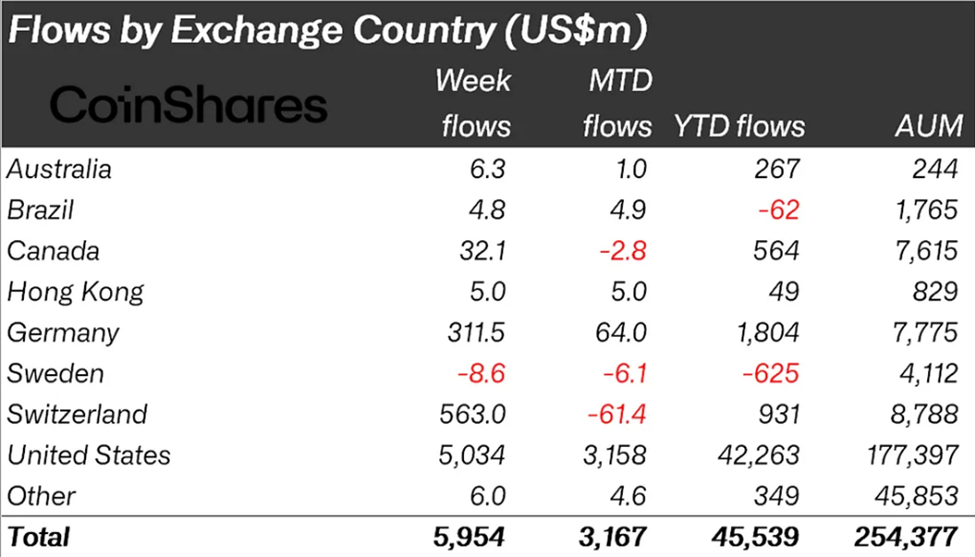 Crypto Inflows by Asset Metrics. Source:
CoinShares Report
The CoinShares executive attributes the rebound to fading inflation fears, dovish rate expectations, and a political risk premium tied to the government shutdown. Together, these have reignited demand for alternative, non-sovereign assets like Bitcoin.
Bitcoin attracted $3.55 billion in inflows, its largest on record, as prices approached all-time highs. Despite these gains, investors notably avoided short-Bitcoin products, suggesting strong conviction that the rally could extend.
Ethereum also enjoyed a stellar week, pulling in $1.48 billion, bringing its year-to-date (YTD) inflows to $13.7 billion, nearly triple its 2024 total.
Solana continued to assert its position as a key institutional favorite, drawing $706.5 million, another all-time weekly record that brought its YTD total to $2.58 billion.
XRP followed with $219.4 million, reflecting renewed appetite for select large-cap altcoins even as smaller tokens saw little interest.
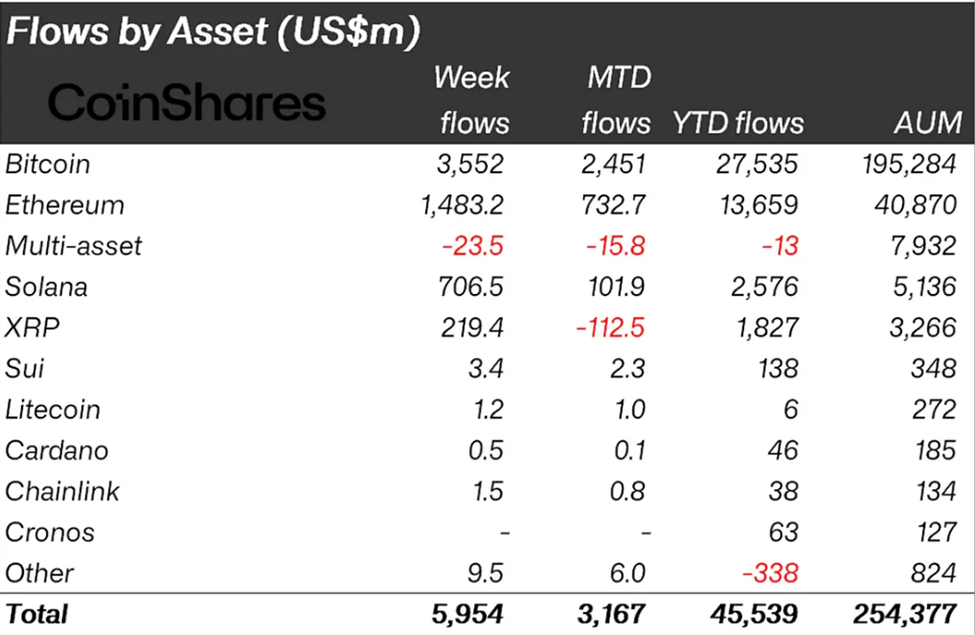 Crypto Inflows by Asset Metrics. Source: CoinShares Report
The swing from a billion-dollar outflow to a near $6 billion inflow in the space of two weeks highlights the crypto market’s heightened sensitivity to macroeconomic and political cues.
With the US government shutdown casting doubts over fiscal management and the Fed signaling a more accommodative stance, digital assets appear to be reasserting their role as risk-on bets and macro hedges.
CoinShares suggests institutional capital could remain sticky if the current momentum persists, especially as investors seek yield and diversification amid volatile traditional markets.
Disclaimer: The content of this article solely reflects the author's opinion and does not represent the platform in any capacity. This article is not intended to serve as a reference for making investment decisions.
You may also like
Wall Street giants collectively raise rate hike forecasts, US Treasury futures continue to fall, gold drops over 1% to break 4000
After the US October CPI exceeded expectations, Goldman Sachs and Nomura added a forecast for an interest rate hike in March next year, while Deutsche Bank included a forecast for a rate hike in January next year. Currently, the market has fully priced in a 25 basis point rate hike in December, with a 13% probability for a 50 basis point hike. On Wednesday, the US Treasury spot market was closed, but Treasury futures continued to fall, with corresponding yields rising by about 2 to 4 basis points, and spot gold came under pressure, dropping by 1.1%.

No Need to Worry About the Cooling Down of AI Data Center Construction? The US Import Boom Is Unlikely to Subside in the Short Term, Real Impact May Come in 2029
It takes an average of 4.8 years from finalizing investment to starting construction of a data center project, and an additional 2.6 years from construction start to becoming operational. Servers usually cannot be installed until after the building structure and racks are completed. For trade partners such as Taiwan (China), South Korea, and Mexico who rely on US data center supply chain demand, the inertia in construction timelines provides at least a one- to two-year buffer for future exports.

Federal Reserve Major Debate: When Should the Tenure of “Number Three” Williams End?
The main point of contention is whether Williams should step down in June 2028, upon completing a full 10-year term, or in June 2027, when he reaches the mandatory retirement age of 65. Analysts point out that the Federal Reserve Board holds ultimate discretion; if he leaves early, Fed Chair Waller would be able to assert greater control over the appointment to this critical position. However, forcing Williams to shorten his term could easily be interpreted as political manipulation. Williams himself is expected to serve until June 2028.

Sunshine Silver weighs doubling mill capacity
Crypto prices
More


