
GENIUS Act could mark the end of the banking rip-off: Multicoin exec

The stablecoin-focused GENIUS Act, which was enacted in July, will trigger an exodus of deposits from traditional bank accounts into higher-yield stablecoins, according to the co-founder of Multicoin Capital.
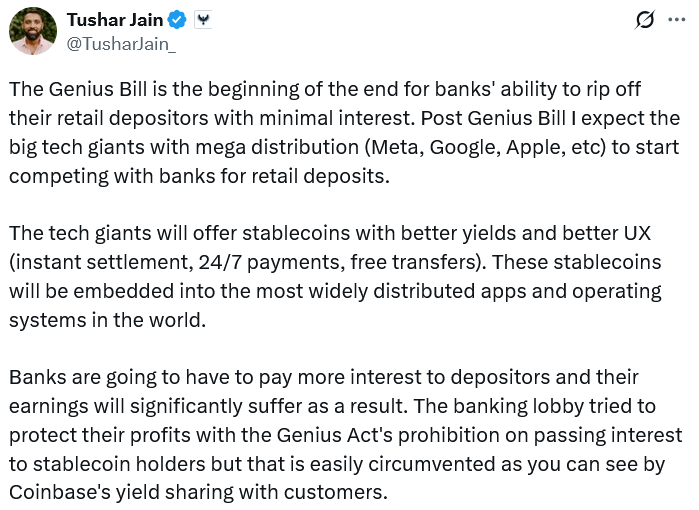
“The GENIUS Bill is the beginning of the end for banks’ ability to rip off their retail depositors with minimal interest,” Multicoin Capital’s co-founder and managing partner, Tushar Jain, posted to X on Saturday.
“Post Genius Bill, I expect the big tech giants with mega distribution (Meta, Google, Apple, etc) to start competing with banks for retail deposits,” Jain added, arguing that they would offer better stablecoin yields with a better user experience for instant settlement and 24/7 payments over traditional banking players.
He noted that banking groups tried to “protect their profits” in mid-August by calling on regulators to close a so-called loophole that may allow stablecoin issuers to pay interest or yields on stablecoins through their affiliates.
The GENIUS Act prohibits stablecoin issuers from offering interest or yield to holders of the token but doesn’t explicitly extend the ban to crypto exchanges or affiliated businesses, potentially enabling issuers to sidestep the law by offering yields through those partners.
US banking groups are concerned that the wide adoption of yield-bearing stablecoins could undermine the traditional banking system, which relies on banks attracting deposits to fund lending.
$6.6 trillion could leave the banking system
Mass stablecoin adoption could trigger around $6.6 trillion in deposit outflows from the traditional banking system, the US Department of the Treasury estimated in April.
“The result will be greater deposit flight risk, especially in times of stress, that will undermine credit creation throughout the economy. The corresponding reduction in credit supply means higher interest rates, fewer loans, and increased costs for Main Street businesses and households,” the Bank Policy Institute said in August.
To stay competitive, “banks are going to have to pay more interest to depositors,” Jain said, adding that “their earnings will significantly suffer as a result.”
Stablecoins offer users up to 10X more interest
The average interest rate for US savings accounts is 0.40%, and in Europe, the average rate on savings accounts is 0.25%, Patrick Collison, CEO of online payments platform Stripe, said last week.
Meanwhile, rates for Tether (USDT) and Circle’s USDC (USDC) on the borrowing and lending platform Aave currently stand at 4.02% and 3.69%, respectively.
Big Tech companies are reportedly exploring stablecoins
Jain’s bet on the Big Tech giants follows a Fortune report in June stating that Apple, Google, Airbnb, and X were among the top companies exploring issuing stablecoins to lower fees and improve cross-border payments. There haven’t been any further developments since.
Related: All currencies will be stablecoins by 2030: Tether co-founder
The stablecoin market currently sits at $308.3 billion, led by USDT and USDC at $177 billion and $75.2 billion, CoinGecko data shows.
The Treasury Department predicts the stablecoin market cap will boom another 566% to reach $2 trillion by 2028.
Magazine: Crypto wanted to overthrow banks, now it’s becoming them in stablecoin fight
Disclaimer: The content of this article solely reflects the author's opinion and does not represent the platform in any capacity. This article is not intended to serve as a reference for making investment decisions.
You may also like

Wall Street giants collectively raise rate hike forecasts, US Treasury futures continue to fall, gold drops over 1% to break 4000
After the US October CPI exceeded expectations, Goldman Sachs and Nomura added a forecast for an interest rate hike in March next year, while Deutsche Bank included a forecast for a rate hike in January next year. Currently, the market has fully priced in a 25 basis point rate hike in December, with a 13% probability for a 50 basis point hike. On Wednesday, the US Treasury spot market was closed, but Treasury futures continued to fall, with corresponding yields rising by about 2 to 4 basis points, and spot gold came under pressure, dropping by 1.1%.

No Need to Worry About the Cooling Down of AI Data Center Construction? The US Import Boom Is Unlikely to Subside in the Short Term, Real Impact May Come in 2029
It takes an average of 4.8 years from finalizing investment to starting construction of a data center project, and an additional 2.6 years from construction start to becoming operational. Servers usually cannot be installed until after the building structure and racks are completed. For trade partners such as Taiwan (China), South Korea, and Mexico who rely on US data center supply chain demand, the inertia in construction timelines provides at least a one- to two-year buffer for future exports.

Federal Reserve Major Debate: When Should the Tenure of “Number Three” Williams End?
The main point of contention is whether Williams should step down in June 2028, upon completing a full 10-year term, or in June 2027, when he reaches the mandatory retirement age of 65. Analysts point out that the Federal Reserve Board holds ultimate discretion; if he leaves early, Fed Chair Waller would be able to assert greater control over the appointment to this critical position. However, forcing Williams to shorten his term could easily be interpreted as political manipulation. Williams himself is expected to serve until June 2028.

Crypto prices
More


