
Bitcoin price to soar as Crypto Fear and Greed Index nears key zone

Bitcoin jumped to a record high, boosted by safe-haven bets, increased exchange-traded funds inflow, and the rising Fear and Greed Index.
- Bitcoin’s latest surge underscores a renewed wave of investor optimism driven by improving market sentiment, expectations of Federal Reserve rate cuts, and mounting inflows into spot ETFs.
- The convergence of macroeconomic tailwinds, seasonal strength, and risk appetite has positioned BTC for another potential leg higher — signaling that the world’s largest cryptocurrency may be entering a new phase of institutional-led momentum.
Bitcoin price rises as Crypto Fear and Greed Index jumps
Bitcoin (BTC) price continued its strong rally as investors embraced a risk-on sentiment. This sentiment is seen in the rising Crypto Fear and Greed Index, which has moved from the fear zone of 39 in September and is approaching the greed zone of 60.
Bitcoin and other cryptocurrencies normally jumps whenever the index is in an uptrend. The gains accelerate whenever it moves to the extreme greed zone.
BTC price is also jumping as investors have embraced it as a safe-haven asset like gold. One evidence for this is that inflows into spot BTC ETFshave continued rising as the government shutdown happened.
SoSoValue data shows that these ETFs added over $3.2 billion in assets, bringing its total inflows to over $60 billion. BlackRock’s IBIT has over $96 billion in assets and is now in the top 20 of the biggest ETFs globally.
Bitcoin price has also jumped to a record high as investors predict that the Federal Reserve will cut interest rates this month. It has already slashed rates by 0.25%, bringing the benchmark rate to between 4.0% and 4.25%.
The possibility of more rate cuts rose after ADP and the Bureau of Labor Statistics published weak jobs numbers. A report by the BLS showed that the number of jobless Americans is higher than the number of vacancies.
Another report by ADP showed that the economy lost 36,000 jobs in September after shedding over 3,000 a month earlier. These numbers meant that the labor market is getting worse, which will put pressure on the Fed to act.
Seasonality has also played a role in the ongoing Bitcoin price rally. Historically, Bitcoin does well in October and the fourth quarter.
BTC price technical analysis
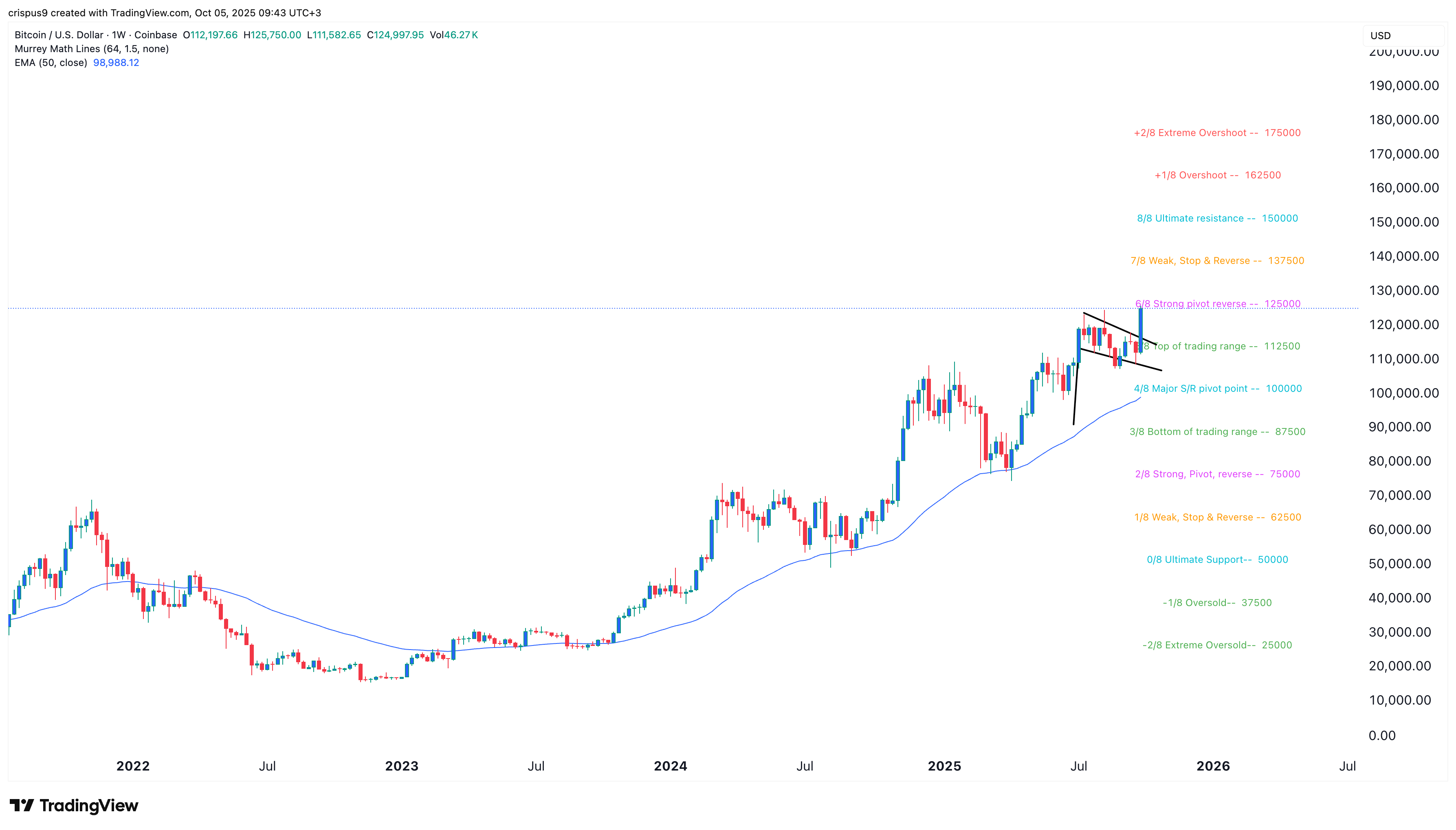
The weekly chart shows that the BTC price has been in a strong bull run this year. It has now jumped to a record high of over $125,500, moving away from the upper side of the bullish flag pattern.
Bitcoin price also moved to the strong pivot reverse point of the Murrey Math Lines tool and remains above all moving averages.
Therefore, the most likely scenario is where the coin continues rising as bulls target the ultimate resistance at $150,000. A move above that level will point to more gains to the extreme overshoot level at $175,000.
Disclaimer: The content of this article solely reflects the author's opinion and does not represent the platform in any capacity. This article is not intended to serve as a reference for making investment decisions.
You may also like

Wall Street giants collectively raise rate hike forecasts, US Treasury futures continue to fall, gold drops over 1% to break 4000
After the US October CPI exceeded expectations, Goldman Sachs and Nomura added a forecast for an interest rate hike in March next year, while Deutsche Bank included a forecast for a rate hike in January next year. Currently, the market has fully priced in a 25 basis point rate hike in December, with a 13% probability for a 50 basis point hike. On Wednesday, the US Treasury spot market was closed, but Treasury futures continued to fall, with corresponding yields rising by about 2 to 4 basis points, and spot gold came under pressure, dropping by 1.1%.

No Need to Worry About the Cooling Down of AI Data Center Construction? The US Import Boom Is Unlikely to Subside in the Short Term, Real Impact May Come in 2029
It takes an average of 4.8 years from finalizing investment to starting construction of a data center project, and an additional 2.6 years from construction start to becoming operational. Servers usually cannot be installed until after the building structure and racks are completed. For trade partners such as Taiwan (China), South Korea, and Mexico who rely on US data center supply chain demand, the inertia in construction timelines provides at least a one- to two-year buffer for future exports.

Federal Reserve Major Debate: When Should the Tenure of “Number Three” Williams End?
The main point of contention is whether Williams should step down in June 2028, upon completing a full 10-year term, or in June 2027, when he reaches the mandatory retirement age of 65. Analysts point out that the Federal Reserve Board holds ultimate discretion; if he leaves early, Fed Chair Waller would be able to assert greater control over the appointment to this critical position. However, forcing Williams to shorten his term could easily be interpreted as political manipulation. Williams himself is expected to serve until June 2028.

Crypto prices
More


