
Can Bitcoin ETFs Fuel the Biggest Price Surge Yet?

Bitcoin price is once again at the center of Wall Street’s attention. After a week of heavy outflows, U.S. spot Bitcoin ETFs have come roaring back with $3.24 billion in fresh inflows—their second-best week since launch. At the same time, BTC is pressing against its all-time high near $124,000, a level that could define whether October becomes the month Bitcoin breaks into uncharted territory. With BlackRock’s IBIT ETF leading the charge and Fidelity’s FBTC adding significant support, the surge in institutional demand raises one pressing question: are ETFs about to drive Bitcoin price into a new price discovery phase?
Bitcoin ETF Inflows Rebound Sharply
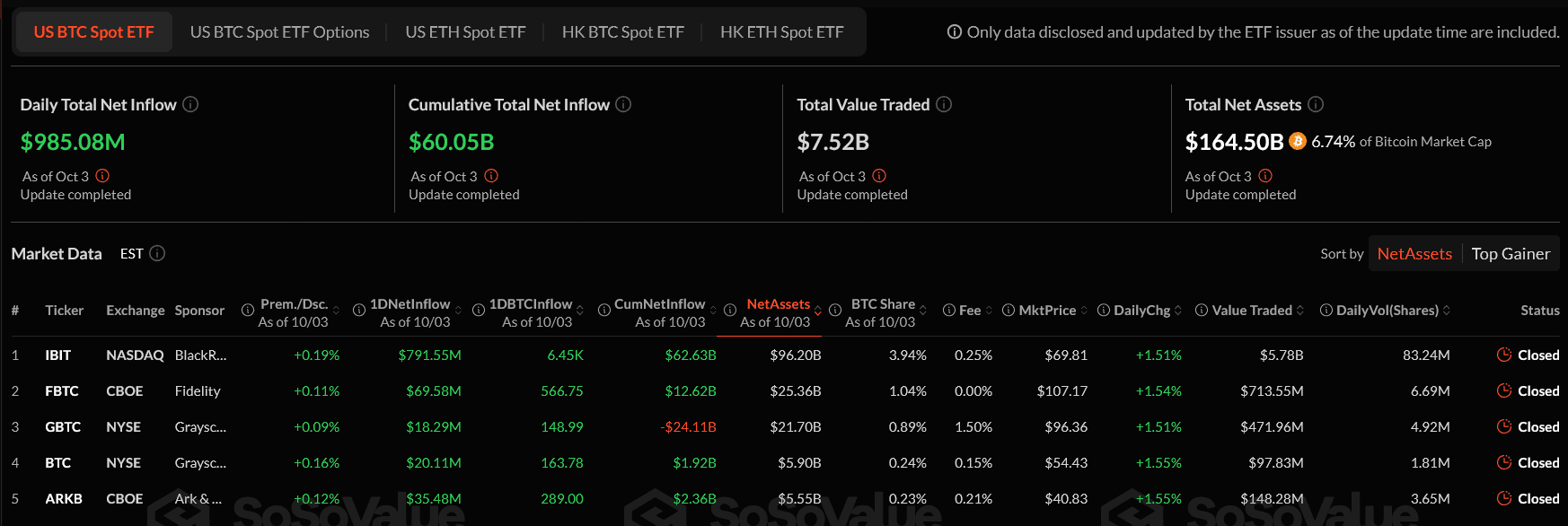 US BTC Spot ETF: Image Source: SoSoValue data
.
Bitcoin spot ETFs in the U.S. just posted their second-strongest weekly inflows on record. According to SoSoValue data , these funds pulled in $3.24 billion last week, a massive turnaround after the prior week’s outflows. To put it in perspective, this surge was only eclipsed once before, back in November 2024, when inflows peaked at $3.38 billion.
BlackRock’s IBIT ETF dominated the landscape, attracting $1.8 billion in inflows and handling several billion dollars in daily trading volume. With $96.2 billion in assets under management, IBIT has established itself as the heavyweight in this space. Fidelity’s FBTC followed with $692 million in inflows, roughly 38% of IBIT’s haul, but still a strong second. Grayscale’s GBTC, in contrast, showed modest inflows but remains weighed down by prior outflows.
The total net assets across U.S. Bitcoin spot ETFs now stand at $164.5 billion, representing nearly 7% of Bitcoin’s entire market capitalization. That concentration underscores just how significant ETFs have become in Bitcoin’s market structure.
Why Are Inflows Surging Again?
The reversal in sentiment looks tied to two factors. First, Bitcoin is retesting its all-time high of around $124,000, first reached in August. Historically, October has been one of Bitcoin’s strongest months, often setting up momentum into year-end rallies. Second, the ongoing U.S. government shutdown may be creating a risk-on environment. When investors distrust traditional systems and data flow is disrupted, hard assets like Bitcoin start to look more attractive.
The $4.14 billion swing in flows compared to the previous week highlights how fast institutional positioning can change. ETF demand acts as a proxy for institutional appetite, and right now that appetite looks bullish.
Can October Push Bitcoin Price Into Price Discovery?
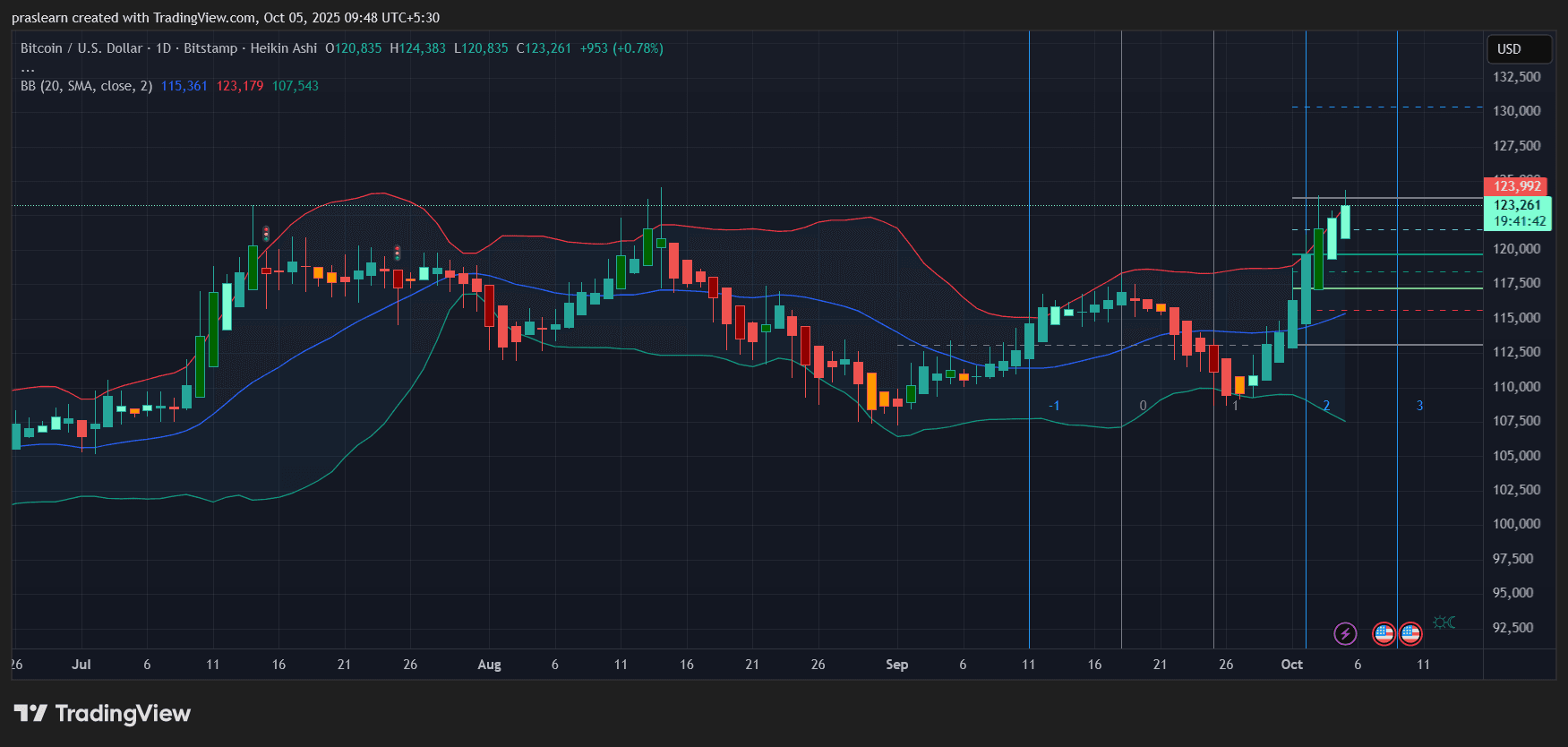 BTC/USD Daily Chart- TradingView
Bitcoin price has already rebounded 1.37% on the week, but the real test will come if it can break past the $124,000 ceiling. If Bitcoin ETF inflows continue at the current pace, there’s a strong probability of fresh all-time highs this month. The daily inflow of nearly $1 billion on October 3 alone suggests momentum is accelerating rather than cooling.
At the same time, Bitcoin ETF data shows concentration risk. With BlackRock holding nearly $100 billion in assets, a sharp reversal in IBIT flows could quickly flip market sentiment. Traders will need to watch not just the aggregate inflow numbers, but how they are distributed across funds.
What Happens If Flows Slow Down?
If inflows taper off or turn negative again, $BTC could stall below $124,000 and retest the $110,000–$115,000 support band. The market remains extremely sensitive to liquidity conditions, and ETF demand has become the key barometer of near-term price action. A dip in enthusiasm from BlackRock or Fidelity clients would be enough to trigger a corrective phase.
Outlook: A Breakout Month Ahead?
October has the ingredients to be a breakout month for $Bitcoin. Strong ETF inflows, seasonal tailwinds, and macro uncertainty all lean in favor of higher prices. The critical line to watch is $124,000. A clean breakout above it, supported by multi-billion-dollar ETF inflows, could launch Bitcoin into uncharted territory and set the stage for a Q4 rally.
If momentum fades, however, expect consolidation before any next leg higher. The deciding factor isn’t retail FOMO this time—it’s institutional flows through ETFs.
Disclaimer: The content of this article solely reflects the author's opinion and does not represent the platform in any capacity. This article is not intended to serve as a reference for making investment decisions.
You may also like
Wall Street giants collectively raise rate hike forecasts, US Treasury futures continue to fall, gold drops over 1% to break 4000
After the US October CPI exceeded expectations, Goldman Sachs and Nomura added a forecast for an interest rate hike in March next year, while Deutsche Bank included a forecast for a rate hike in January next year. Currently, the market has fully priced in a 25 basis point rate hike in December, with a 13% probability for a 50 basis point hike. On Wednesday, the US Treasury spot market was closed, but Treasury futures continued to fall, with corresponding yields rising by about 2 to 4 basis points, and spot gold came under pressure, dropping by 1.1%.

No Need to Worry About the Cooling Down of AI Data Center Construction? The US Import Boom Is Unlikely to Subside in the Short Term, Real Impact May Come in 2029
It takes an average of 4.8 years from finalizing investment to starting construction of a data center project, and an additional 2.6 years from construction start to becoming operational. Servers usually cannot be installed until after the building structure and racks are completed. For trade partners such as Taiwan (China), South Korea, and Mexico who rely on US data center supply chain demand, the inertia in construction timelines provides at least a one- to two-year buffer for future exports.

Federal Reserve Major Debate: When Should the Tenure of “Number Three” Williams End?
The main point of contention is whether Williams should step down in June 2028, upon completing a full 10-year term, or in June 2027, when he reaches the mandatory retirement age of 65. Analysts point out that the Federal Reserve Board holds ultimate discretion; if he leaves early, Fed Chair Waller would be able to assert greater control over the appointment to this critical position. However, forcing Williams to shorten his term could easily be interpreted as political manipulation. Williams himself is expected to serve until June 2028.

Sunshine Silver weighs doubling mill capacity
Crypto prices
More


