
Will tariffs and Federal Reserve decisions make or break the bitcoin bull market?

As Bitcoin rises to $122,000, the Supreme Court is reviewing Trump's tariff authority and control over the Federal Reserve.
Bitcoin price has soared to over $122,000, testing the upper Bollinger Band and breaking through multi-week resistance. However, this rally is colliding with a major macroeconomic uncertainty: the upcoming US Supreme Court hearings on Trump’s tariff authority and control over the Federal Reserve. These cases could reshape monetary policy, trade flows, and investor sentiment. The question is whether BTC price can benefit as a hedge against policy risk, or if uncertainty will drag it back to the $115,000 range.
Bitcoin Price Prediction: How Will Tariff Rulings Affect BTC Price?
The court will decide whether Trump’s sweeping import tariffs under the International Emergency Economic Powers Act are legal. If ruled invalid, global markets may breathe a sigh of relief—this would strengthen the US dollar, which typically puts downward pressure on Bitcoin. But if Trump is granted tariff authority, we could see a renewed trade war. Higher tariffs undermine confidence in fiat currency systems and may drive more capital into hard assets like Bitcoin.
On the charts, Bitcoin price has already priced in volatility: the breakout above $120,000 coincides with expectations of economic turbulence. If tariffs are upheld, Bitcoin price could test the $127,000–$130,000 range due to global trade uncertainty.
Will Federal Reserve Control Trigger a Bitcoin Price Surge?
The bigger risk is Trump’s attempt to fire Federal Reserve Governor Cook. If the court rules in his favor, presidential influence over the Fed will surge. This could mean artificially low interest rates, sparking inflation concerns. Historically, Bitcoin has performed well in inflationary environments as a hedge against currency devaluation.
The charts support this scenario: Bitcoin price has already broken above its 20-day moving average and is hugging the upper Bollinger Band. Momentum indicators suggest traders are preparing for inflation risk, which could push prices toward $130,000 in the coming weeks.
What If the Court Blocks Trump?
If the court limits Trump’s powers—on tariffs and the Fed—the narrative will flip. Stability in monetary policy and reduced trade war risk will strengthen the dollar. In this case, $BTC may see profit-taking. Technically, support lies around $118,000–$115,000. A drop below the middle Bollinger Band would confirm a reversal, putting downward pressure toward $110,000.
Key Technical Levels to Watch
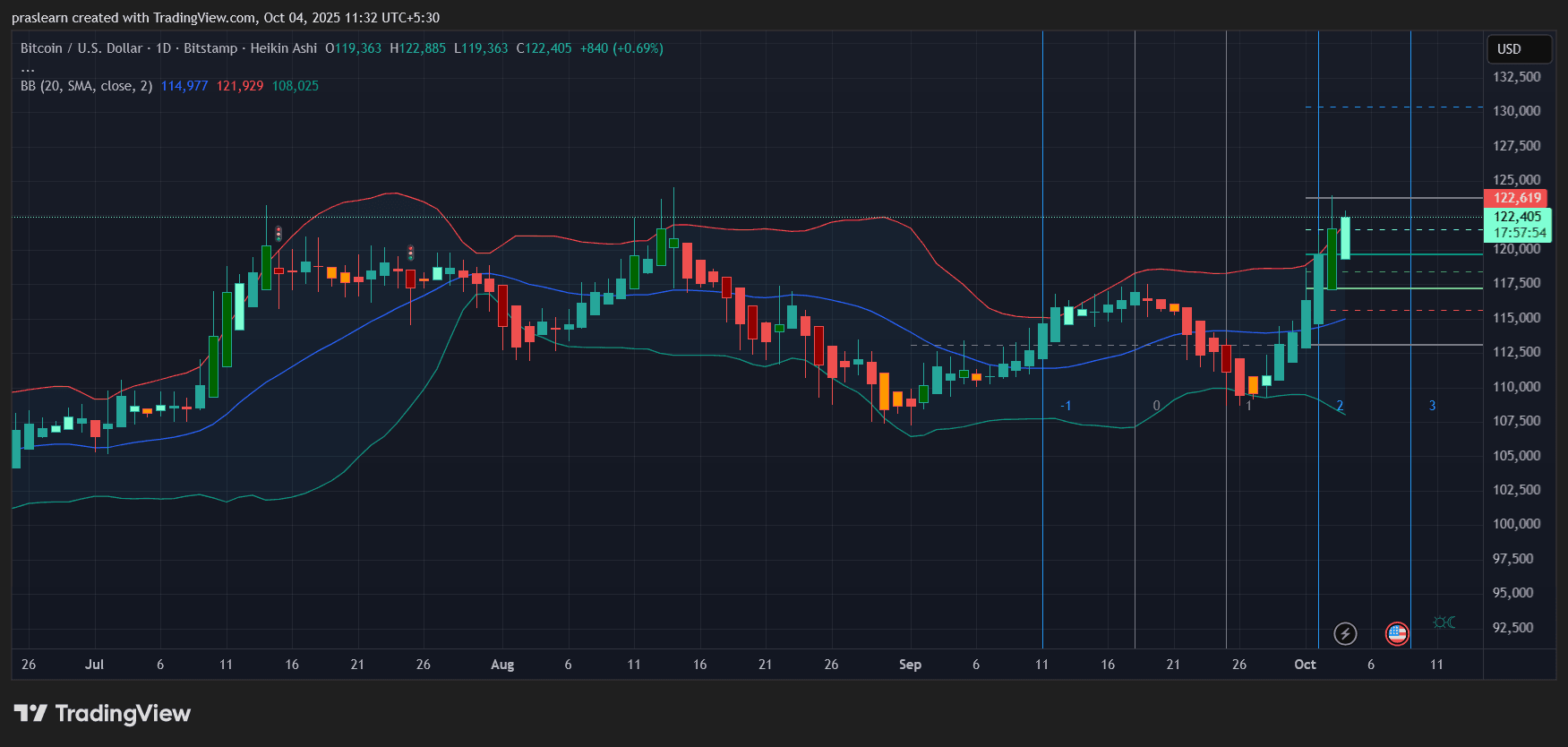 BTC/USD Daily Chart- TradingView
- Resistance: $125,000, $127,000, $130,000
- Support: $118,000, $115,000, $110,000
Bollinger Bands: Bitcoin is testing the upper band, indicating overbought conditions but also strong breakout potential.
Bitcoin Price Prediction: Inflation Hedge vs. Stable Trading
Bitcoin’s next major move depends on how the Supreme Court impacts US economic policy. If Trump wins expanded powers, expect Bitcoin to accelerate toward $130,000 as inflation hedging takes center stage. If the court limits his authority, a return to stability and a stronger dollar could see a pullback to $115,000.
Conclusion
Bitcoin price stands at the crossroads of legal rulings and technical momentum. The Supreme Court could not only shape America’s economic future—but also decide whether Bitcoin’s current rally extends to new highs or enters another consolidation phase. For traders, the message is clear: watch the court schedule as closely as you watch the candlestick charts.
Disclaimer: The content of this article solely reflects the author's opinion and does not represent the platform in any capacity. This article is not intended to serve as a reference for making investment decisions.
You may also like
Wall Street giants collectively raise rate hike forecasts, US Treasury futures continue to fall, gold drops over 1% to break 4000
After the US October CPI exceeded expectations, Goldman Sachs and Nomura added a forecast for an interest rate hike in March next year, while Deutsche Bank included a forecast for a rate hike in January next year. Currently, the market has fully priced in a 25 basis point rate hike in December, with a 13% probability for a 50 basis point hike. On Wednesday, the US Treasury spot market was closed, but Treasury futures continued to fall, with corresponding yields rising by about 2 to 4 basis points, and spot gold came under pressure, dropping by 1.1%.

No Need to Worry About the Cooling Down of AI Data Center Construction? The US Import Boom Is Unlikely to Subside in the Short Term, Real Impact May Come in 2029
It takes an average of 4.8 years from finalizing investment to starting construction of a data center project, and an additional 2.6 years from construction start to becoming operational. Servers usually cannot be installed until after the building structure and racks are completed. For trade partners such as Taiwan (China), South Korea, and Mexico who rely on US data center supply chain demand, the inertia in construction timelines provides at least a one- to two-year buffer for future exports.

Federal Reserve Major Debate: When Should the Tenure of “Number Three” Williams End?
The main point of contention is whether Williams should step down in June 2028, upon completing a full 10-year term, or in June 2027, when he reaches the mandatory retirement age of 65. Analysts point out that the Federal Reserve Board holds ultimate discretion; if he leaves early, Fed Chair Waller would be able to assert greater control over the appointment to this critical position. However, forcing Williams to shorten his term could easily be interpreted as political manipulation. Williams himself is expected to serve until June 2028.

Sunshine Silver weighs doubling mill capacity
Crypto prices
More


