
Did the "top-escape master" sell too early?

Ethereum Foundation has sold coins again.
Overnight, the foundation announced that it would sell 1,000 ETH (worth about $4.5 million) through the decentralized trading platform CoWSwap using the TWAP function, exchanging them for stablecoins to support "R&D, grants, and donation work."
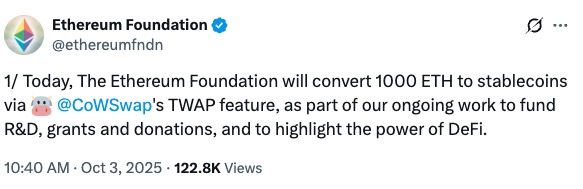
If this sounds familiar, it's because they just sold some last month. That time was even bigger—10,000 ETH, worth over $43 million.
As a result, the community is in an uproar again. Some joked: "The master of selling at the top is back online."
Why is everyone always watching the foundation's coin sales?
In fact, the Ethereum Foundation's coin sales are discussed almost every year. The reason is simple—it holds too much ETH, and every sale is worth millions of dollars. Moreover, each sale often happens when the market is doing well, inevitably leading people to associate it with "cashing out at the top."
The community jokingly calls the foundation the "master of selling at the top," and it's not without reason:
-
During the 2021 bull market, it sold a batch of ETH;
-
During the 2022 bear market, it barely moved;
-
Since 2024, it has made several moves during ETH rebounds.
Of course, from the foundation's perspective, these actions all have reasonable explanations: every year, they need to provide substantial funding for ecosystem projects, hackathons, research, and personnel, so converting some to stablecoins for expenses is indeed necessary.
But the market is driven by sentiment. No matter how rational the foundation's motives are, every coin sale triggers the discussion: "Is this the top again?"
On-chain signals: ETH is "quietly running out"
It is worth noting that although the foundation is selling coins, on-chain data shows that the overall supply of ETH is decreasing. Currently, ETH reserves on exchanges are at a historic low, only about 9.2 million.
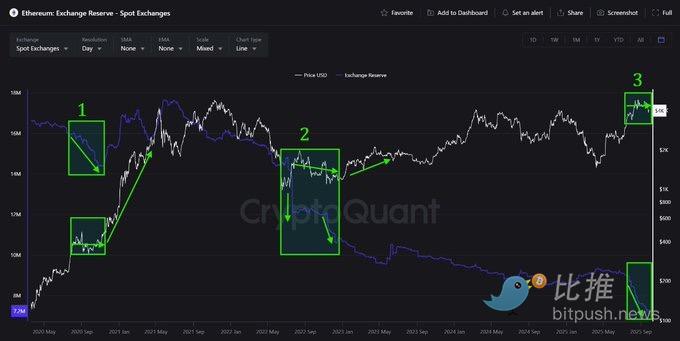
This means that there is less and less ETH available for immediate sale on the market.
Analyst Leon Waidmann summarized three similar situations in ETH's history:
-
2020-2021: Reserves dropped from 16 million to 10 million, ETH soared from $400 to $4,800;
-
2022-2023: Reserves dropped from 15 million to 9 million, ETH rose from $1,100 to $4,000;
-
Now: Reserves are again around 9 million, price has rebounded to near $4,500, with a 7-day increase of over 10%.
Waidmann used a vivid analogy: "It's like draining a bathtub—if the water level doesn't drop, it's because new water is flowing in (buying pressure is absorbing the supply). Once sellers are exhausted and demand explodes, the water will suddenly overflow."
In other words, the current market is in a stage of "supply exhaustion + pent-up demand": it appears calm on the surface, but is actually building momentum.
Macro environment: Policy shifts may be the key catalyst
On the other hand, the macro environment is also changing. Due to the US government shutdown, the release of September's Non-Farm Payroll (NFP) data has been delayed, and the market expects the Federal Reserve to possibly cut rates twice this year.
Coinbase's research team wrote in their latest report: "The interest rate market has already priced in two 25-basis-point rate cuts. The weakening dollar and record-high gold prices have reduced the appeal of cash assets, which is favorable for the crypto market."
This means that if funds flow back into risk assets, Ethereum could be among the first beneficiaries.
ETH ETF has seen net inflows of over $1 billion for four consecutive days, and whale wallet buying has also increased significantly.
Technical analysis: Key breakout level at $4,800
The warming macro environment provides momentum for the market, while technical trends offer an important window to observe the strength of this momentum.
From a technical perspective, Ethereum is currently at a critical decision point. After successfully breaking through the $4,500 resistance and hitting a new two-week high, the price is now facing the downward trendline formed since August 24. Whether this key resistance can be broken will determine the subsequent trend. If it breaks through effectively, the next target will be $4,800; otherwise, a short-term pullback may occur.
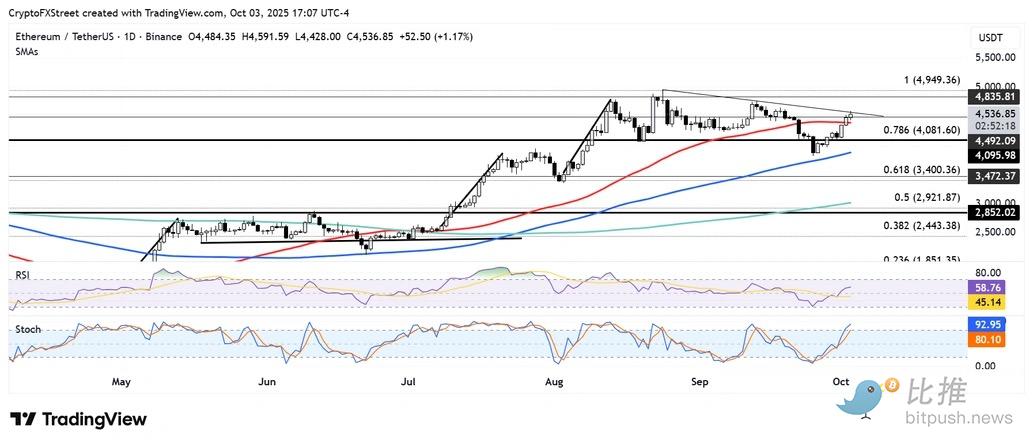
In the past 24 hours, the Ethereum futures market saw $123.8 million in liquidations, of which $7.3 million were short positions. Technical indicators show a mixed picture: the Relative Strength Index (RSI) remains above the neutral line, maintaining bullish momentum, but the Stochastic Oscillator (Stoch) has entered the overbought zone.
As for key support levels, the $4,100 level will be an important defense line. If this level is breached, the 100-day Simple Moving Average (SMA) will provide subsequent support. Close attention should be paid to whether the trendline is broken; a successful hold above the resistance line will open up new upside potential, otherwise a technical correction may occur.
Therefore, the following key points and risks should be watched:
-
Support levels: If ETH falls below key supports (such as around $4,100 or $4,000), it may trigger a chain reaction of declines;
-
Buy trigger points: If institutions or DATs (Digital Asset Treasuries) start large-scale buying again, it will be a catalyst for a new rally;
-
Macro changes: Federal Reserve interest rate policy, dollar strength, regulatory policies, etc., remain key factors guiding the market direction.
Author: Seed.eth
Disclaimer: The content of this article solely reflects the author's opinion and does not represent the platform in any capacity. This article is not intended to serve as a reference for making investment decisions.
You may also like
Wall Street giants collectively raise rate hike forecasts, US Treasury futures continue to fall, gold drops over 1% to break 4000
After the US October CPI exceeded expectations, Goldman Sachs and Nomura added a forecast for an interest rate hike in March next year, while Deutsche Bank included a forecast for a rate hike in January next year. Currently, the market has fully priced in a 25 basis point rate hike in December, with a 13% probability for a 50 basis point hike. On Wednesday, the US Treasury spot market was closed, but Treasury futures continued to fall, with corresponding yields rising by about 2 to 4 basis points, and spot gold came under pressure, dropping by 1.1%.

No Need to Worry About the Cooling Down of AI Data Center Construction? The US Import Boom Is Unlikely to Subside in the Short Term, Real Impact May Come in 2029
It takes an average of 4.8 years from finalizing investment to starting construction of a data center project, and an additional 2.6 years from construction start to becoming operational. Servers usually cannot be installed until after the building structure and racks are completed. For trade partners such as Taiwan (China), South Korea, and Mexico who rely on US data center supply chain demand, the inertia in construction timelines provides at least a one- to two-year buffer for future exports.

Federal Reserve Major Debate: When Should the Tenure of “Number Three” Williams End?
The main point of contention is whether Williams should step down in June 2028, upon completing a full 10-year term, or in June 2027, when he reaches the mandatory retirement age of 65. Analysts point out that the Federal Reserve Board holds ultimate discretion; if he leaves early, Fed Chair Waller would be able to assert greater control over the appointment to this critical position. However, forcing Williams to shorten his term could easily be interpreted as political manipulation. Williams himself is expected to serve until June 2028.

Sunshine Silver weighs doubling mill capacity
Crypto prices
More


