
Bitcoin No Longer Follows The Old Halving Model

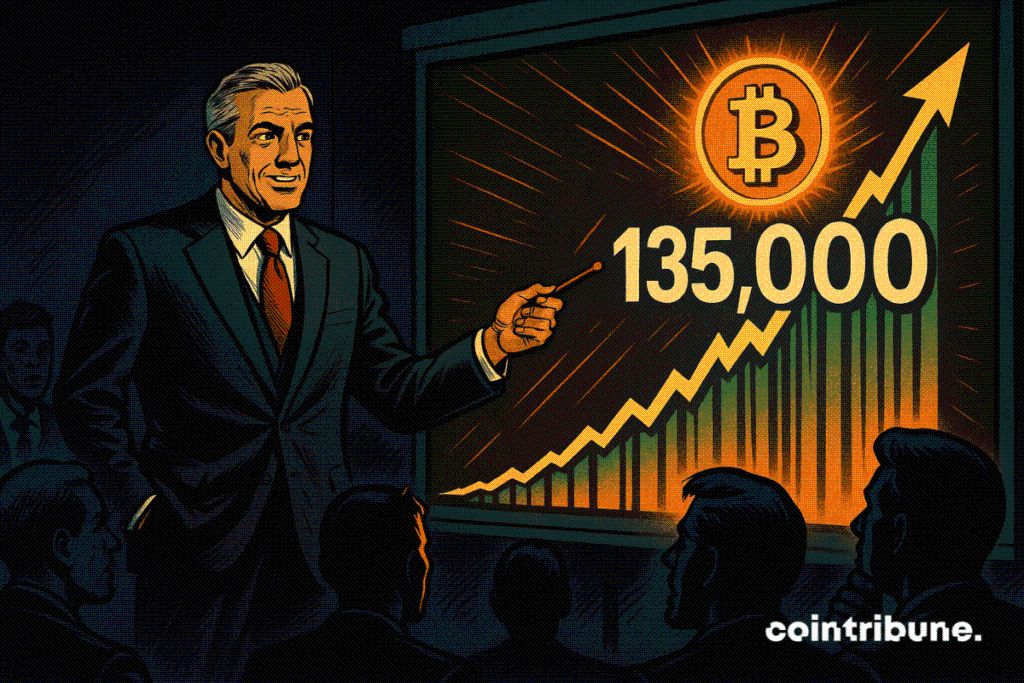
While financial markets waver under the weight of monetary uncertainties and political tensions, a bold projection revives the debate. Bitcoin could reach $135,000, according to Standard Chartered. In a recent note, the British bank disrupts established scenarios by stating that the current market dynamics invalidate historical post-halving patterns. This change of tone, coming from a major player in traditional finance, revitalizes bullish expectations as BTC enters a new phase of acceleration.
In Brief
- Standard Chartered expects Bitcoin could reach $135,000 very soon, even $200,000 by the end of 2025.
- The bank challenges a historical cyclical model that predicted a post-halving drop.
- Contrary to expectations, Bitcoin remains above $120,000 after the April 2024 halving.
- This dynamic fits within a seasonal bullish trend nicknamed ‘Uptober’.
A Historical Model Disrupted According to Standard Chartered
In a shared note, Geoff Kendrick, global head of crypto research at Standard Chartered, questions one of the most entrenched cyclical patterns in crypto market analysis: the drop in bitcoin prices 18 months after a halving.
“Bitcoin has departed from a pattern that, until now, saw prices fall 18 months after the halving”, he observes . However, this cycle should have, according to this logic, triggered a notable retreat by this year’s end, following the April 2024 halving. This is evidently not the case. Bitcoin remains strong, even accelerating, breaking through the $120,000 mark this week.
This dynamic seems to confirm that the crypto market is escaping its old structural benchmarks. To support this idea, several factual elements reinforce the thesis of a new post-halving paradigm :
- Bitcoin currently trades at $120,606, up 1.71 % over 24 hours ;
- The price already reached $120,286 the day before, marking a nearly 8 % increase over the week ;
- This rise fits into a trend nicknamed “Uptober”, well known among observers for its typical bullish momentum in the last quarter.
Kendrick points out that this trajectory is unprecedented compared to the post-halving cycle observed in 2018–2019, where the market remained inert despite a U.S. government shutdown similar to the current one.
Massive Flows into Bitcoin ETFs
Beyond cyclical considerations, Standard Chartered highlights a fundamental element in the current bitcoin rise: institutional demand. In his note, Geoff Kendrick specifies that net inflows into Bitcoin ETFs now reach $58 billion, including $23 billion generated in 2025 alone.
He states : “I anticipate at least an additional $20 billion by year-end, an amount that would make my forecast of $200,000 for bitcoin at that deadline possible”. The analyst thus suggests that the current dynamic could not only lead to a peak of $135,000 but potentially to $200,000 by the end of the year, should the flows continue.
Looking ahead, several implications can be considered. First, this rise in institutional participants could contribute to reducing bitcoin’s historical volatility while increasing its correlation with global macroeconomic indicators. Next, the increase in flows toward ETFs fuels a form of financial legitimization of BTC, likely to attract capital still on the fringes of the crypto market in this thrilling year-end .
Disclaimer: The content of this article solely reflects the author's opinion and does not represent the platform in any capacity. This article is not intended to serve as a reference for making investment decisions.
You may also like
Wall Street giants collectively raise rate hike forecasts, US Treasury futures continue to fall, gold drops over 1% to break 4000
After the US October CPI exceeded expectations, Goldman Sachs and Nomura added a forecast for an interest rate hike in March next year, while Deutsche Bank included a forecast for a rate hike in January next year. Currently, the market has fully priced in a 25 basis point rate hike in December, with a 13% probability for a 50 basis point hike. On Wednesday, the US Treasury spot market was closed, but Treasury futures continued to fall, with corresponding yields rising by about 2 to 4 basis points, and spot gold came under pressure, dropping by 1.1%.

No Need to Worry About the Cooling Down of AI Data Center Construction? The US Import Boom Is Unlikely to Subside in the Short Term, Real Impact May Come in 2029
It takes an average of 4.8 years from finalizing investment to starting construction of a data center project, and an additional 2.6 years from construction start to becoming operational. Servers usually cannot be installed until after the building structure and racks are completed. For trade partners such as Taiwan (China), South Korea, and Mexico who rely on US data center supply chain demand, the inertia in construction timelines provides at least a one- to two-year buffer for future exports.

Federal Reserve Major Debate: When Should the Tenure of “Number Three” Williams End?
The main point of contention is whether Williams should step down in June 2028, upon completing a full 10-year term, or in June 2027, when he reaches the mandatory retirement age of 65. Analysts point out that the Federal Reserve Board holds ultimate discretion; if he leaves early, Fed Chair Waller would be able to assert greater control over the appointment to this critical position. However, forcing Williams to shorten his term could easily be interpreted as political manipulation. Williams himself is expected to serve until June 2028.

Sunshine Silver weighs doubling mill capacity
Crypto prices
More


