

Wall Street crypto IPOs are large, IPO-ready cryptocurrency firms attracting institutional capital; Matrixport estimates a pipeline of about $200 billion in companies that could raise $30–45 billion in 2025, potentially damping volatility while selectively fueling an ETF-backed altcoin rally.
-
Wall Street pipeline: ~ $200B in IPO-ready crypto firms, $30–45B potential raise
-
Institutional flows may reduce Bitcoin volatility and favor ETF-backed altcoins.
-
SEC ETF decision windows and filings (Oct. dates) are key catalysts; BitGo reported $90.3B in custody.
Wall Street crypto IPOs could inject $30–45B into markets; discover which IPO-ready firms and ETF timelines may trigger a selective altcoin season—read the analysis now.
Wall Street capital is flowing into late-stage, IPO-ready crypto firms, signaling new dynamics at play for the incoming altcoin season.
Wall Street’s growing interest in late-stage cryptocurrency firms could alter the market cycle for digital assets, according to research from Matrixport. Institutional focus is shifting toward scalable, IPO-ready companies that are positioned for public markets.
Matrixport estimates that more than $200 billion worth of crypto companies are preparing initial public offerings (IPOs), which could raise between $30 billion and $45 billion in new capital.
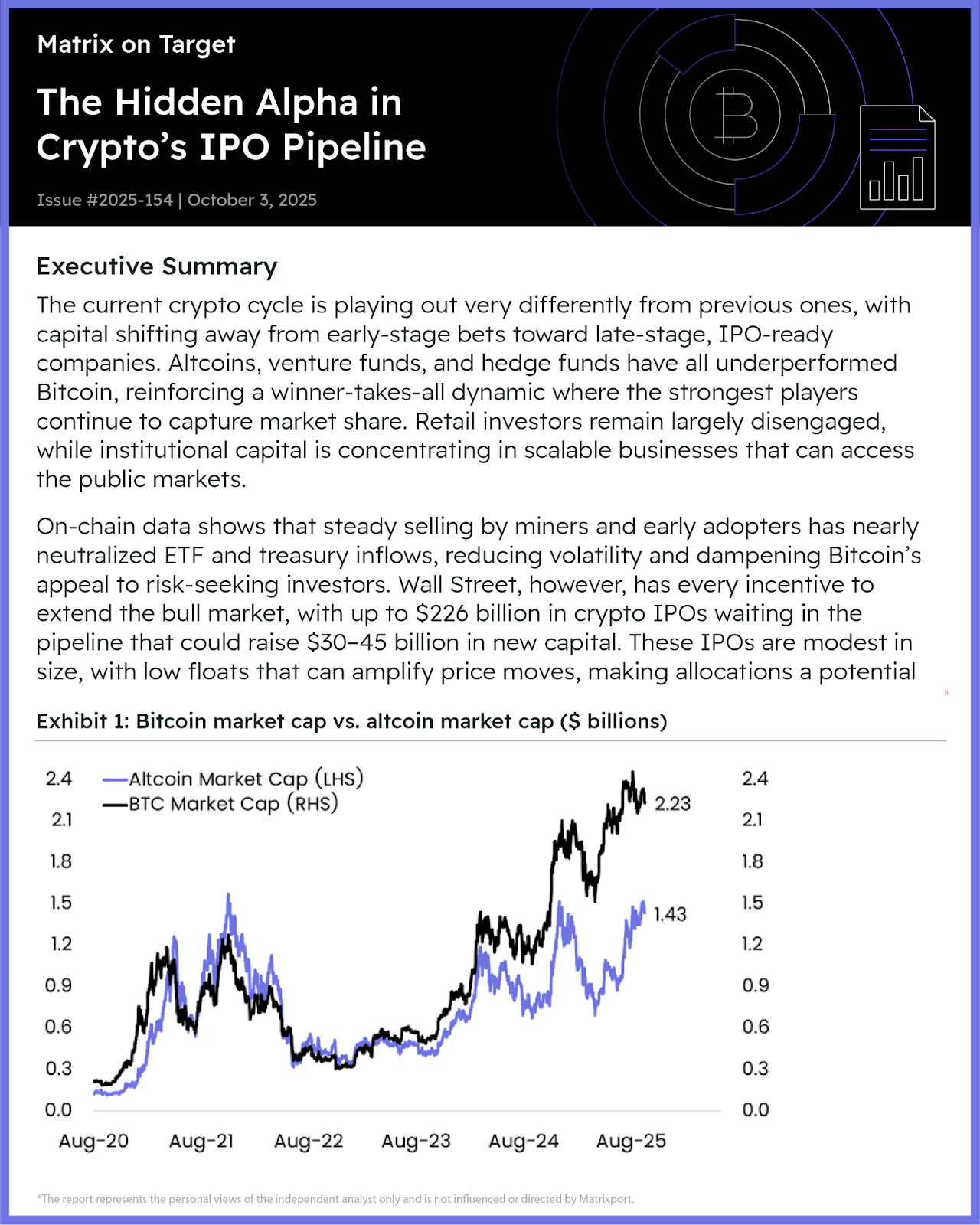
Source: Matrixport
What are Wall Street crypto IPOs?
Wall Street crypto IPOs are late-stage cryptocurrency companies preparing to list on public markets, attracting institutional investors and large capital raises. These IPOs typically come from exchanges, custodians, and financial-service providers and can inject substantial, more stable capital into the crypto sector.
How could a wave of crypto IPOs affect the 2025 altcoin season?
Institutional IPO proceeds can stabilize markets by increasing long-term, paper-backed capital. Matrixport’s assessment of a ~$200 billion IPO pipeline and a $30–45 billion potential raise suggests capital rotation away from early-stage, high-volatility bets.
That rotation may reduce pure risk-seeking flows into Bitcoin while selectively lifting altcoins with institutional exposure or pending ETF approval. Onchain data and industry commentary indicate Ethereum (ETH) and a limited set of tokens are already showing outperformance.
Key data points:
-
Matrixport: ~$200 billion in IPO-ready companies; $30–45 billion potential capital.
-
BitGo filing (U.S. IPO): reported about $90.3 billion in assets under custody and 1.1 million users.
-
Multiple ETF filing deadlines in October 2025 could act as catalysts for select tokens.

BitGo files for US IPO. Source: James Seyffart
Why are ETFs and IPOs being called a route to a “paper-backed altseason”?
ETFs create a regulated, institutional-friendly vehicle for exposure, which can concentrate flows into tokens with approved or pending ETF products. Analysts describe this emerging environment as a selective, paper-backed altseason—driven by institutional products rather than broad retail speculation.
Industry voices supporting this view include Nic Puckrin (The Coin Bureau), who notes ETH outperformance as Bitcoin dominance slips, and Ki Young Ju (CryptoQuant), who labeled the trend “paper-backed altseason.”
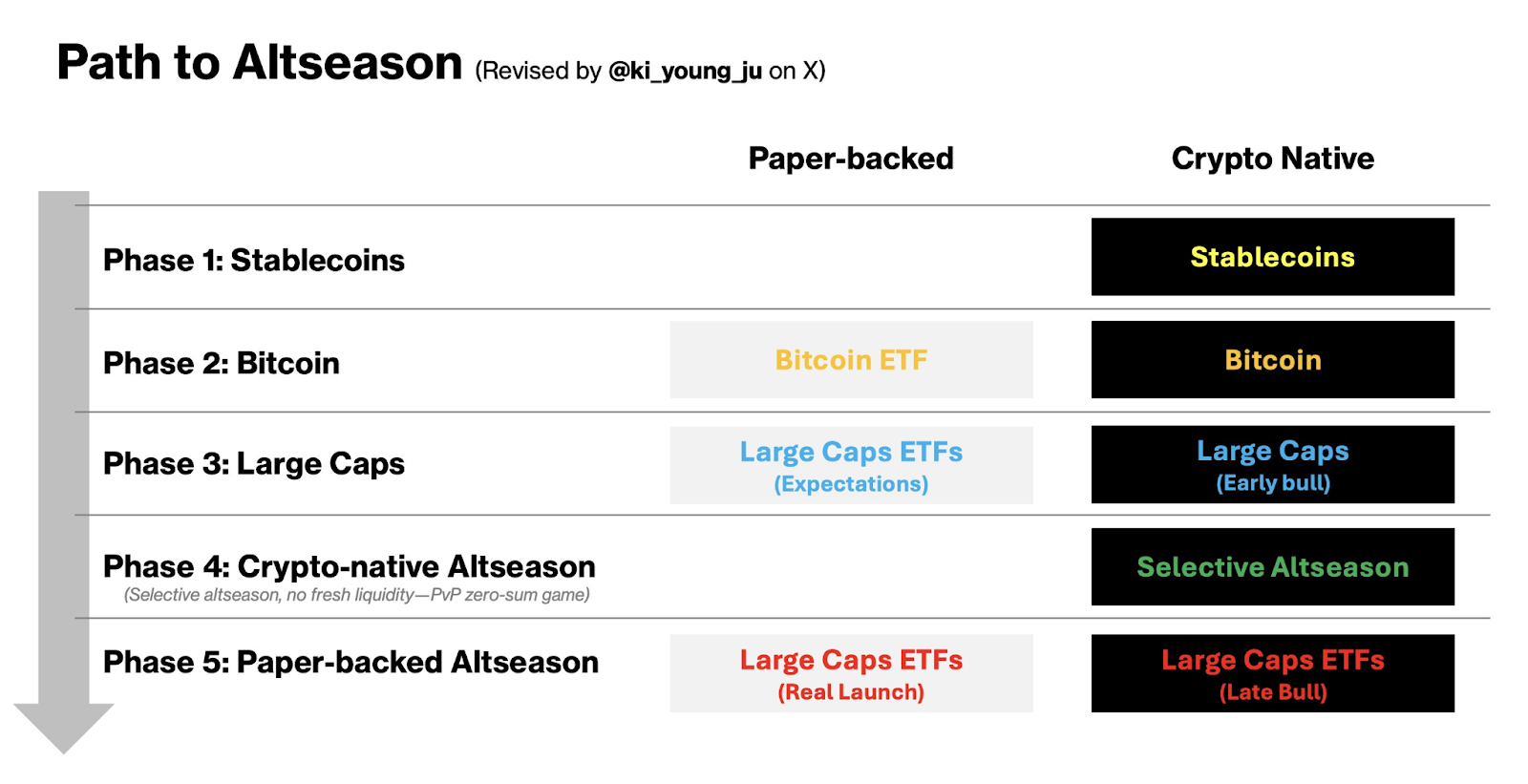
Source: Ki Young Ju
When are ETF and IPO decision windows that matter?
Several ETF filing deadlines fall in October 2025; specific dates have been set for Solana, XRP, DOGE and Cardano-related ETF decisions. The Securities and Exchange Commission’s responses in these windows could materially influence where institutional capital flows next.
Separately, high-profile IPO moves—such as exchange funding rounds and custodian filings—signal which firms are closest to public-market readiness and therefore more likely to attract large allocations.
Frequently Asked Questions
Which major firms are preparing IPOs?
Reported examples include large exchanges and custodians moving toward public listings; BitGo filed a U.S. IPO with ~$90.3 billion in assets under custody, and Kraken has reported late-stage funding rounds consistent with IPO preparation (reported valuation figures are cited in industry press).
How should investors interpret institutional IPO interest?
Institutional interest signals maturation: expect more regulated products, selective altcoin outperformance, and capital that may be less prone to rapid churn than retail flows. Investors should focus on fundamentals and institutional backing.
Key Takeaways
- Large IPO pipeline: Matrixport identifies ~ $200B in IPO-ready firms, potentially raising $30–45B.
- Selective altcoin rally: ETF filings and institutional backing favor specific tokens rather than a broad altseason.
- Watch timelines: October ETF windows and high-profile IPO filings are primary catalysts to monitor.
Conclusion
Wall Street crypto IPOs are reshaping the flow of institutional capital into digital assets, potentially reducing volatility while enabling a targeted, ETF-driven altcoin run. Market participants should watch IPO pipelines, custody figures like BitGo’s, and scheduled ETF decision windows for signs of where capital will concentrate next. COINOTAG will continue to track developments and regulatory milestones.
Published: 2025-10-03 — Updated: 2025-10-03 | Author: COINOTAG





