
Could a Government Shutdown Downgrade the US Credit Rating?

The US government shutdown threatens credit downgrades and economic turmoil, but crypto’s bullish reaction hints at its potential as a recession hedge.
The US government shutdown is threatening to be a long one, which may cause rating agencies to downgrade the nation’s credit. This bearish signal would cause chaos for TradFi, but a possible opportunity for Web3.
Specifically, agencies warned that further deadlock could damage the US’s credit rating. Prediction markets are currently rather confident that this shutdown will continue for longer than the historical average.
Can Shutdowns Cause Credit Downgrades?
After a narrow vote in Congress failed last night, the US federal government entered a shutdown, with huge potential ramifications for the crypto market.
For example, even though TradFi stocks went down, the crypto sector is feeling bullish, as the leading tokens and general market cap have both risen healthily:
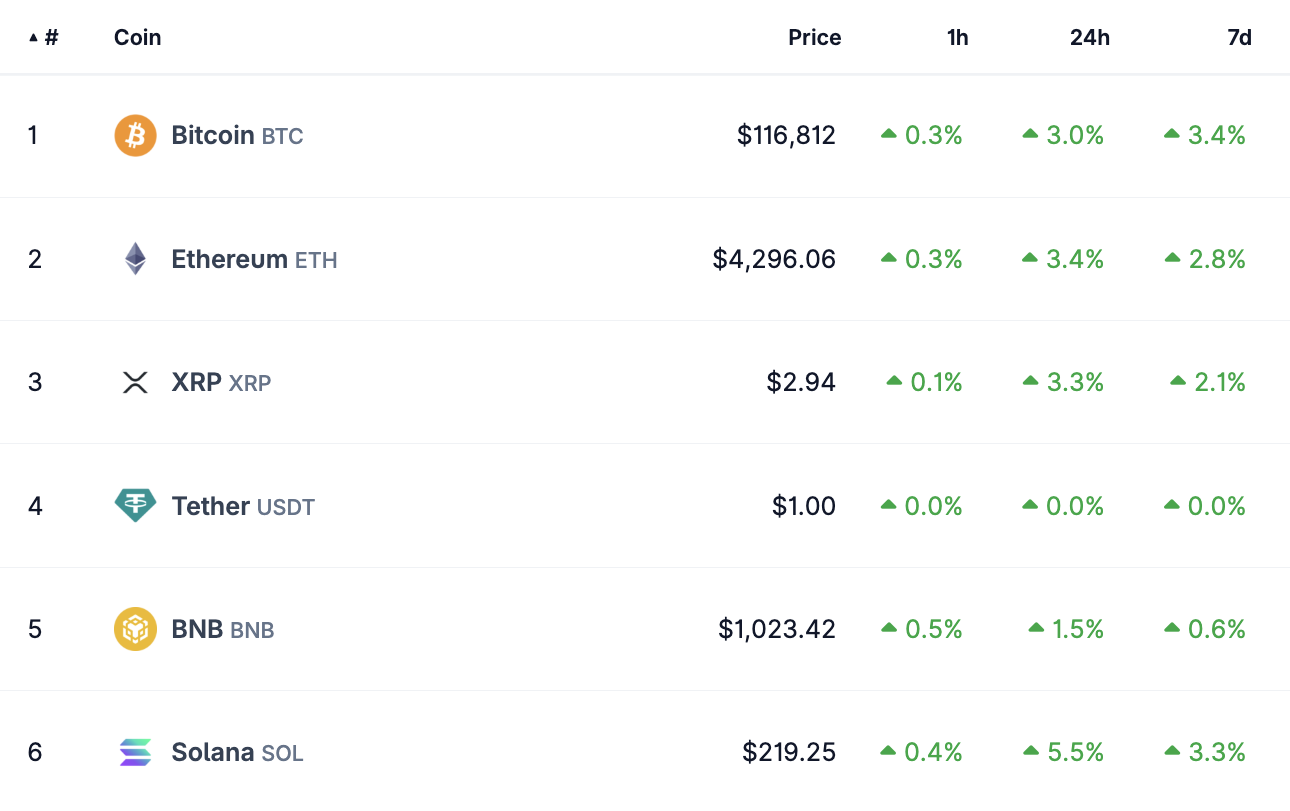 Crypto Reacts to US Shutdown. Source:
CoinGecko
However, there’s one wild card at play here that could prove to be a real stress test for crypto’s use as a recession hedge.
Specifically, there are growing concerns that this shutdown could cause rating agencies to downgrade the US credit. This move would compound ongoing losses from the chaotic incident.
The US government shutdown:For the first time since 2018, the US is about to enter a government shutdown and investors are bracing for it.This would furlough 750,000 workers PER DAY, costing ~$400M in daily compensation.What does it all mean? Let us explain.(a thread) pic.twitter.com/oewTTeOATc
— The Kobeissi Letter (@KobeissiLetter) September 30, 2025
How plausible is this scenario? Unfortunately, there are good reasons to believe that another government shutdown could cause a credit downgrade.
In 2023, Fitch cited a 2018 shutdown and other Congressional gridlock when it reduced the US’s credit rating. Moody’s did something similar in May 2025, cautioning the government that more downgrades could follow:
“The rating could be [further] downgraded if policy effectiveness or the strength of institutions were to erode to such a degree that materially weakens the sovereign’s credit profile. This would be the case if it were to lead to a deterioration in medium-term growth or economic resilience to shocks, or if it was accompanied by a significant and lasting move by global investors out of the US dollar,” Moody’s claimed in its last downgrade.
Granted, the rating agency didn’t explicitly cite government shutdowns as part of its downgrade decision, but it certainly seems like a plausible subtext. Moreover, this incident could prove particularly punishing.
Lengthy Deadlock and Crypto Opportunities
Specifically, analysts determined that the average US government shutdown only lasted eight days. However, Trump’s 2018 deadlock is a major outlier; at 35 days, it skewed the entire data set substantially upwards.
Right now, as economists have noted, prediction markets believe that this shutdown will last two weeks or longer:
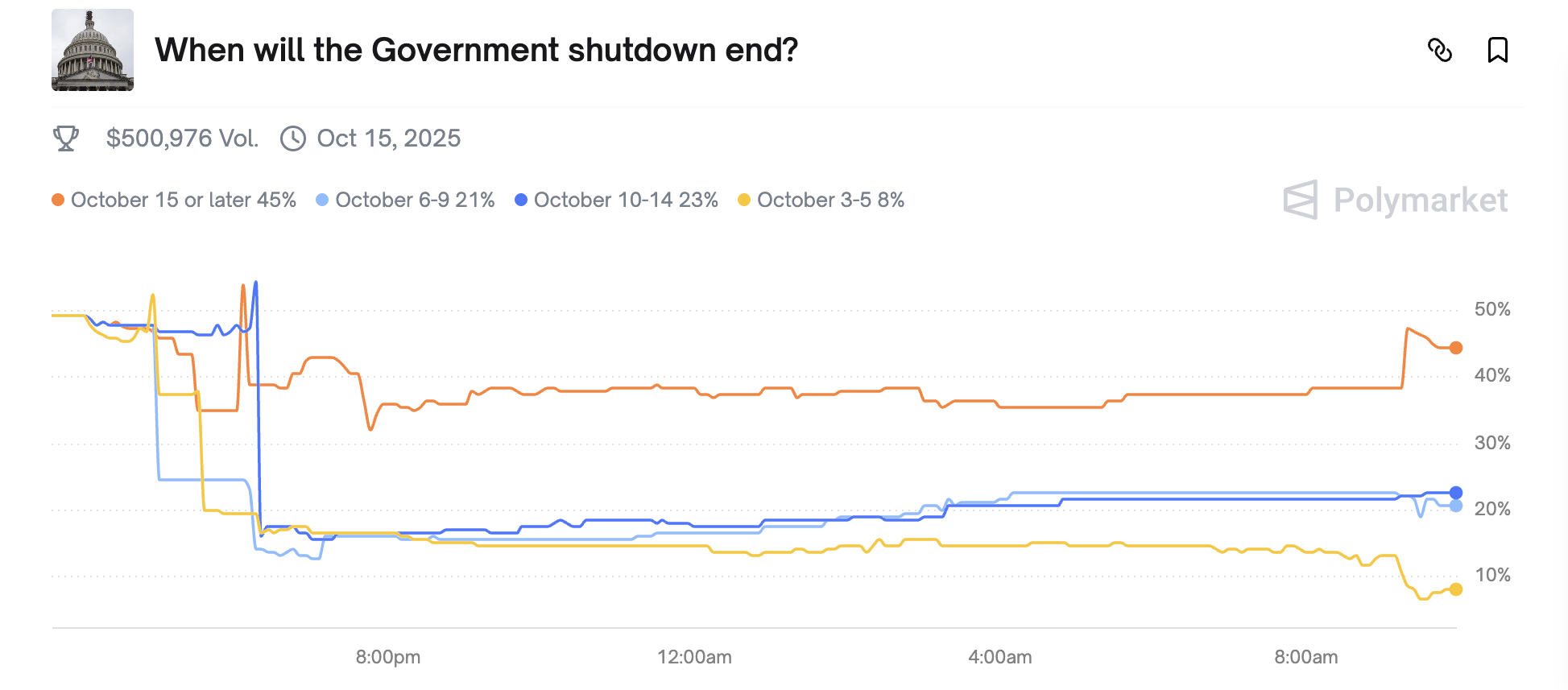 Prediction Markets Assess Shutdown Length. Source:
Polymarket
Of course, Polymarket isn’t always right, but it serves as a crucial barometer for market sentiment. If a plurality of investors believe that this shutdown will go far longer than average, it could further spur a credit downgrade.
This bearish signal might cause any number of downstream effects.
All that is to say, crypto’s high performance on the shutdown’s first day is an important indicator too. There’s a lot of controversy over how Bitcoin will fare in a longer recession, but we have a critical opportunity to gather some hard data here.
If token markets continue rising through a shutdown and a credit downgrade, that would constitute a strong signal that crypto will be a valuable recession hedge.
Disclaimer: The content of this article solely reflects the author's opinion and does not represent the platform in any capacity. This article is not intended to serve as a reference for making investment decisions.
You may also like
Wall Street giants collectively raise rate hike forecasts, US Treasury futures continue to fall, gold drops over 1% to break 4000
After the US October CPI exceeded expectations, Goldman Sachs and Nomura added a forecast for an interest rate hike in March next year, while Deutsche Bank included a forecast for a rate hike in January next year. Currently, the market has fully priced in a 25 basis point rate hike in December, with a 13% probability for a 50 basis point hike. On Wednesday, the US Treasury spot market was closed, but Treasury futures continued to fall, with corresponding yields rising by about 2 to 4 basis points, and spot gold came under pressure, dropping by 1.1%.

No Need to Worry About the Cooling Down of AI Data Center Construction? The US Import Boom Is Unlikely to Subside in the Short Term, Real Impact May Come in 2029
It takes an average of 4.8 years from finalizing investment to starting construction of a data center project, and an additional 2.6 years from construction start to becoming operational. Servers usually cannot be installed until after the building structure and racks are completed. For trade partners such as Taiwan (China), South Korea, and Mexico who rely on US data center supply chain demand, the inertia in construction timelines provides at least a one- to two-year buffer for future exports.

Federal Reserve Major Debate: When Should the Tenure of “Number Three” Williams End?
The main point of contention is whether Williams should step down in June 2028, upon completing a full 10-year term, or in June 2027, when he reaches the mandatory retirement age of 65. Analysts point out that the Federal Reserve Board holds ultimate discretion; if he leaves early, Fed Chair Waller would be able to assert greater control over the appointment to this critical position. However, forcing Williams to shorten his term could easily be interpreted as political manipulation. Williams himself is expected to serve until June 2028.

Sunshine Silver weighs doubling mill capacity
Crypto prices
More


