
Wisconsin Lawmakers Push Bill to Ease Crypto Rules

Contents
Toggle- Quick breakdown
- Key provisions of the bill
- Legislative path and challenges
Quick breakdown
- Wisconsin’s Assembly Bill 471 seeks to exempt crypto mining, staking, and blockchain development from money transmitter licencing.
- The bill also safeguards the right to use self-hosted wallets and accept digital assets for payments.
- It faces hurdles, with only 25% legislative progress and several stages left for approval.
Wisconsin legislators have introduced a new bill that could exempt individuals and businesses engaged in crypto activities from obtaining money transmitter licences. The proposal, Assembly Bill 471, aims to create clearer regulatory boundaries for digital asset use in the state.
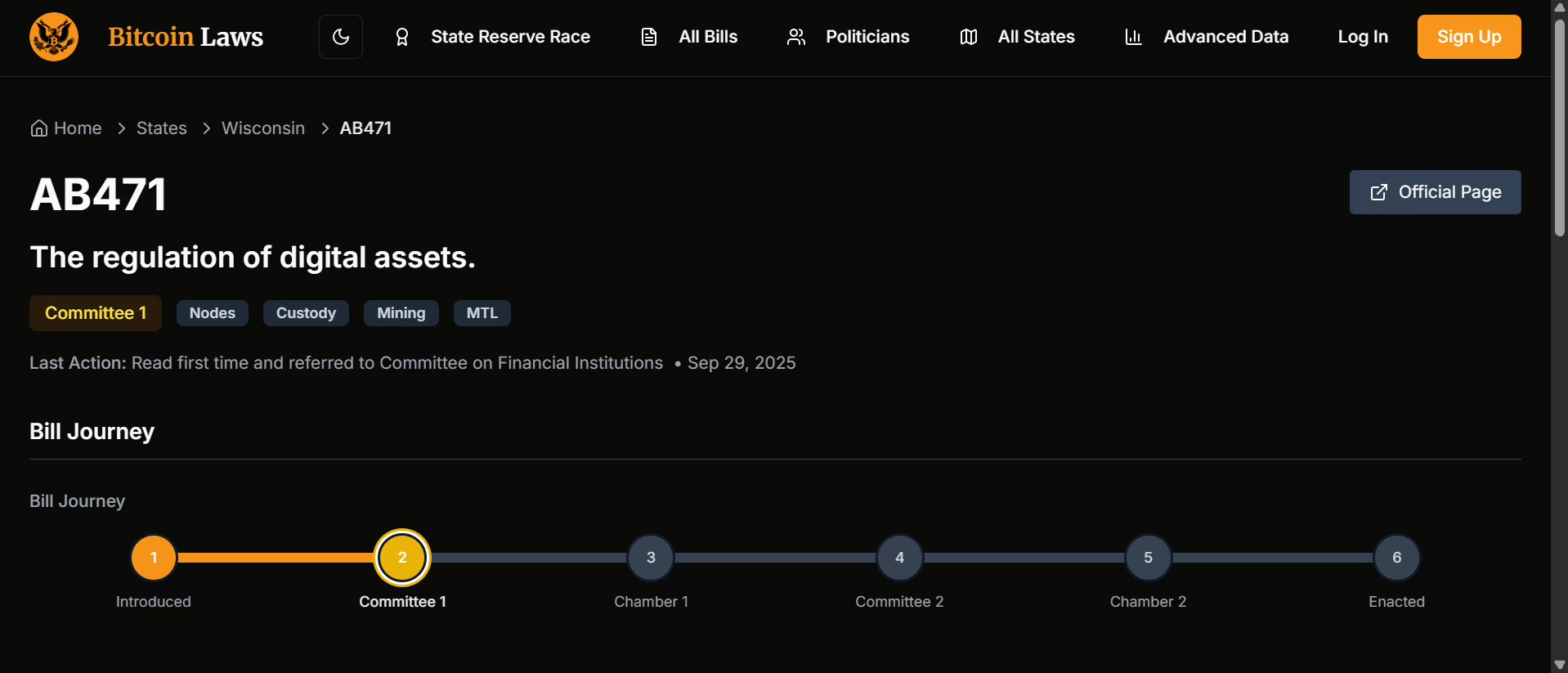 Progress of AB471 Bill. Source: Bitcoin Laws
Key provisions of the bill
According to the Wisconsin Legislative Reference Bureau, the measure would allow residents to engage in mining, staking, and blockchain software development without requiring a license from the Department of Financial Institutions (DFI).
The exemptions would also cover the exchange of digital assets, provided the transactions do not involve converting tokens into legal tender or bank deposits.
“Under the bill, neither a state agency nor a political subdivision may prohibit or restrict a person in accepting digital assets as a method of payment for legal goods and services or in taking custody of digital assets using a self-hosted wallet or hardware wallet,”
the document reads, adding that,
“The bill also specifies that a person in this state may 1) operate a node for the purpose of connecting to a blockchain protocol and participating in the blockchain protocol’s operations; 2) develop software on a blockchain protocol; 3) transfer digital assets to another person utilizing a blockchain protocol; and 4) participate in staking on a blockchain protocol.”
Legislative path and challenges
The bill has bipartisan interest but is currently sponsored by seven Republican Assembly members and two Republican senators. It has been referred to the Committee on Financial Institutions for review.
According to Legiscan data, the measure has reached just 25% progress and still needs to clear one chamber and two additional committees before it can be enacted into law.
Notably, the Wisconsin DFI launched a publicly accessible tracker to combat cryptocurrency and other investment scams. This initiative comes in response to nearly $3.55 million lost by Wisconsinites to financial grooming and cryptocurrency fraud between January 2022 and June 2024.
Disclaimer: The content of this article solely reflects the author's opinion and does not represent the platform in any capacity. This article is not intended to serve as a reference for making investment decisions.
You may also like
US Treasury "Liquidity Drain" Starts Again: Treasury Department Aggressively Issues Short-term Debt—Can Fragile AI Trading Withstand the Storm?
As artificial intelligence (AI) trading faces significant challenges, another liquidity “drain” triggered by U.S. Treasury issuance appears poised to impact the entire U.S. stock market.

Goldman Sachs: The U.S. stock market will have a "final surge" in 2027, but what follows may resemble the period just before the 2000 bubble burst
Goldman Sachs warns that the three core variables driving the strong performance of U.S. stocks over the past four years—earnings growth, capital flows, and the AI narrative—have all deteriorated at the margin. It is expected that the S&P 500 will complete its last round of gains, after which, in 2027, it will face the largest net equity supply shock since the bursting of the internet bubble in 2000.
Nvidia (NVDA.US) stock plunges in after-hours trading amid Jensen Huang’s personal scandal and internal investigation
Due to personal scandals involving CEO Jensen Huang and the company's initiation of an independent investigation, Nvidia's stock price plummeted by over 4% during after-hours trading on November 8.

Tech stocks experience their worst week since the pandemic; Morgan Stanley: AI trading hits the "wall" moment in the marathon.
After more than two years of a strong bull run, the market once believed that the AI narrative was already more than halfway completed and victory was within reach. However, last week’s crash suggests that the real test may have only just begun.
Crypto prices
More


