
Tether’s grip on stablecoins slips below 60% for first time since 2023

USDT dominance is eroding as Circle and other stablecoin competitors fight for a share of the pie.
- USDT dominance fell below 60% for the first time since 2023
- Circle’s USDC is its primary competitor, nearing 30% dominance
- The passage of the US GENIUS Act is making the market more competitive
Competition among stablecoin issuers is growing. On Friday, August 29, USDT dominance fell to 59.45%, according to data from DeFiLlama. This was the first time the key figure fell to these levels since March 2023, indicating that Tether may be losing its grip on the market.
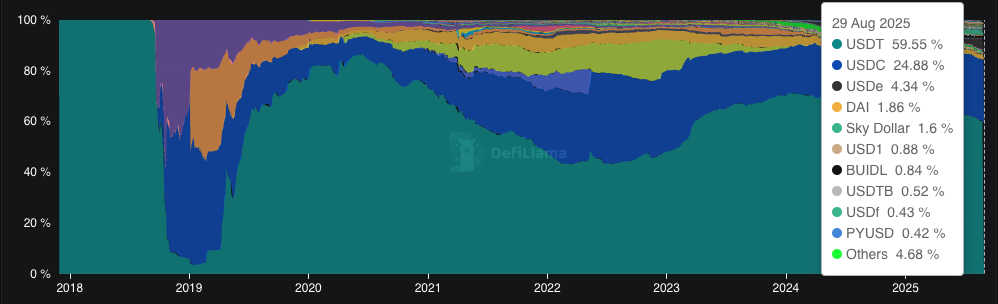
Notably, in the first half of 2024, USDT dominance hovered around 70%. At the same time, Tether’s main competitor, Circle’s USDC, controlled just 18% of the market, a figure which is now close to 30%. On the other hand, DAI’s dominance fell in that period, from around 3.5% to its current level of 1.86%.
One standout performer this year is Ethena’s USDe. Launched in December 2024, already reached 4.34% in dominance and a market cap of $12.275 billion. On the other hand, Trump World Liberty Financial’s USD1 controls 0.88% of the market.
Tether faces regulatory issues in Europe, the U.S.
Tether is not just facing increased competition. With more countries issuing stricter rules on stablecoins, its USDT is at a disadvantage. So far, Tether has declined to comply with Europe’s MiCA stablecoin framework, leading to its delisting on major exchanges.
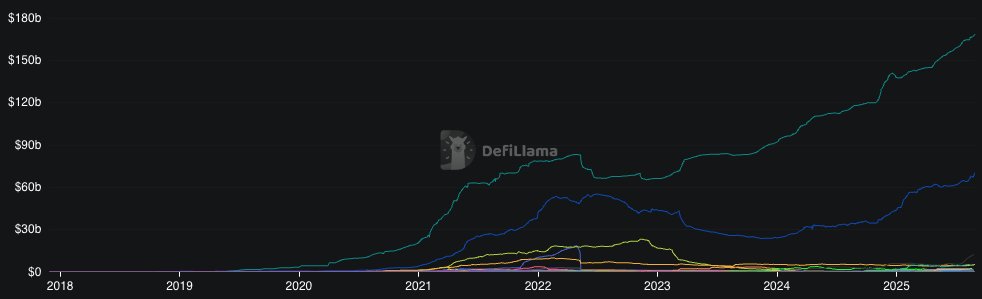
Tether may soon face the same issue in the United States, which recently passed the GENIUS Act, which requires more transparency from stablecoin issuers. Still, despite a shift in market positioning, major players, including Tether, are on the rise. Both USDT and USDC are at record levels, at $168.43 billion and $70.378 billion, respectively.
Disclaimer: The content of this article solely reflects the author's opinion and does not represent the platform in any capacity. This article is not intended to serve as a reference for making investment decisions.
You may also like
Cardano Foundation unveils zero-knowledge series as ADA drops 2.8% to $0.1725

How much CPO demand will Nvidia Rubin Ultra generate? Bernstein: Optical value per Pod will increase fivefold
Bernstein believes that the co-packaged optics (CPO) and fiber demand driven by Nvidia's Rubin Ultra architecture will surge significantly, with the optical content per Pod rising from $1 million to $5.4 million. This will propel the size of Nvidia's optical ecosystem market to $46.8 billion by 2028 (a 91% annual increase). Although the industry faces supply bottlenecks with InP substrates, the outlook remains positive. The institution reiterates its “outperform” rating for Lumentum, Coherent, and Ciena.

UBS Q3 implements a two-way strategy with gold options, heavily invests in technology stocks, and builds positions in SK Hynix (SKHY.US)
UBS Group (UBS.US) has submitted its Q3 holdings report (13F) as of September 30, 2026.

SpaceX (SPCX.US) reportedly attempts “de-Nvidiaization” at the rack level: developing Kessel cabinets to bypass L6 compute boards, purchasing only chips
SemiAnalysis: SpaceX has developed its own Kessel cabinet, bypassing Nvidia's L6 cards to provide more options for manufacturing its own hardware.

Crypto prices
More


