
Alibaba surges strongly after earnings, Group CEO says AI investments are starting to show results

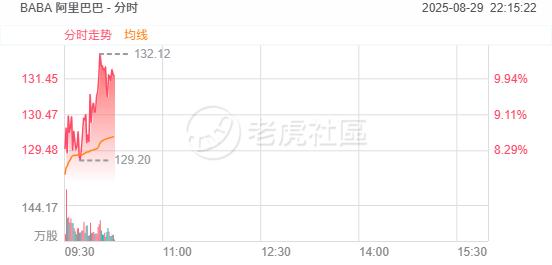
On Friday, Alibaba performed strongly after its earnings release, surging over 10% as of press time. In terms of news, the company’s Q2 fiscal revenue grew by 2% year-on-year, lower than expected, while net profit soared by 76% to 42.4 billion yuan, mainly due to gains from changes in the fair value of equity investments. Instant retail business revenue grew by 12% year-on-year in the first half of 2025. Alibaba Cloud revenue increased by 26% year-on-year, and AI-related product revenue achieved triple-digit year-on-year growth for eight consecutive quarters. Capital expenditure surged from about 11.9 billion yuan in the same period last year to about 38.7 billion yuan this quarter.
During tonight’s conference call, Alibaba Group CEO Wu Yongming stated that Alibaba owns the world’s fourth and Asia’s top cloud, and possesses full-stack technical capabilities from AI computing power, AI cloud platforms, AI models, open-source ecosystems to AI applications. This quarter, Alibaba’s Capex investment in AI+cloud reached 38.6 billion yuan. Over the past four quarters, more than 100 billion yuan has been invested in AI infrastructure and AI product R&D. Alibaba’s investment in AI has begun to show results. Whether it’s Alibaba Cloud’s rapid growth driven by customers’ AI demand or the AI experience upgrades in a wide range of to-C and to-B scenarios, the AI-driven path for Alibaba’s rapid growth has become even clearer.
Alibaba stated during the conference call that Taobao Flash Sale’s monthly active users have reached 300 million, a 200% increase from April, and that flash sales and instant retail are expected to bring 1 trillion yuan in new transactions over the next three years.
In addition, there are reports that Alibaba has developed a new AI chip to fill the gap left by Nvidia in the Chinese market. According to sources, this new chip is currently being tested and is designed to serve a broader range of AI inference tasks, and is compatible with Nvidia. The new chip is no longer manufactured by TSMC, but instead by a domestic company.
Disclaimer: The content of this article solely reflects the author's opinion and does not represent the platform in any capacity. This article is not intended to serve as a reference for making investment decisions.
You may also like
Cardano Foundation unveils zero-knowledge series as ADA drops 2.8% to $0.1725

How much CPO demand will Nvidia Rubin Ultra generate? Bernstein: Optical value per Pod will increase fivefold
Bernstein believes that the co-packaged optics (CPO) and fiber demand driven by Nvidia's Rubin Ultra architecture will surge significantly, with the optical content per Pod rising from $1 million to $5.4 million. This will propel the size of Nvidia's optical ecosystem market to $46.8 billion by 2028 (a 91% annual increase). Although the industry faces supply bottlenecks with InP substrates, the outlook remains positive. The institution reiterates its “outperform” rating for Lumentum, Coherent, and Ciena.

UBS Q3 implements a two-way strategy with gold options, heavily invests in technology stocks, and builds positions in SK Hynix (SKHY.US)
UBS Group (UBS.US) has submitted its Q3 holdings report (13F) as of September 30, 2026.

SpaceX (SPCX.US) reportedly attempts “de-Nvidiaization” at the rack level: developing Kessel cabinets to bypass L6 compute boards, purchasing only chips
SemiAnalysis: SpaceX has developed its own Kessel cabinet, bypassing Nvidia's L6 cards to provide more options for manufacturing its own hardware.

Crypto prices
More


