Bitget App
Trade smarter
Buy cryptoMarketsTradeFuturesStocksEarnInstitutionAI & More
BitTorrent (BTT) To Soar Further? Key Harmonic Pattern Hints at Potential Upside Move

BitTorrent (BTT) To Soar Further? Key Harmonic Pattern Hints at Potential Upside Move

CoinsProbeCoinsProbe2025/08/26 23:25
By:Nilesh Hembade

Date: Mon, Aug 25, 2025 | 11:56 AM GMT

The cryptocurrency market is cooling off after Jerome Powell hinted at potential rate cuts in September during today’s Jackson Hole event. Bitcoin (BTC) has retraced to $111K from its 24-hour high of $115K, while Ethereum (ETH) has dipped by 3%, adding downside pressure on major altcoins .

Despite this volatility, BitTorrent (BTT) is showing resilience and remains in the green — supported by an key harmonic structure.

BitTorrent (BTT) To Soar Further? Key Harmonic Pattern Hints at Potential Upside Move image 0 Source: Coinmarketcap

Harmonic Pattern Hints at Potential Upside

On the 4H chart, BTT is currently forming a Bearish Butterfly harmonic pattern. While the name implies a bearish setup, this pattern often involves a strong bullish rally in the CD leg before approaching its Potential Reversal Zone (PRZ).

The structure began from Point X near $0.0000007544, declined to Point A, rallied toward Point B, and then corrected to Point C near $0.0000006375. From there, BTT has staged a recovery and is now trading at $0.0000007125, with bullish momentum starting to build again.
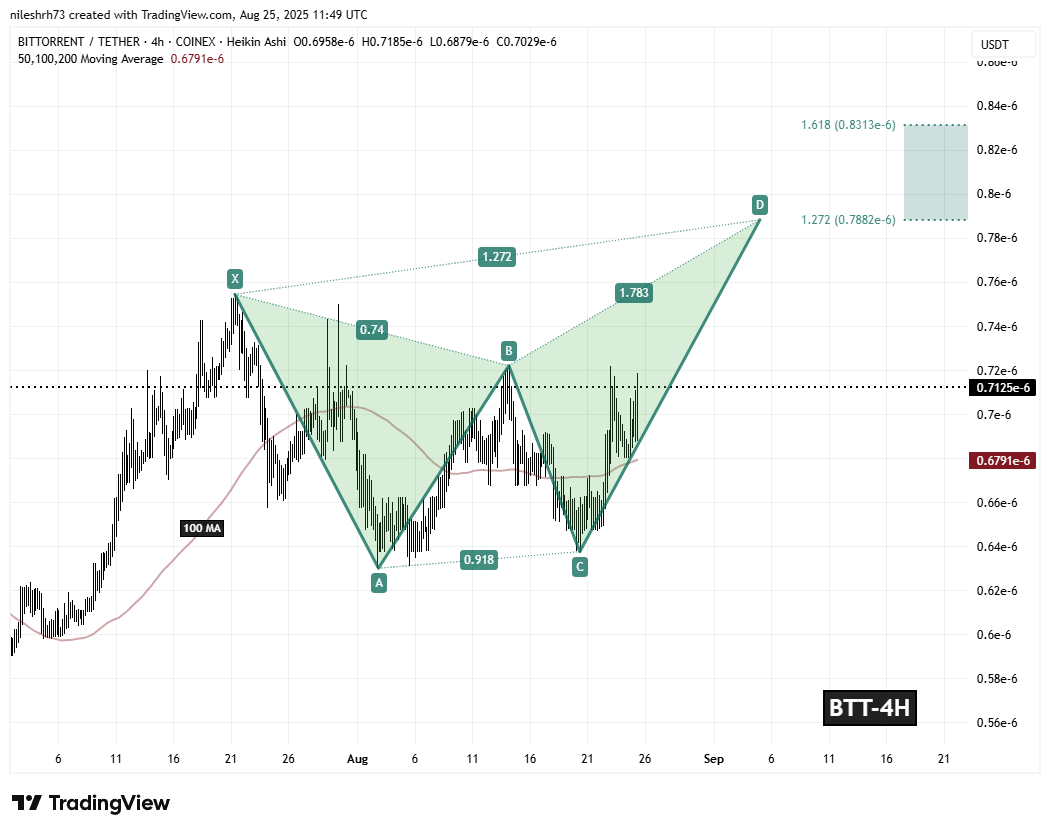
BitTorrent (BTT) To Soar Further? Key Harmonic Pattern Hints at Potential Upside Move image 1 BitTorrent (BTT) 4H Chart/Coinsprobe (Source: Tradingview)

Importantly, BTT is holding above its 200-day moving average at $0.0000006791, a critical support zone that could serve as a foundation for the next leg higher.

What’s Next for BTT?

If buyers continue to defend the 200-day MA, BTT could extend its rally into the PRZ zone between $0.0000007882 (1.272 Fibonacci extension) and $0.0000008313 (1.618 extension). This would complete the Butterfly pattern and represent an upside potential of +16% from current levels.

However, traders should also remain cautious — intraday retracements toward the lower edge of the CD leg cannot be ignored, especially if momentum weakens before reaching the PRZ.


0
0

Disclaimer: The content of this article solely reflects the author's opinion and does not represent the platform in any capacity. This article is not intended to serve as a reference for making investment decisions.

Understand the market, then trade.
Bitget offers one-stop trading for cryptocurrencies, stocks, and gold.
Trade now!

You may also like

How much CPO demand will Nvidia Rubin Ultra generate? Bernstein: Optical value per Pod will increase fivefold

Bernstein believes that the co-packaged optics (CPO) and fiber demand driven by Nvidia's Rubin Ultra architecture will surge significantly, with the optical content per Pod rising from $1 million to $5.4 million. This will propel the size of Nvidia's optical ecosystem market to $46.8 billion by 2028 (a 91% annual increase). Although the industry faces supply bottlenecks with InP substrates, the outlook remains positive. The institution reiterates its “outperform” rating for Lumentum, Coherent, and Ciena.

华尔街见闻•2026/11/11 08:47
How much CPO demand will Nvidia Rubin Ultra generate? Bernstein: Optical value per Pod will increase fivefold

UBS Q3 implements a two-way strategy with gold options, heavily invests in technology stocks, and builds positions in SK Hynix (SKHY.US)

UBS Group (UBS.US) has submitted its Q3 holdings report (13F) as of September 30, 2026.

智通财经•2026/11/11 08:22
UBS Q3 implements a two-way strategy with gold options, heavily invests in technology stocks, and builds positions in SK Hynix (SKHY.US)

SpaceX (SPCX.US) reportedly attempts “de-Nvidiaization” at the rack level: developing Kessel cabinets to bypass L6 compute boards, purchasing only chips

SemiAnalysis: SpaceX has developed its own Kessel cabinet, bypassing Nvidia's L6 cards to provide more options for manufacturing its own hardware.

智通财经•2026/11/11 08:20
SpaceX (SPCX.US) reportedly attempts “de-Nvidiaization” at the rack level: developing Kessel cabinets to bypass L6 compute boards, purchasing only chips

