
Ethereum Price Faces a Drop to $4,000 Owing to $2 Billion ETH Selling

Ethereum faces mounting pressure as $2.3 billion worth of ETH flows to exchanges, with risks of a drop to $4,000 if support fails.
Ethereum failed to reach the $5,000 mark earlier this month and is now struggling to remain above $4,500.
The altcoin king faces increasing pressure as recent market conditions weaken support levels. With selling activity rising, Ethereum could be vulnerable to further declines in the near term.
Ethereum Holders Are Selling
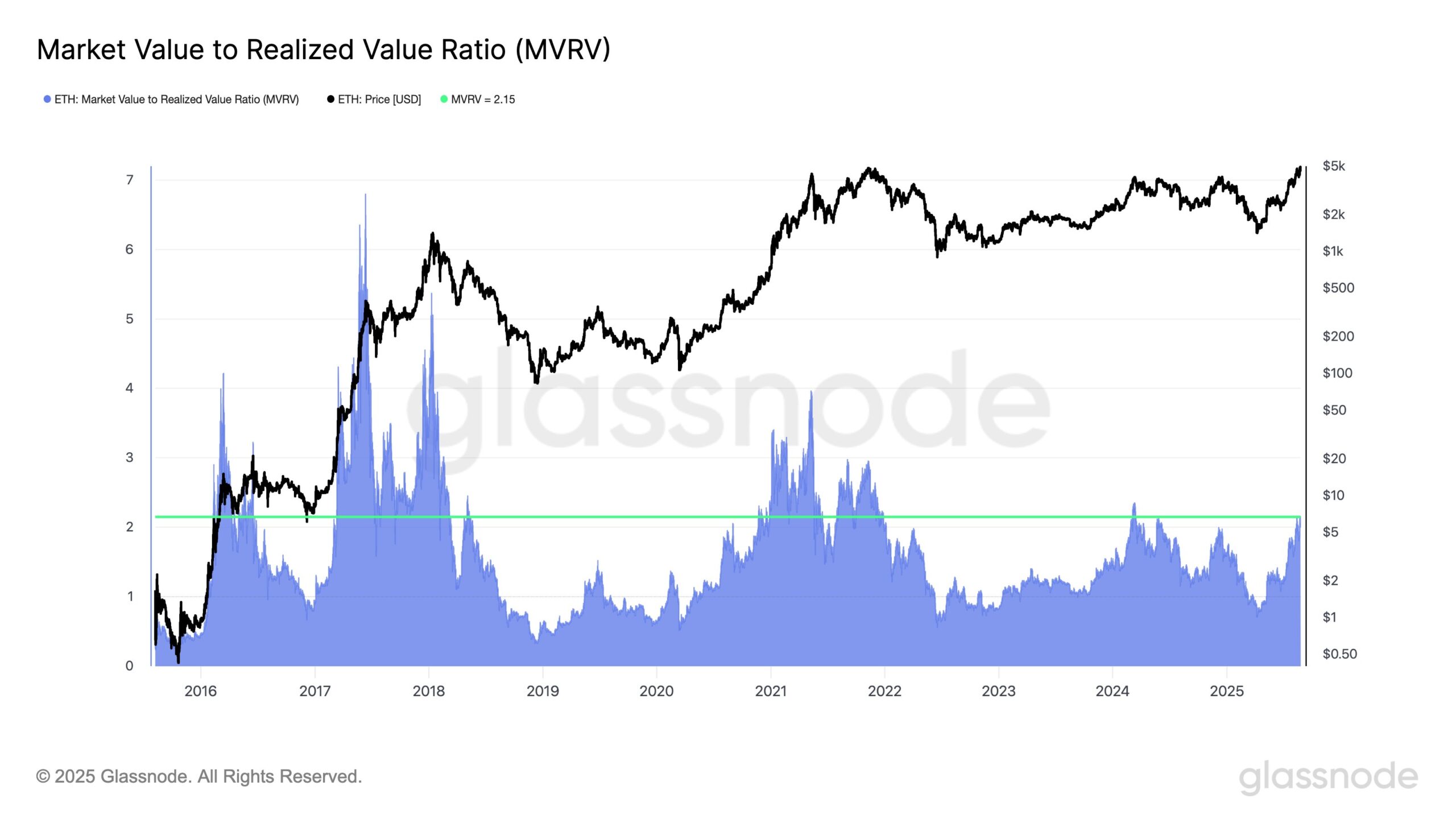
The MVRV Ratio for Ethereum has climbed to 2.15, showing that on average, investors currently hold 2.15 times their initial capital as unrealized gains. This level has historically coincided with periods of increased profit-taking. Similar patterns were observed in March 2024 and December 2020, both followed by heightened volatility.
On-chain data confirms profit-taking is already elevated. Investors are using these levels to lock in gains, leading to increased selling pressure. The correlation between the current MVRV ratio and past cycles highlights the likelihood of short-term corrections.
Want more token insights like this? Sign up for Editor Harsh Notariya’s Daily Crypto Newsletter
 Ethereum MVRV. Source:
Glassnode
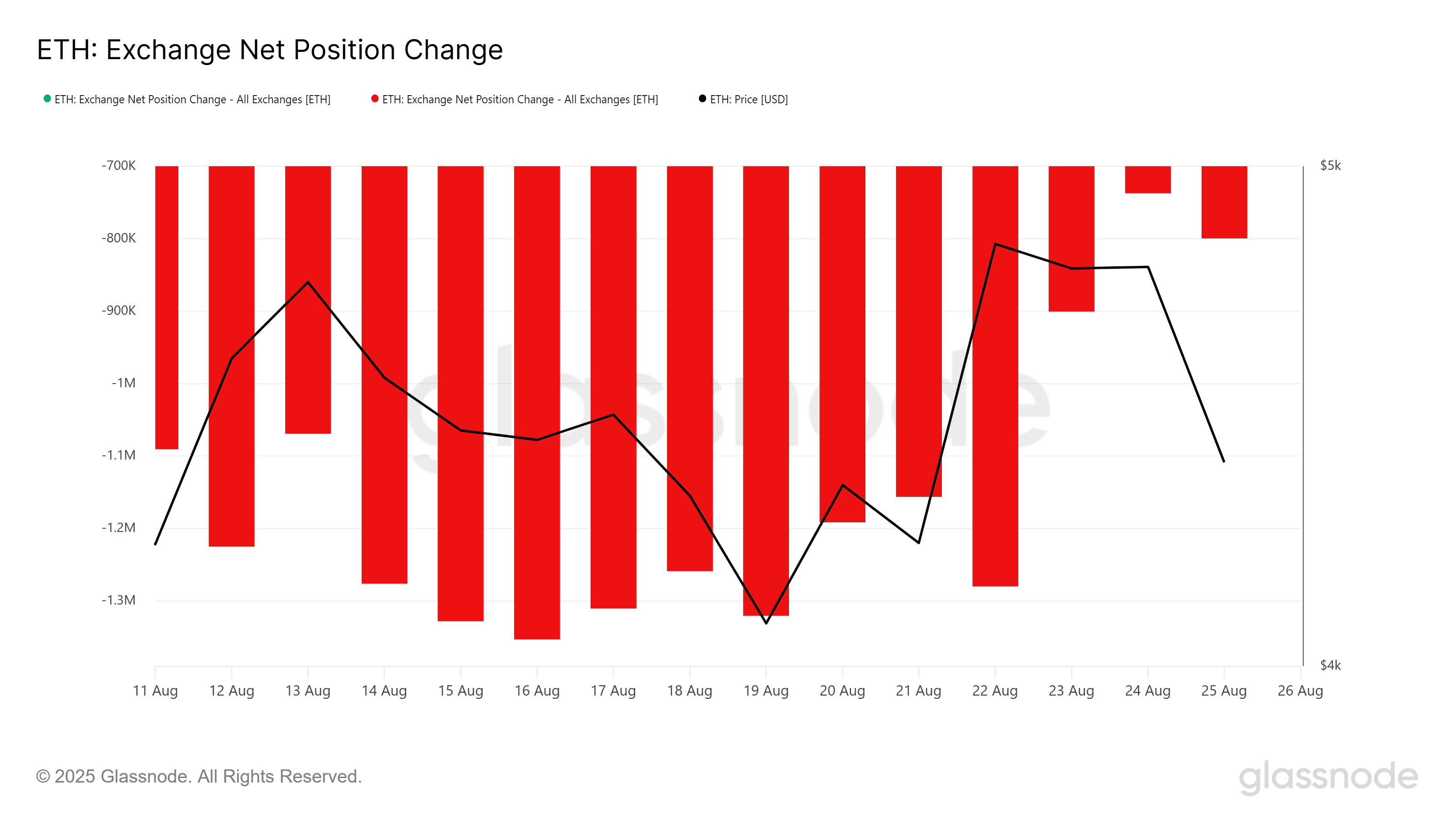
The exchange net position change further highlights selling activity. Investors have shifted from accumulation to distribution, with 521,000 ETH worth over $2.3 billion sent to exchanges in the past week. This scale of inflow indicates widespread profit-taking across the market. Such actions typically increase the chance of extended corrections.
The timing aligns with the MVRV signal, reinforcing the historical pattern of sharp declines following high unrealized gains. Fear of saturation in bullish momentum appears to be driving capital rotation. The combination of heavy inflows and elevated profit-taking weakens.
 Ethereum Exchange Net Position Change. Source:
Glassnode
ETH Price Remains Vulnerable
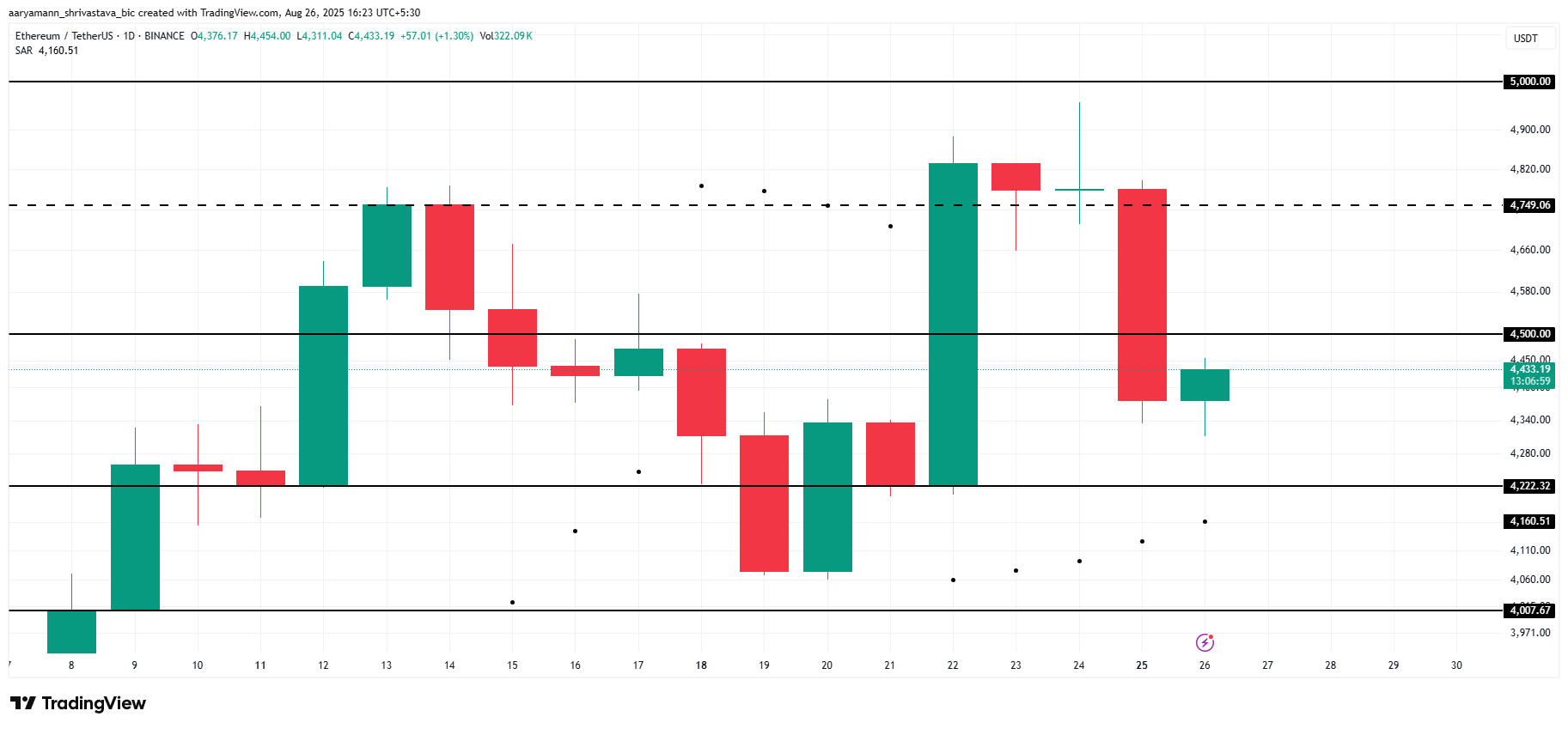
Ethereum trades at $4,433 at the time of writing, sitting below the $4,500 resistance. The asset failed to reclaim this level as support, signaling weakness in sustaining higher ground. Without renewed buying, Ethereum risks sliding further into lower ranges.
The prevailing conditions suggest Ethereum could break the $4,222 support. A decline below this level may push the altcoin king down to $4,007 or lower. Such movement would confirm broader selling trends and align with on-chain indicators signaling profit-taking.
 ETH Price Analysis. Source:
TradingView
If selling pressure halts, Ethereum may bounce from $4,222 and attempt to reclaim $4,500. A successful recovery could extend to $4,749, re-establishing short-term strength. This move would invalidate bearish signals.
Disclaimer: The content of this article solely reflects the author's opinion and does not represent the platform in any capacity. This article is not intended to serve as a reference for making investment decisions.
You may also like
Cardano Foundation unveils zero-knowledge series as ADA drops 2.8% to $0.1725

How much CPO demand will Nvidia Rubin Ultra generate? Bernstein: Optical value per Pod will increase fivefold
Bernstein believes that the co-packaged optics (CPO) and fiber demand driven by Nvidia's Rubin Ultra architecture will surge significantly, with the optical content per Pod rising from $1 million to $5.4 million. This will propel the size of Nvidia's optical ecosystem market to $46.8 billion by 2028 (a 91% annual increase). Although the industry faces supply bottlenecks with InP substrates, the outlook remains positive. The institution reiterates its “outperform” rating for Lumentum, Coherent, and Ciena.

UBS Q3 implements a two-way strategy with gold options, heavily invests in technology stocks, and builds positions in SK Hynix (SKHY.US)
UBS Group (UBS.US) has submitted its Q3 holdings report (13F) as of September 30, 2026.

SpaceX (SPCX.US) reportedly attempts “de-Nvidiaization” at the rack level: developing Kessel cabinets to bypass L6 compute boards, purchasing only chips
SemiAnalysis: SpaceX has developed its own Kessel cabinet, bypassing Nvidia's L6 cards to provide more options for manufacturing its own hardware.

Crypto prices
More


