
Decentralized Science Project Aubrai Launches on Base to Tackle Science Funding's ‘Valley of Death’

Longevity research is intersecting with crypto through Aubrai, a decentralized science (DeSci) and AI agent launched this week on Base as part of the Bio Protocol.
Decentralized science, or DeSci, uses blockchain and DAOs to fund experiments directly, attribute credit transparently, and turn research outputs into tokenized assets that let labs sustain themselves beyond philanthropy and traditional capital markets.
The AUBRAI token, launching on Bio Protocol’s Launchpad, makes holders permanent stakeholders in the agent’s research outputs, with governance rights over funding decisions and a share in revenues from commercialized discoveries
Built by VitaDAO and Bio Protocol with Aubrey de Grey’s LEV Foundation, Aubrai aims to bridge the “valley of death,” where long-horizon discoveries stall as capital markets retreat and labs depend on philanthropy.
de Grey is a biomedical gerontologist best known for pioneering longevity research through his Strategies for Engineered Negligible Senescence (SENS) framework and for advocating that aging can be treated as a curable condition.
“The consequences of traditional financing are a chronic funding gap, over-reliance on philanthropy, and a ‘valley of death’ between discovery and the clinic," de Grey told CoinDesk in an interview.
"That’s why we champion alternative mechanisms – DAOs, longevity-focused venture funds, and DeSci platforms – which can tolerate long horizons, align incentives around societal benefit, and crowd-source risk,” de Grey said.
Aubrai’s approach combines de Grey’s unpublished lab data with onchain incentives. By drawing on de Grey’s unpublished lab data, Aubrai gains access to exclusive insights beyond public literature, giving the agent a first-mover advantage in generating novel, commercially relevant hypotheses in longevity science.
The agent ingests experiments into a knowledge graph, generates hypotheses, and routes them to token-holder votes for funding.
“We are already seeing the agent formulate intriguing new hypotheses and recommend next steps,” de Grey said. “It’s the combination of agentic AI intelligence and expert human intelligence that has the potential to dramatically speed up breakthroughs in the fight against aging.”
Once experiments are validated, discoveries are minted into IP-tokens that can be licensed to pharmaceutical or biotech firms, with revenues cycling back to researchers and contributors.
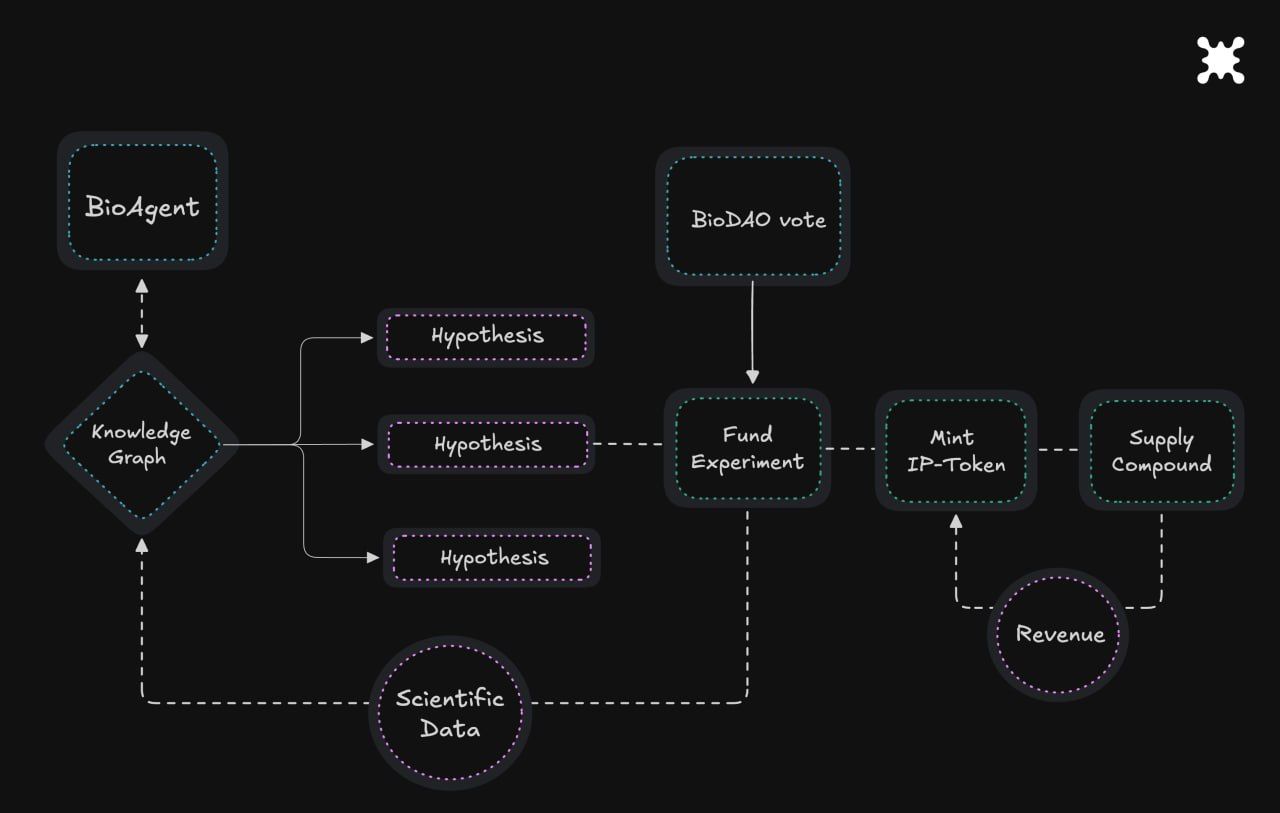
The system is already in use in de Grey’s Robust Mouse Rejuvenation (RMR2) study, one of the largest mouse lifespan experiments ever attempted. Aubrai has suggested methodological tweaks and flagged dosing caveats that researchers had only discovered after weeks of manual review.
“Having the agent at our disposal has been transformative for our planning pipeline,” de Grey said, noting that RMR2 involves nearly a dozen overlapping studies. “It identified points of consideration we had not yet encountered through literature, and it was proactive in suggesting ways to circumvent foreseen limitations.”
For Paul Kohlhaas, Bio Protocol’s founder, Aubrai represents a turning point in how science can be organized and financed.
“Just as Substack gave writers the ability to monetize outside legacy media, Bio’s infrastructure can turn scientists into the next great creator economy,” he said.
DeSci will face challenges
While projects like Aubrai and Bio Protocol demonstrate the potential of crypto capital beyond memecoins, tokenized intellectual property is likely to attract regulatory scrutiny, and established pharmaceutical firms may hesitate to adopt discoveries born out of decentralized collectives.
However, for a field like longevity, where breakthroughs often die in the space between early results and human trials because of a disinterested capital market, Aubrai offers an alternative path.
If it succeeds, it could demonstrate blockchain's potential to do more than just pump the next memecoin. It could provide the infrastructure to accelerate research itself, pushing the field of longevity closer to therapies that extend human health span.
It would also signal that decentralized science can function as a viable market alternative to the entrenched funding structures that have long constrained biomedical innovation.
Disclaimer: The content of this article solely reflects the author's opinion and does not represent the platform in any capacity. This article is not intended to serve as a reference for making investment decisions.
You may also like
Cardano Foundation unveils zero-knowledge series as ADA drops 2.8% to $0.1725

How much CPO demand will Nvidia Rubin Ultra generate? Bernstein: Optical value per Pod will increase fivefold
Bernstein believes that the co-packaged optics (CPO) and fiber demand driven by Nvidia's Rubin Ultra architecture will surge significantly, with the optical content per Pod rising from $1 million to $5.4 million. This will propel the size of Nvidia's optical ecosystem market to $46.8 billion by 2028 (a 91% annual increase). Although the industry faces supply bottlenecks with InP substrates, the outlook remains positive. The institution reiterates its “outperform” rating for Lumentum, Coherent, and Ciena.

UBS Q3 implements a two-way strategy with gold options, heavily invests in technology stocks, and builds positions in SK Hynix (SKHY.US)
UBS Group (UBS.US) has submitted its Q3 holdings report (13F) as of September 30, 2026.

SpaceX (SPCX.US) reportedly attempts “de-Nvidiaization” at the rack level: developing Kessel cabinets to bypass L6 compute boards, purchasing only chips
SemiAnalysis: SpaceX has developed its own Kessel cabinet, bypassing Nvidia's L6 cards to provide more options for manufacturing its own hardware.

Crypto prices
More


