
Pavel Durov Battles France Over Crypto Rules and Privacy Rights


- Pavel Durov said the French case against him is still unable to show wrongdoing.
- Telegram will not create backdoors or hand over encryption keys to authorities.
- Europe is weighing whether privacy and crypto are drivers of progress or seen as risks.
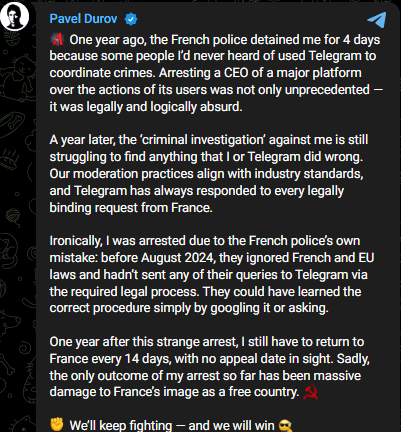
Pavel Durov, founder of Telegram, said the criminal case against him in France is still “struggling” to establish evidence a year after his arrest, raising new questions over Europe’s approach to crypto and privacy. He described the August 2024 arrest as “unprecedented” and insisted that holding a tech executive accountable for user activity was “legally and logically absurd.”
 Source:
Telegram
Investigation and Political Reactions
French authorities charged Durov after detaining him at Le Bourget Airport in connection with Telegram’s content moderation practices. Law enforcement claimed the platform hosted harmful content, sparking a wider probe into its operations. Durov confirmed that he was initially barred from leaving France and placed under strict judicial supervision as the investigation continued without a trial date.
Durov asserted in a Telegram post that his company has always responded to every legally binding request from France. He said moderation policies at Telegram align with global industry standards. According to him, the ongoing investigation has not uncovered wrongdoing by either himself or the platform.
The arrest triggered worldwide condemnation. Edward Snowden accused French President Emmanuel Macron of “taking hostages to gain access to private communications.” The TON Society called the case “a direct assault on a basic human right.”
Macron denied political motivation. In an August 26 post on X, he wrote, “In a state governed by the rule of law, freedoms are upheld within a legal framework, both on social media and in real life, to protect citizens and respect their fundamental rights.” Mert Mumtaz, CEO of Helius, responded by questioning why Macron himself was not accountable for failing to stop crime within France.
Privacy, Backdoors, and Censorship Concerns
Durov reaffirmed that Telegram would never provide encryption keys or build backdoors into its system. He warned that undermining encryption would expose users to greater risks. He also pledged that Telegram would leave any jurisdiction that required censorship rather than compromise privacy.
The arrest, according to many observers, became a flashpoint in the growing debate over state access to encrypted communications. Privacy advocates view the case as evidence of Europe’s determination to push platforms into compliance at the expense of digital freedom.
Related: Pavel Durov Gets Court Approval for 14-Day Trip to Dubai
Europe’s Larger Battle with Innovation
The investigation into Durov is increasingly being framed as part of Europe’s wider struggle with innovation in the digital economy. Critics argue that targeting individuals such as Durov could deter entrepreneurs from developing privacy-focused or decentralized technologies.
The European Union has already intensified scrutiny of encrypted platforms. Denmark has proposed legislation requiring companies such as WhatsApp, Signal, and Telegram to scan all user messages. The controversial “Chat Control” measure has backing from 19 of 27 EU states.
Observers warn that the legal battle could shape Europe’s digital trajectory. Will the continent embrace crypto and privacy as engines of innovation, or will it continue to treat these technologies as threats?
The post Pavel Durov Battles France Over Crypto Rules and Privacy Rights appeared first on Cryptotale.
Disclaimer: The content of this article solely reflects the author's opinion and does not represent the platform in any capacity. This article is not intended to serve as a reference for making investment decisions.
You may also like
Cardano Foundation unveils zero-knowledge series as ADA drops 2.8% to $0.1725

How much CPO demand will Nvidia Rubin Ultra generate? Bernstein: Optical value per Pod will increase fivefold
Bernstein believes that the co-packaged optics (CPO) and fiber demand driven by Nvidia's Rubin Ultra architecture will surge significantly, with the optical content per Pod rising from $1 million to $5.4 million. This will propel the size of Nvidia's optical ecosystem market to $46.8 billion by 2028 (a 91% annual increase). Although the industry faces supply bottlenecks with InP substrates, the outlook remains positive. The institution reiterates its “outperform” rating for Lumentum, Coherent, and Ciena.

UBS Q3 implements a two-way strategy with gold options, heavily invests in technology stocks, and builds positions in SK Hynix (SKHY.US)
UBS Group (UBS.US) has submitted its Q3 holdings report (13F) as of September 30, 2026.

SpaceX (SPCX.US) reportedly attempts “de-Nvidiaization” at the rack level: developing Kessel cabinets to bypass L6 compute boards, purchasing only chips
SemiAnalysis: SpaceX has developed its own Kessel cabinet, bypassing Nvidia's L6 cards to provide more options for manufacturing its own hardware.

Crypto prices
More


