
USDC on Ethereum Surges to $748B Monthly Transfers in July

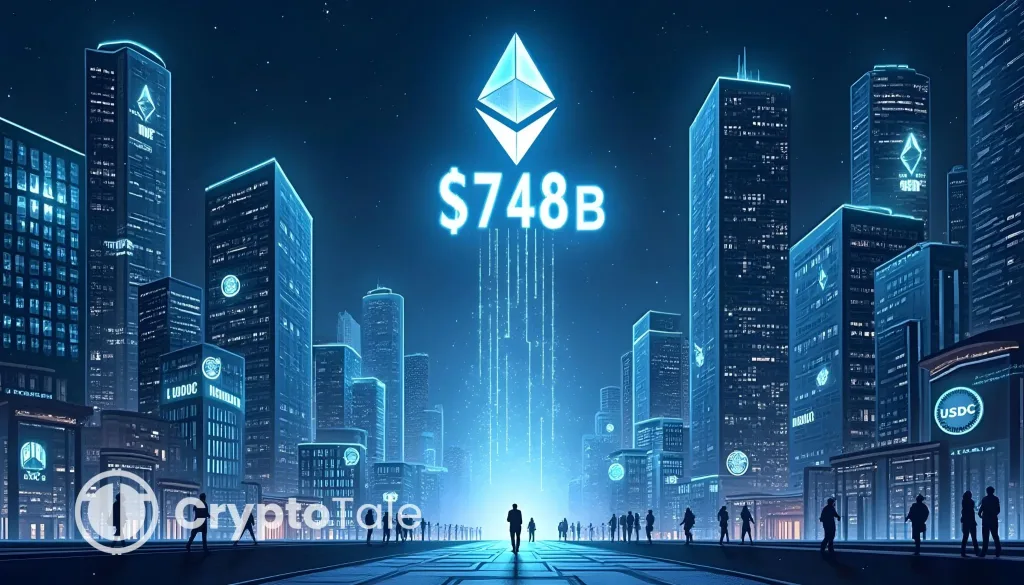
- USDC transfers on Ethereum surged to $748B in July, marking a record transaction volume.
- Stablecoin adoption continues to rise as USDC drives major settlement flows across Ethereum.
- Analysts from Goldman Sachs highlight stablecoin use as critical for institutional adoption.
The stablecoin sector has entered a new stage of expansion. In July 2025, USDC transfers on Ethereum reached $748.3 billion. During the same month, the network processed 8.3 million transactions. These figures show stablecoins are approaching settlement volumes once dominated by banks.
Ethereum Becomes a Settlement Hub
According to the data from Token Terminal, which tracks blockchain metrics, USDC activity rose 300% from January 2024 lows. Since 2018, Ethereum has processed $39.7 trillion in swapped stablecoin volume. USDC has been the main driver of this surge. The network now handles daily transfer volumes that surpass rival blockchains. This dominance strengthens Ethereum’s position as the primary hub for global stablecoin transactions.
— Token Terminal
BREAKING: USDC usage on @ethereum is at an all-time high, w/ key metrics up ~300% from Jan '24 lows.
Monthly transfer volume in July was $748.3 billion & transfer count 8.3 million.@circle, a listed company w/ a ~$31 billion market cap, is scaling on public blockchains. pic.twitter.com/etMoC0w3VZ(@tokenterminal) August 24, 2025

Stablecoins are enabling payments, remittances, and decentralized finance on a scale formerly reserved for banks. Circle, the issuer of USDC, has played a central role in this growth. The listed firm now carries a market cap of about $31 billion. Its expansion of USDC across public blockchains gives the token a broader reach and deeper integration.
Competing blockchains like Solana and Tron have also gained some traction around stablecoin activity, but at a smaller scale. Tron has gained popularity in Asia for its cheap remittance, while Solana has attracted developers with its speed. However, institutional actors still make use of Ethereum due to its depth of liquidity, security, and its established ecosystem. This foundation makes Ethereum the preferred settlement layer for global firms experimenting with digital assets.
Analysts Highlight a Turning Point
Goldman Sachs analysts have referred to 2025 as the “summer of stablecoins”. They believe that stablecoins can improve the global banking purview. Analysts claim that stablecoins might not replace banks, but have become a vital part of financial infrastructure in the world.
The trend highlights how blockchain-based assets are solving real-world problems. Stablecoins allow fast, low-cost transfers across borders. Their role in global commerce, remittances, and digital payments is expanding quickly. Governments and central banks are also monitoring the trend.
The growth of USDC also coincides with a milestone for Ethereum itself. On August 25, 2025, Ether peaked at $4,953, marking its all-time high. The rally was preceded by consistent accumulation in the mid-$4,700 area, with the demand absorbing historical resistance.
Market observers view the breakout as evidence of shifting momentum. The rallies in Bitcoin have decelerated, whereas the Ethereum market action has gained momentum. Analysts believe that this momentum confirms Ethereum as the leading blockchain in terms of stablecoins and financial activity.
Related: Ethereum at an Inflection Point: Can it Deliver Its “Wall Street Moment”?
Stablecoins Enter the Mainstream
The July surge marks a turning point in the history of stablecoins. Transfers of $748.3 billion in USDC are evidence that this sector is now working at a banking level. Its expansion demonstrates that stablecoins are no longer niche assets. They are becoming essential to digital finance and settlement systems worldwide. Industry analysts expect this trend to continue. With emerging regulatory clarity, stablecoins may serve as bridges rather than replacements for banks.
The post USDC on Ethereum Surges to $748B Monthly Transfers in July appeared first on Cryptotale.
Disclaimer: The content of this article solely reflects the author's opinion and does not represent the platform in any capacity. This article is not intended to serve as a reference for making investment decisions.
You may also like
Cardano Foundation unveils zero-knowledge series as ADA drops 2.8% to $0.1725

How much CPO demand will Nvidia Rubin Ultra generate? Bernstein: Optical value per Pod will increase fivefold
Bernstein believes that the co-packaged optics (CPO) and fiber demand driven by Nvidia's Rubin Ultra architecture will surge significantly, with the optical content per Pod rising from $1 million to $5.4 million. This will propel the size of Nvidia's optical ecosystem market to $46.8 billion by 2028 (a 91% annual increase). Although the industry faces supply bottlenecks with InP substrates, the outlook remains positive. The institution reiterates its “outperform” rating for Lumentum, Coherent, and Ciena.
UBS Q3 implements a two-way strategy with gold options, heavily invests in technology stocks, and builds positions in SK Hynix (SKHY.US)
UBS Group (UBS.US) has submitted its Q3 holdings report (13F) as of September 30, 2026.

SpaceX (SPCX.US) reportedly attempts “de-Nvidiaization” at the rack level: developing Kessel cabinets to bypass L6 compute boards, purchasing only chips
SemiAnalysis: SpaceX has developed its own Kessel cabinet, bypassing Nvidia's L6 cards to provide more options for manufacturing its own hardware.

Crypto prices
More


