
Dogecoin Price Explosion: Is $1 Back on the Table?

Dogecoin price has once again become the center of market attention after a string of regulatory and corporate developments coincided with a sharp price rebound. From a Trump-linked $50 million acquisition in DOGE mining to Wyoming launching the first state-backed stablecoin, the environment around digital assets is shifting. Add to that the Federal Reserve signaling a softer stance on crypto, and you have the perfect recipe for institutional inflows into meme coins like DOGE.
The daily chart now reflects this renewed optimism, with price action pushing past short-term resistance and testing the upper Bollinger Band. The big question: can this wave of institutional confidence sustain a rally toward 30 cents and beyond?
Dogecoin Price Prediction: Why the News Matters for DOGE Price?
The $50 million acquisition of Dogehash by Thumzup , a Trump-affiliated entity, is more than just a headline. It signals confidence in Dogecoin infrastructure from politically connected, deep-pocketed backers. This isn’t speculative retail enthusiasm — it’s a show of long-term commitment to DOGE mining .
Wyoming’s state-backed stablecoin, the Frontier Stable Token, adds legitimacy to U.S. digital assets and indirectly strengthens DOGE’s narrative as a parallel, community-driven coin. At the same time, Fed Vice Chair Michelle Bowman’s comments warning banks against delaying digital asset adoption signal that regulatory headwinds are easing. Together, these catalysts explain why institutional flows picked up sharply this week.
Chart Analysis: Dogecoin Daily Trend
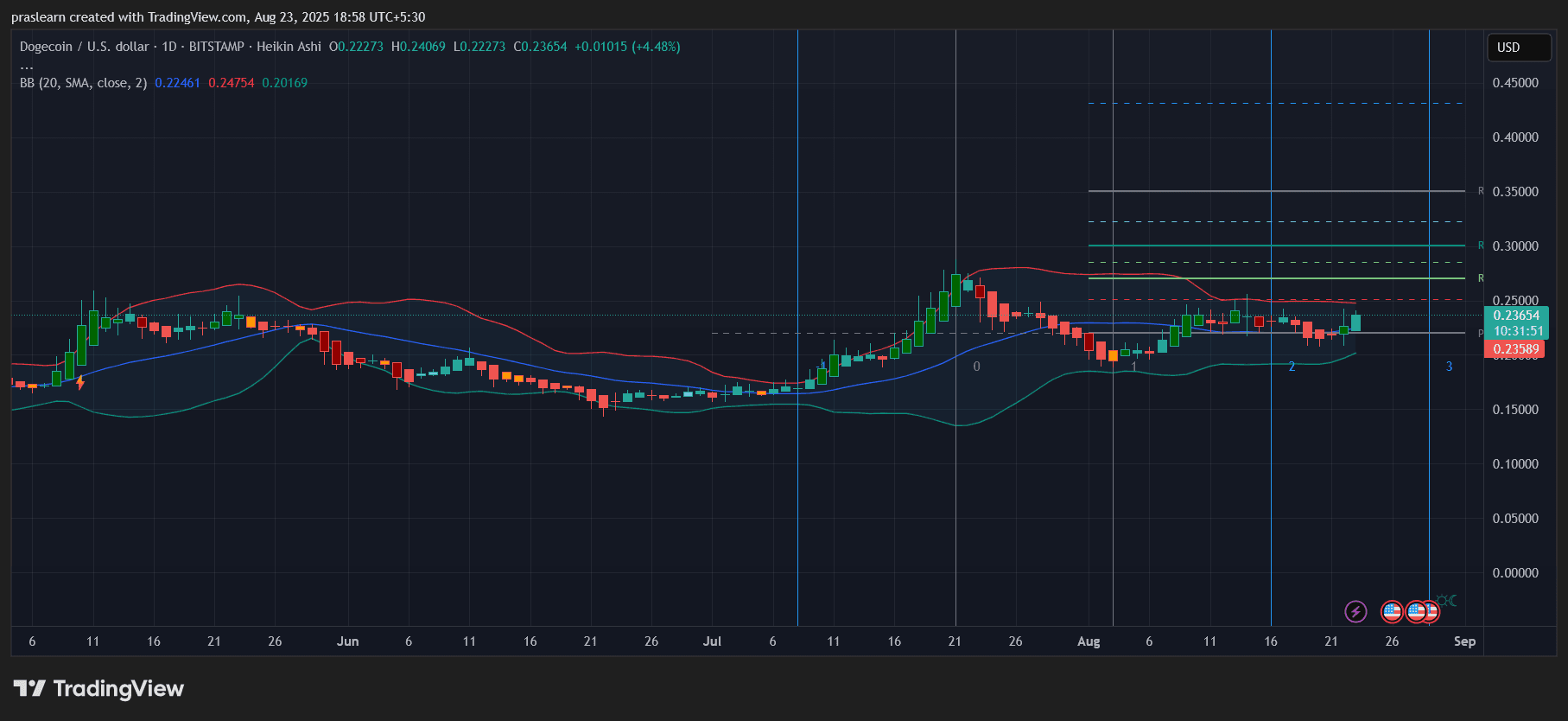 DOGE/USD Daily Chart- TradingView
On the daily chart, DOGE price is trading at $0.236, up 4.5% on the session. The move took price back above the 20-day simple moving average and toward the midpoint of the Bollinger Band range.
Key observations from the chart:
- Strong support sits around $0.21, where DOGE consolidated with heavy volume earlier this week.
- The first resistance zone is near $0.25, coinciding with the upper Bollinger Band. A breakout here could quickly open up the $0.28–$0.30 range.
- A sustained close above $0.30 would target $0.35 and potentially $0.42 based on Fibonacci extensions.
Momentum has turned positive, but volumes will need to remain high for follow-through. The chart shows higher lows forming, which strengthens the bullish case.
Institutional Flows vs Retail Speculation
DOGE’s latest rally has been driven less by retail euphoria and more by institutional positioning. Large trading volumes between $0.21–$0.22 suggest accumulation. If institutions continue to see DOGE as an on-ramp into broader crypto narratives, price stability above $0.25 could invite further flows.
The difference this time is that DOGE price isn’t just riding Elon Musk’s tweets or meme hype — it’s riding real structural shifts in U.S. digital asset adoption.
Dogecoin Price Prediction: Near-Term and 30-Day Outlook
- Bullish scenario: A break above $0.25 could ignite momentum toward $0.30 in the coming week. If volume supports the move, $0.35–$0.42 becomes a realistic 30-day target.
- Neutral scenario: DOGE price consolidates between $0.21 and $0.25, with sideways movement as traders digest the news.
- Bearish scenario: A breakdown below $0.21 would re-expose $0.18 as support, invalidating the bullish thesis.
Given the combination of chart strength and regulatory tailwinds, the probability currently leans bullish.
Final Takeaway
Dogecoin price recent surge isn’t just another meme rally — it’s the result of institutional adoption signals and regulatory momentum in the U.S. With $50 million pouring into DOGE mining, a state-backed stablecoin in Wyoming, and the Fed softening its tone, the backdrop for DOGE is stronger than it has been in months.
As long as DOGE holds above $0.21, the path toward $0.30 looks increasingly viable. A decisive breakout there could set the stage for a much larger rally into the 35–40 cent range in the coming month.
$Dogecoin, $DOGE
Disclaimer: The content of this article solely reflects the author's opinion and does not represent the platform in any capacity. This article is not intended to serve as a reference for making investment decisions.
You may also like
Cardano Foundation unveils zero-knowledge series as ADA drops 2.8% to $0.1725

How much CPO demand will Nvidia Rubin Ultra generate? Bernstein: Optical value per Pod will increase fivefold
Bernstein believes that the co-packaged optics (CPO) and fiber demand driven by Nvidia's Rubin Ultra architecture will surge significantly, with the optical content per Pod rising from $1 million to $5.4 million. This will propel the size of Nvidia's optical ecosystem market to $46.8 billion by 2028 (a 91% annual increase). Although the industry faces supply bottlenecks with InP substrates, the outlook remains positive. The institution reiterates its “outperform” rating for Lumentum, Coherent, and Ciena.

UBS Q3 implements a two-way strategy with gold options, heavily invests in technology stocks, and builds positions in SK Hynix (SKHY.US)
UBS Group (UBS.US) has submitted its Q3 holdings report (13F) as of September 30, 2026.

SpaceX (SPCX.US) reportedly attempts “de-Nvidiaization” at the rack level: developing Kessel cabinets to bypass L6 compute boards, purchasing only chips
SemiAnalysis: SpaceX has developed its own Kessel cabinet, bypassing Nvidia's L6 cards to provide more options for manufacturing its own hardware.

Crypto prices
More


