
Cardano Price Holds Bullish Pattern—But a 90% Drop in Key Metric May Spell Trouble

Cardano’s price still looks technically bullish, but buyer strength is thinning fast. One on-chain metric just fell 90%, raising new downside risk.
The Cardano price is up 2.9% in the past 24 hours, showing surprising strength while most top altcoins remain flat. But on the 7-day chart, ADA is still down over 12%.
ADA’s short-term chart shows a strong bullish pattern with upside potential. But if we zoom out or check on-chain data, there’s a visible weakness forming beneath the surface. A bullish pattern alone isn’t enough—especially when key support metrics are vanishing. Cardano may be holding structure, but it’s losing critical ground.
Cardano’s 90% Drop in Outflow Hints at Buyer Weakness
Over the past few days, net outflows from ADA spot exchanges have slowed drastically. At its local peak, Cardano recorded $40.07 million in daily outflows: a clear sign of strong buying conviction, as traders were pulling coins off exchanges.
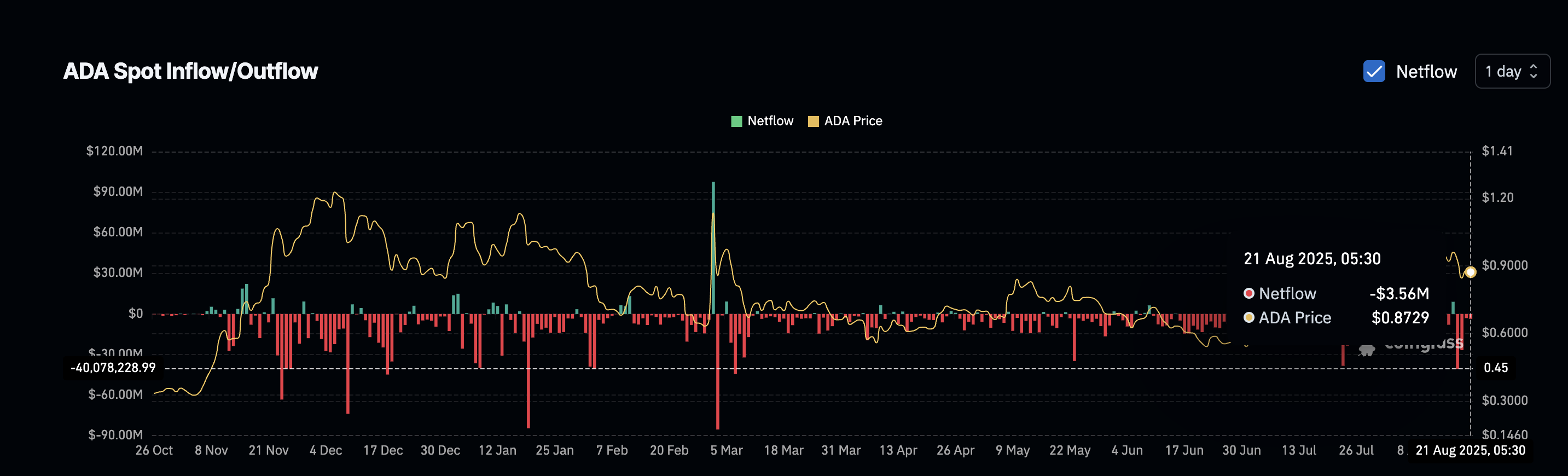 Cardano buyers are backing out:
Coinglass
That conviction has faded. By August 21, ADA’s net outflow dropped to just $3.56 million. That’s a 91% decline from peak demand. While this still represents net outflow, the plunge in size suggests buyers are stepping aside. There’s still no aggressive inflow, but momentum has stalled.
For token TA and market updates: Want more token insights like this? Sign up for Editor Harsh Notariya’s Daily Crypto Newsletter
Too Many Longs? Leverage Stack Could Add Fuel to the Fire
Liquidation map data shows ADA’s long positions are stacked dangerously tight. On Bitget, over $174.80 million in long leverage is built up, compared to just $73.56 million in shorts.
The biggest leveraged cluster sits near $0.83 to $0.85, meaning if the Cardano price drops to that range, liquidations could snowball. Even though too many Long positions signify positive bias but an imbalance as this can lead to a long squeeze.
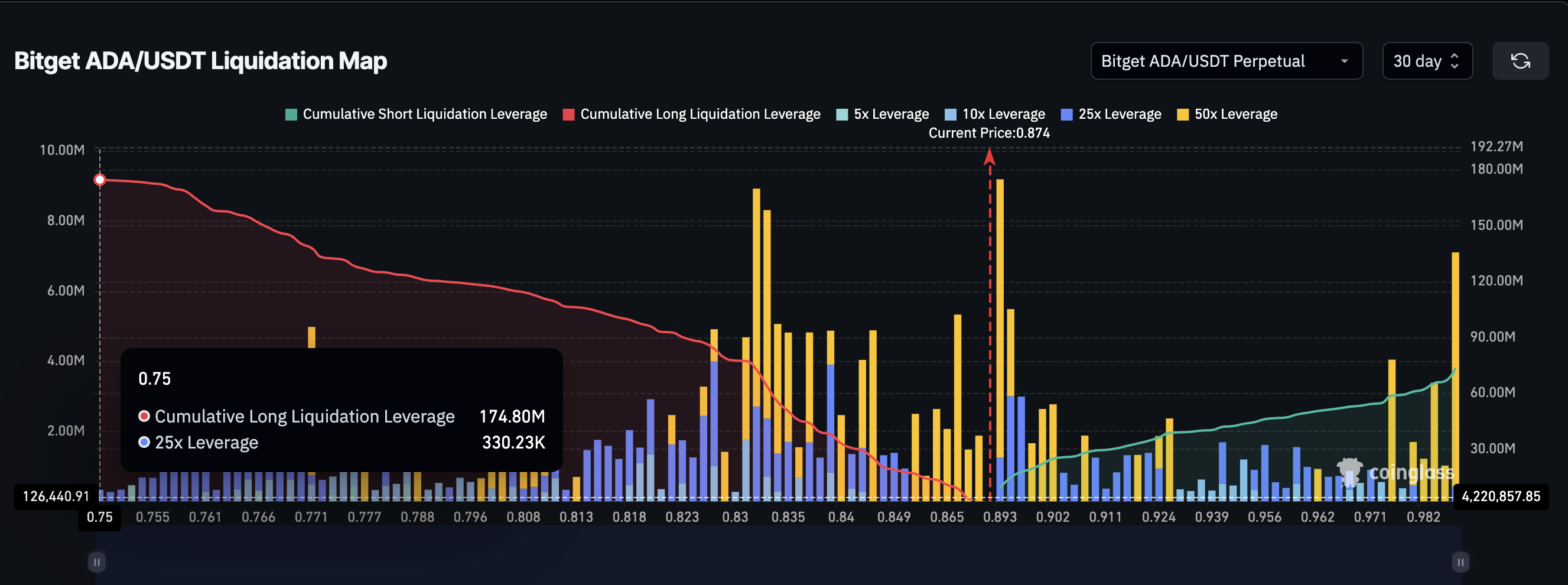 Cardano derivatives favor a long squeeze:
Coinglass
With most of the market betting long, a dip below the key support level could cause fast unwinding and volatility.
It’s a classic overload setup. Bullish traders may unknowingly be fueling a sudden move down, especially since the price is sitting right on top of key long clusters, and sellers are starting to gain strength.
Cardano Price Pattern Remains Intact, But Pressure Points Are Building
On the daily chart, the Cardano price continues to trade within an ascending triangle. The immediate breakout level sits at $0.91. If that clears, ADA could run toward $1.01–$1.10, backed by the most important 0.5 and 0.618 Fibonacci extension levels.
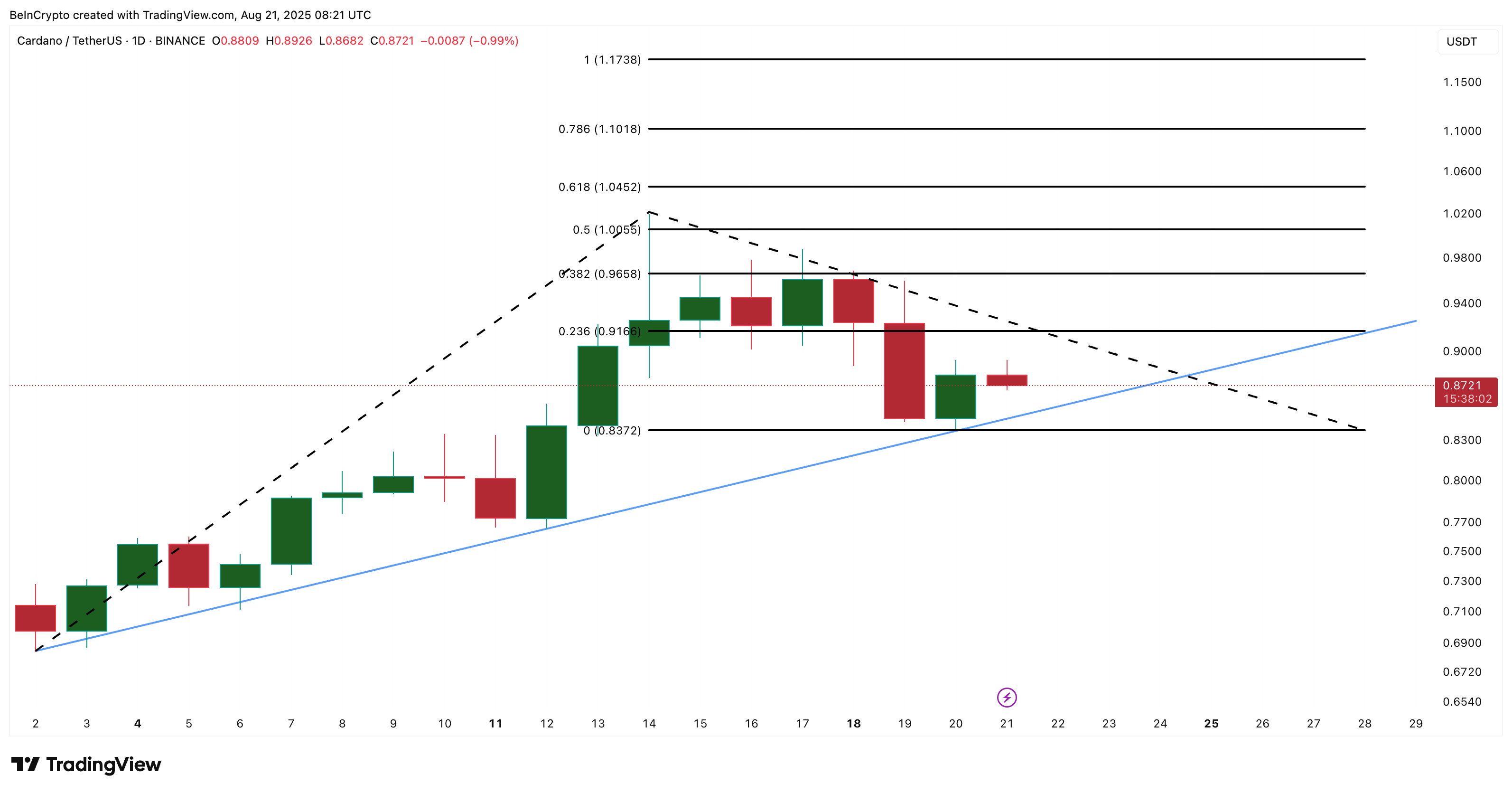 ADA price analysis:
TradingView
But the support line at $0.83 is now critical. If the ADA price breaks below this, the triangle pattern breaks down, and all bullish setups become invalidated.
With reduced outflow support and leverage imbalance, this level is no longer well-defended. The Cardano price may look bullish structurally, but it’s leaning on weakening legs.
Disclaimer: The content of this article solely reflects the author's opinion and does not represent the platform in any capacity. This article is not intended to serve as a reference for making investment decisions.
You may also like
How much CPO demand will Nvidia Rubin Ultra generate? Bernstein: Optical value per Pod will increase fivefold
Bernstein believes that the co-packaged optics (CPO) and fiber demand driven by Nvidia's Rubin Ultra architecture will surge significantly, with the optical content per Pod rising from $1 million to $5.4 million. This will propel the size of Nvidia's optical ecosystem market to $46.8 billion by 2028 (a 91% annual increase). Although the industry faces supply bottlenecks with InP substrates, the outlook remains positive. The institution reiterates its “outperform” rating for Lumentum, Coherent, and Ciena.

UBS Q3 implements a two-way strategy with gold options, heavily invests in technology stocks, and builds positions in SK Hynix (SKHY.US)
UBS Group (UBS.US) has submitted its Q3 holdings report (13F) as of September 30, 2026.

SpaceX (SPCX.US) reportedly attempts “de-Nvidiaization” at the rack level: developing Kessel cabinets to bypass L6 compute boards, purchasing only chips
SemiAnalysis: SpaceX has developed its own Kessel cabinet, bypassing Nvidia's L6 cards to provide more options for manufacturing its own hardware.

$3.7 billion “data center power equipment prepayments” abandoned! What did "the most active buyer of gas turbines", SoftBank, see?
In the second quarter of fiscal year 2026, SoftBank reported a net loss of $7.1 billion, primarily due to a $3.7 billion impairment charge from a $9.5 billion advance payment for power generation equipment for US data centers—of which about $2.9 billion was non-refundable and effectively lost. The CFO admitted that SoftBank placed orders before the project plan was finalized, and is now conducting a comprehensive review of its procurement strategy. "The most aggressive purchaser of gas turbines has now written off the deposit in this way."
Crypto prices
More


