
DBS Launches Tokenized Structured Notes on Ethereum Blockchain

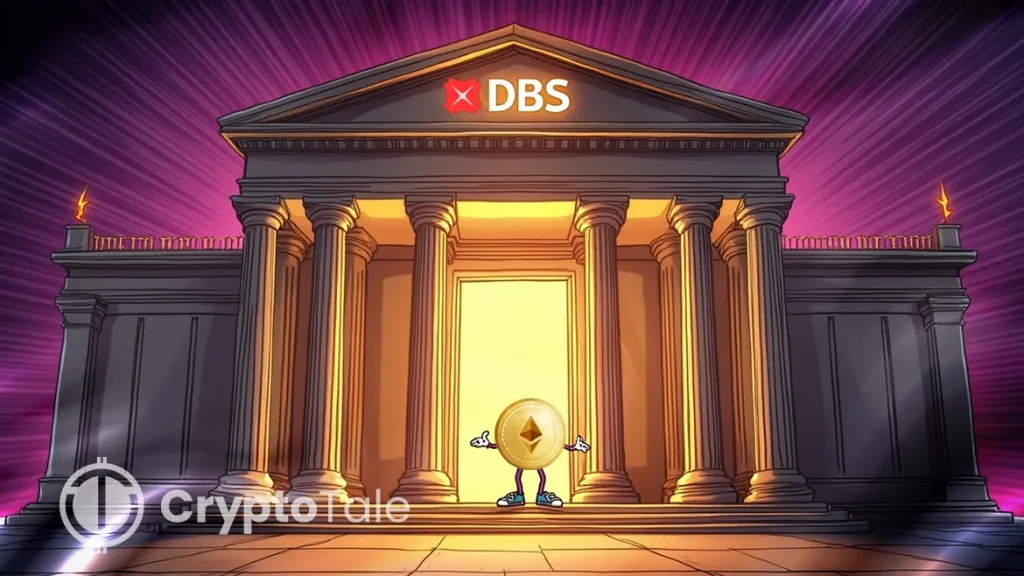
- DBS cuts thresholds to $1K, making structured finance easier for investors to access.
- The bank uses Ethereum to improve liquidity and trading through smaller, flexible units.
- Programmable tools streamline the issuing and redemption process for clients worldwide.
Singapore’s largest bank, DBS, has launched tokenized structured notes on Ethereum’s public blockchain, expanding access to complex products once reserved for private banking clients. The bank said the instruments will be distributed through licensed exchanges ADDX, DigiFT, and HydraX, making them available to accredited and institutional investors outside its own network for the first time. In a press release, DBS described this as a landmark expansion of its blockchain strategy.
Broader Access Through Tokenization
Li Zhen, head of foreign exchange and digital markets at DBS, said, “Asset tokenization is the next frontier of financial markets infrastructure. Our first tokenized product, a crypto-linked note, addresses the growing institutional appetite for digital assets.”
Structured notes link their value to an underlying asset or index, often tailored to meet investor requirements such as boosting returns or reducing downside exposure. These traditionally carry minimum investment thresholds of $100,000. DBS confirmed that its tokenized version lowers the entry point by breaking each instrument into $1,000 units.
The bank explained that this change makes securities fungible and easier to trade. Smaller denominations provide greater flexibility for portfolio management and secondary market activity. DBS also indicated that the products are designed to provide cash payouts when cryptocurrency prices rise while limiting losses when prices fall.
Rising Institutional Demand
According to DBS, demand for such instruments has always been high, as investors wish to diversify their digital asset portfolio by applying advanced strategies. In the first half of 2025, structured product trades executed by DBS clients amounted to over $1 billion, with the trade volume increasing by close to 60% from Q1 to Q2.
The bank has observed that this growth is particularly pertinent to the family office sector and professional investors. In 2024, Singapore saw an increase of over 2,000 single-family offices, representing a 43% addition from 2023.
This development also aligns with Singapore’s growing position as a hub for tokenized finance. The Monetary Authority of Singapore has been leading pilots through Project Guardian, which explores tokenization across fixed income, foreign exchange, and funds, while supporting the development of cross-border infrastructure like Global Layer One.
Related: Institutional Bitcoin Staking Boosts With Core-Hex Partnership
Shifting Finance Toward Public Blockchain
DBS said the launch demonstrates that tokenization has moved from concept to practical use in mainstream finance. Instead of relying on private blockchains, the bank is issuing structured notes directly on Ethereum.
The tokenized structured notes hold the promise of better transparency, enhanced efficiency, and reduced counterparty risk due to smart contract-based execution. Lower minimum investment thresholds and increased flexibility also bring higher liquidity, broadening access to a wider range of institutional markets.
DBS’s launch not only brings a new product to the crypto market but also signals a shift in structured finance. The bank can optimize these entry thresholds, improve liquidity, and streamline operations using programmable efficiency through tokenization on Ethereum. This move would provide a base of financial instruments that are both accessible and transparent and are globally scalable. Furthermore, it would signify a revolutionary future of institutional investment.
The post DBS Launches Tokenized Structured Notes on Ethereum Blockchain appeared first on Cryptotale.
Disclaimer: The content of this article solely reflects the author's opinion and does not represent the platform in any capacity. This article is not intended to serve as a reference for making investment decisions.
You may also like
How much CPO demand will Nvidia Rubin Ultra generate? Bernstein: Optical value per Pod will increase fivefold
Bernstein believes that the co-packaged optics (CPO) and fiber demand driven by Nvidia's Rubin Ultra architecture will surge significantly, with the optical content per Pod rising from $1 million to $5.4 million. This will propel the size of Nvidia's optical ecosystem market to $46.8 billion by 2028 (a 91% annual increase). Although the industry faces supply bottlenecks with InP substrates, the outlook remains positive. The institution reiterates its “outperform” rating for Lumentum, Coherent, and Ciena.

UBS Q3 implements a two-way strategy with gold options, heavily invests in technology stocks, and builds positions in SK Hynix (SKHY.US)
UBS Group (UBS.US) has submitted its Q3 holdings report (13F) as of September 30, 2026.

SpaceX (SPCX.US) reportedly attempts “de-Nvidiaization” at the rack level: developing Kessel cabinets to bypass L6 compute boards, purchasing only chips
SemiAnalysis: SpaceX has developed its own Kessel cabinet, bypassing Nvidia's L6 cards to provide more options for manufacturing its own hardware.

$3.7 billion “data center power equipment prepayments” abandoned! What did "the most active buyer of gas turbines", SoftBank, see?
In the second quarter of fiscal year 2026, SoftBank reported a net loss of $7.1 billion, primarily due to a $3.7 billion impairment charge from a $9.5 billion advance payment for power generation equipment for US data centers—of which about $2.9 billion was non-refundable and effectively lost. The CFO admitted that SoftBank placed orders before the project plan was finalized, and is now conducting a comprehensive review of its procurement strategy. "The most aggressive purchaser of gas turbines has now written off the deposit in this way."
Crypto prices
More


