
XLM Eyes Bullish Continuation After Rising From Support

XLM traded in a narrow band between $0.39 and $0.41 over a 24-hour stretch ending Aug. 21, reflecting a consolidation phase ahead of a potential move. Sellers repeatedly capped upside at $0.41, while buyers defended support at $0.40, keeping volatility subdued. A gradual dip in volume suggested traders were positioning for a breakout attempt.
That breakout came in the final hour of trading, when XLM rallied from $0.396 to $0.399. Strong buying momentum pushed through the $0.398 resistance level, accompanied by a sharp spike in volume exceeding 1.5 million tokens traded. The push set fresh intraday highs, reinforcing a short-term bullish setup.
Broader market currents also support rising demand for payment-focused tokens. Shifting trade dynamics, evolving stablecoin frameworks, and heightened inflation risks tied to supply chain pressures are reshaping the global payments landscape. Against this backdrop, XLM’s recent strength reflects growing interest in blockchain-based settlement alternatives.
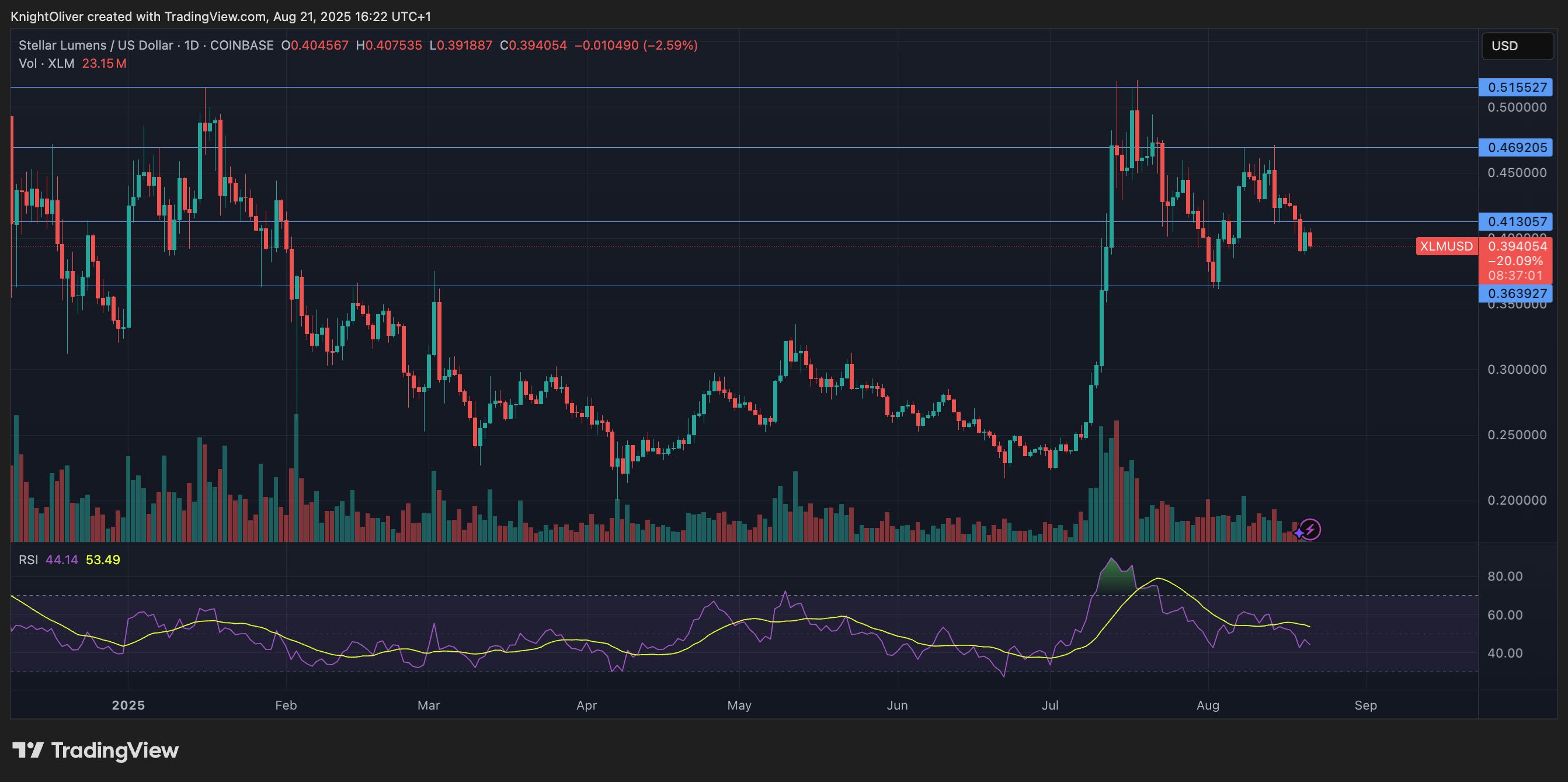
Technical Indicators Signal Bullish Momentum
- Price action broke through key $0.398 resistance level with strong volume confirmation.
- Trading range of $0.01 or 3% indicates contained volatility before breakout.
- Volume spike exceeding 1.55 million during final hour suggests institutional interest.
- Support established around $0.40 level with multiple successful bounces.
- Declining volume trend reversed during breakout, indicating renewed conviction.
Disclaimer: The content of this article solely reflects the author's opinion and does not represent the platform in any capacity. This article is not intended to serve as a reference for making investment decisions.
You may also like
Cardano Foundation unveils zero-knowledge series as ADA drops 2.8% to $0.1725

How much CPO demand will Nvidia Rubin Ultra generate? Bernstein: Optical value per Pod will increase fivefold
Bernstein believes that the co-packaged optics (CPO) and fiber demand driven by Nvidia's Rubin Ultra architecture will surge significantly, with the optical content per Pod rising from $1 million to $5.4 million. This will propel the size of Nvidia's optical ecosystem market to $46.8 billion by 2028 (a 91% annual increase). Although the industry faces supply bottlenecks with InP substrates, the outlook remains positive. The institution reiterates its “outperform” rating for Lumentum, Coherent, and Ciena.

UBS Q3 implements a two-way strategy with gold options, heavily invests in technology stocks, and builds positions in SK Hynix (SKHY.US)
UBS Group (UBS.US) has submitted its Q3 holdings report (13F) as of September 30, 2026.

SpaceX (SPCX.US) reportedly attempts “de-Nvidiaization” at the rack level: developing Kessel cabinets to bypass L6 compute boards, purchasing only chips
SemiAnalysis: SpaceX has developed its own Kessel cabinet, bypassing Nvidia's L6 cards to provide more options for manufacturing its own hardware.

Crypto prices
More


