
Why Shiba Inu’s 11% Weekly Loss Could Be the Setup for a Bullish Breakout

Despite an 11% weekly loss, Shiba Inu’s rising weighted sentiment and Chaikin Money Flow (CMF) indicate growing market confidence, hinting at a possible rebound toward $0.00001295.
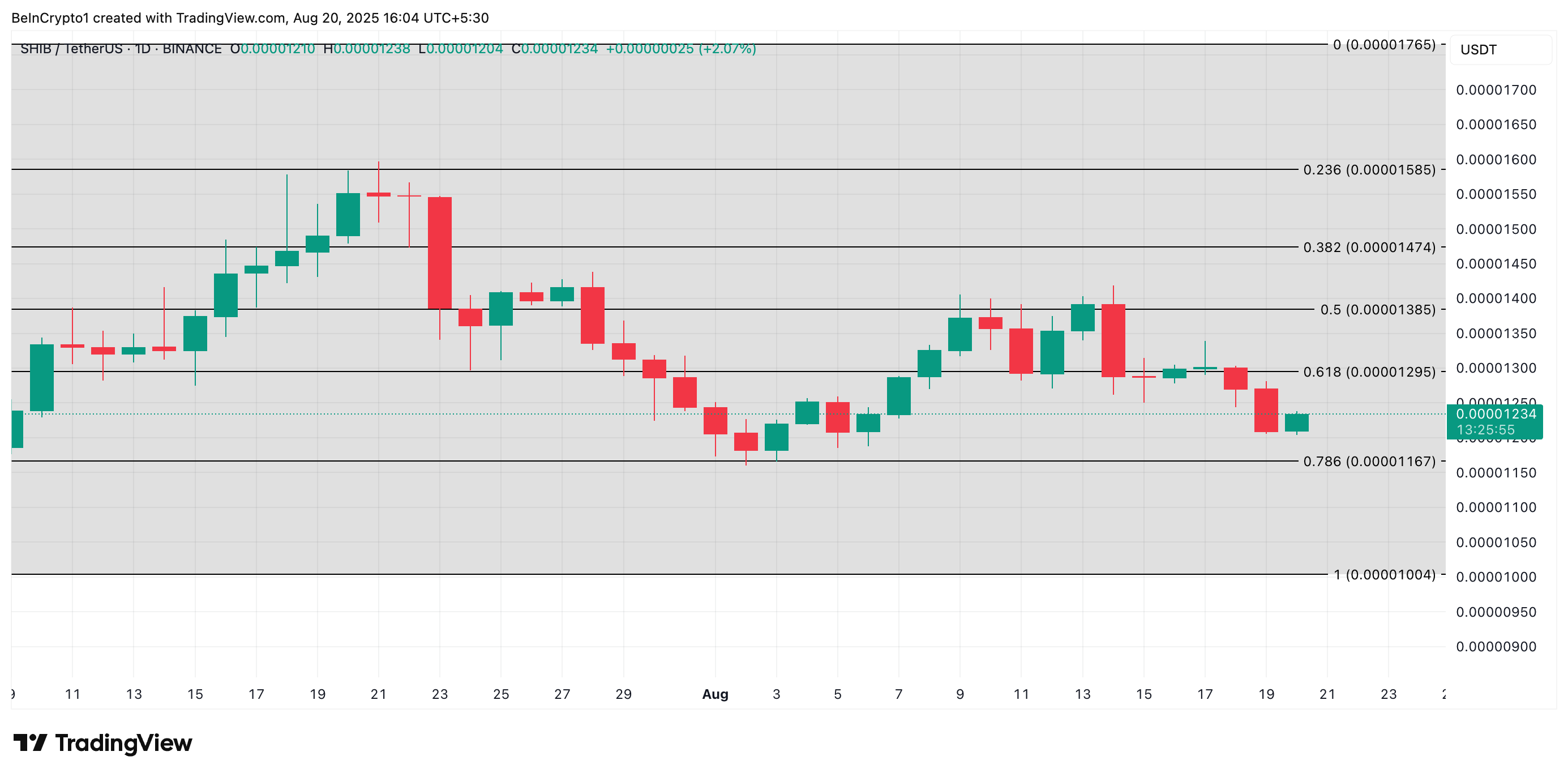
The slowdown across the meme coin market has dragged Shiba Inu (SHIB) down 11% in the past week. At press time, the leading meme coin trades at $0.00001234.
However, despite the price decline, two key on-chain indicators are flashing bullish divergences, raising the possibility of a near-term turnaround.
Traders Grow Optimistic on SHIB Despite Price Drop
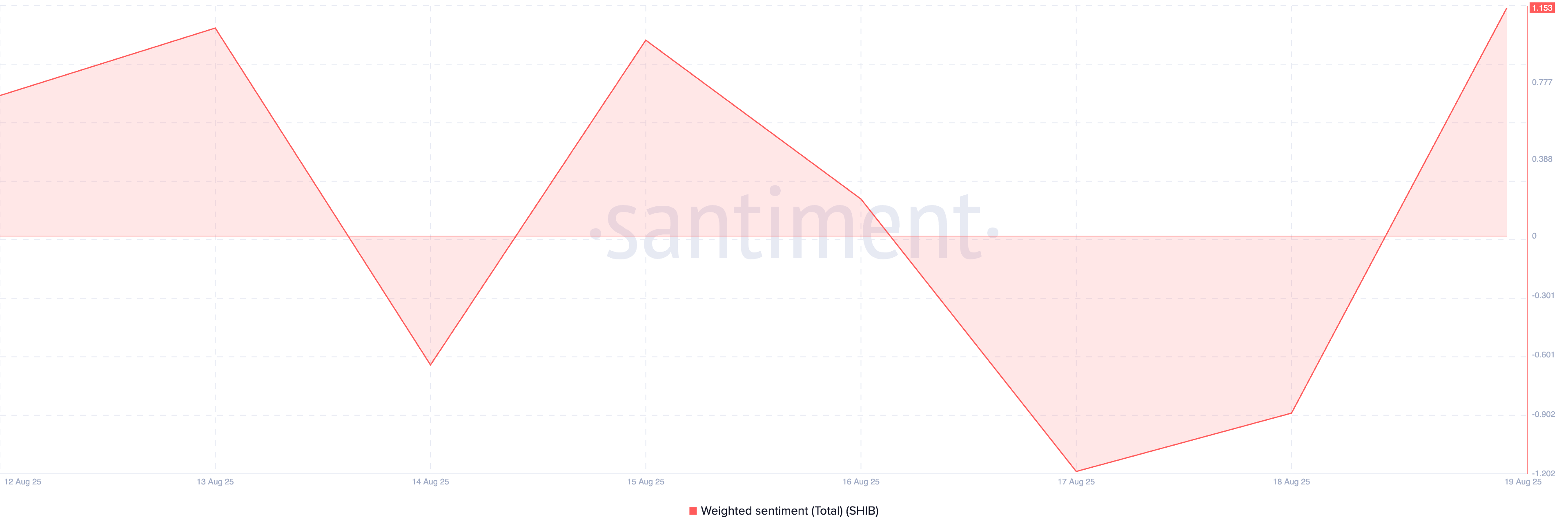
Despite its recent lackluster performance, SHIB has seen its weighted sentiment shift upward, showing that traders are growing increasingly optimistic about the meme coin. According to Santiment, this metric stands at a seven-day high of 1.153 at press time.
 SHIB Weighted Sentiment. Source:
Santiment
An asset’s weighted sentiment measures its overall positive or negative bias by combining the volume of social media mentions with the tone of those discussions.
When an asset’s weighted sentiment is positive, it signals rising confidence and renewed interest in the asset, even if prices are under pressure.
On the other hand, a negative weighted sentiment reflects bearish conditions. This means investors have become skeptical of the token’s short-term prospects, which may cause them to trade less.
SHIB’s falling price, alongside a rising weighted sentiment, creates bullish divergence, showing market confidence is climbing despite downward price action. This divergence is usually interpreted as a precursor to a potential reversal, suggesting that traders may be quietly positioning themselves for a rebound.
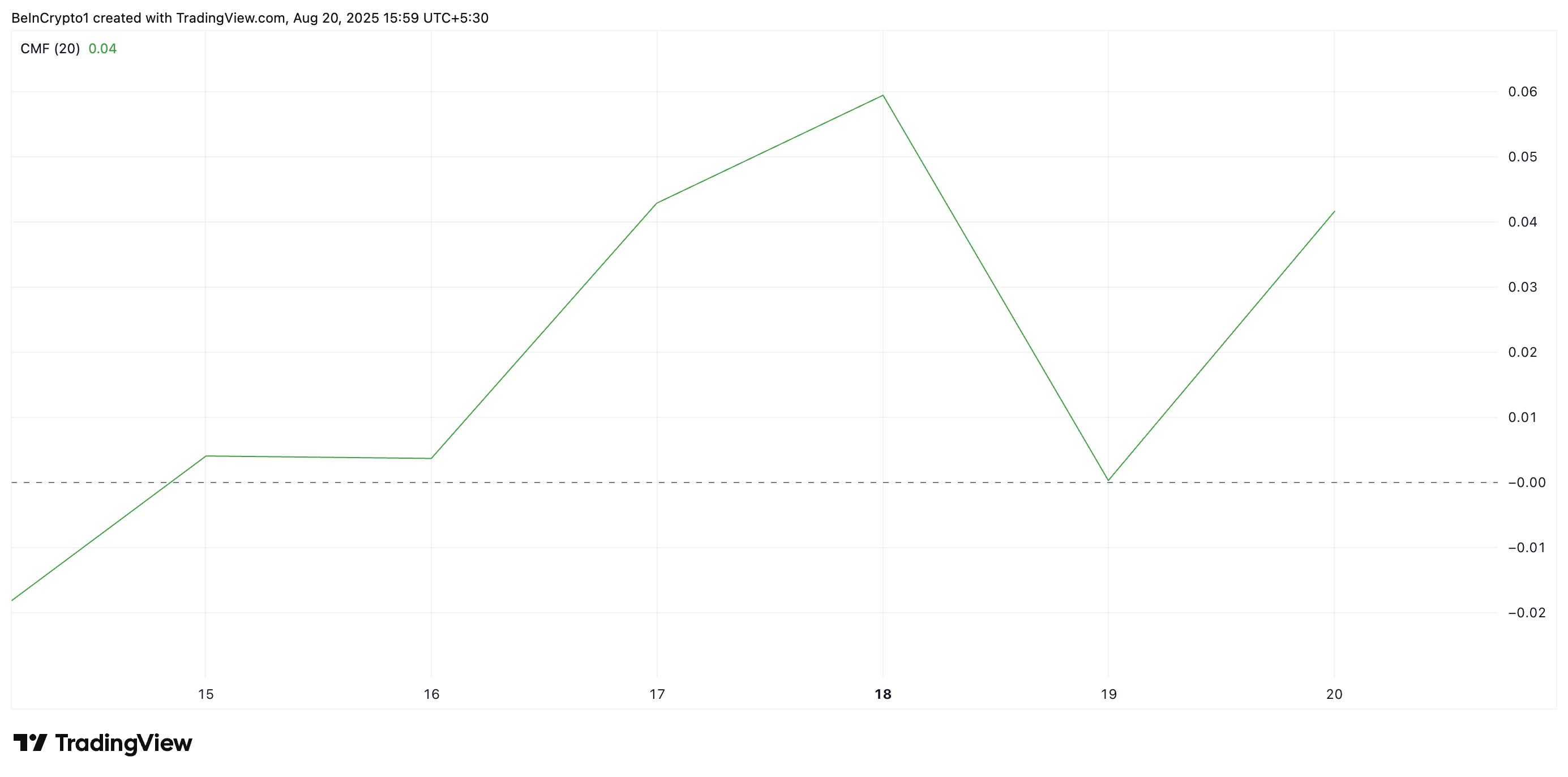
Furthermore, the setup of the altcoin’s Chaikin Money Flow (CMF) supports this bullish outlook. Readings from the meme coin’s daily chart show the CMF climbing steadily, even as SHIB’s price declined, forming another bullish divergence.
At press time, the CMF stands at 0.04, signaling that money is beginning to flow back into the asset.
 SHIB CMF. Source:
TradingView
The CMF measures buying and selling pressure based on price and trading volume. A positive CMF reading, such as the one SHIB currently holds, suggests that more capital is entering the market than leaving it.
When this occurs alongside a price drop, traders are quietly accumulating the token at lower levels, a sign of underlying strength.
Can Shiba Inu Turn Losses Into a Breakout?
When bullish divergences like these form, they often point to a potential trend reversal. For SHIB, these mean its buyers are gaining enough momentum to challenge the sell-side pressure and trigger a rebound toward $0.00001295.
 SHIB Price Analysis. Source:
TradingView
On the other hand, if sellofs continue, SHIB risks falling to $0.00001167.
Disclaimer: The content of this article solely reflects the author's opinion and does not represent the platform in any capacity. This article is not intended to serve as a reference for making investment decisions.
You may also like
How much CPO demand will Nvidia Rubin Ultra generate? Bernstein: Optical value per Pod will increase fivefold
Bernstein believes that the co-packaged optics (CPO) and fiber demand driven by Nvidia's Rubin Ultra architecture will surge significantly, with the optical content per Pod rising from $1 million to $5.4 million. This will propel the size of Nvidia's optical ecosystem market to $46.8 billion by 2028 (a 91% annual increase). Although the industry faces supply bottlenecks with InP substrates, the outlook remains positive. The institution reiterates its “outperform” rating for Lumentum, Coherent, and Ciena.

UBS Q3 implements a two-way strategy with gold options, heavily invests in technology stocks, and builds positions in SK Hynix (SKHY.US)
UBS Group (UBS.US) has submitted its Q3 holdings report (13F) as of September 30, 2026.

SpaceX (SPCX.US) reportedly attempts “de-Nvidiaization” at the rack level: developing Kessel cabinets to bypass L6 compute boards, purchasing only chips
SemiAnalysis: SpaceX has developed its own Kessel cabinet, bypassing Nvidia's L6 cards to provide more options for manufacturing its own hardware.

$3.7 billion “data center power equipment prepayments” abandoned! What did "the most active buyer of gas turbines", SoftBank, see?
In the second quarter of fiscal year 2026, SoftBank reported a net loss of $7.1 billion, primarily due to a $3.7 billion impairment charge from a $9.5 billion advance payment for power generation equipment for US data centers—of which about $2.9 billion was non-refundable and effectively lost. The CFO admitted that SoftBank placed orders before the project plan was finalized, and is now conducting a comprehensive review of its procurement strategy. "The most aggressive purchaser of gas turbines has now written off the deposit in this way."
Crypto prices
More


